Insights
North American trade routes are developing an important change as businesses mainly adopt nearshoring strategies to update supply chain resilience & enhance operational efficiency. In response to global issues, developing transportation costs, & changing geopolitical dynamics, companies are relocating production closer to key consumer markets, mainly within the United States, Mexico, & Canada. This shift is not only minimizing dependency on distant manufacturing hubs but also developing cross-border logistics, trade flows, & industrial networks. Narshoring is growing as a powerful trend in how goods move across North America in a more growing, responsive, & cost-effective manner.
What is Nearshoring?
Nearshoring is a part of offshoring in which an organization selects employees from a neighboring country to complete services. Nearshoring combines the best of both onshore outsourcing & offshore outsourcing because it makes a similar culture, proximity, & language to the brand, but at a more affordable cost. Nearshore outsourcing provides the logistical benefits that working nearby brings, but with cost savings you just can’t find at home. Some main advantages of nearshoring include lower labor costs, avoidance of language issues, cultural alignment, geographical proximity, & a similar time zone.
Nearshoring can also benefit your company in more operational & strategic ways as well. Nearshore outsourcing lets you tap into a global pool of highly skilled workers beyond the geographical footprint of your home country, & nearshore locations tend to be centralized in metropolitan areas that have a strong network in place, allowing your nearshore partner to scale quickly & easily.
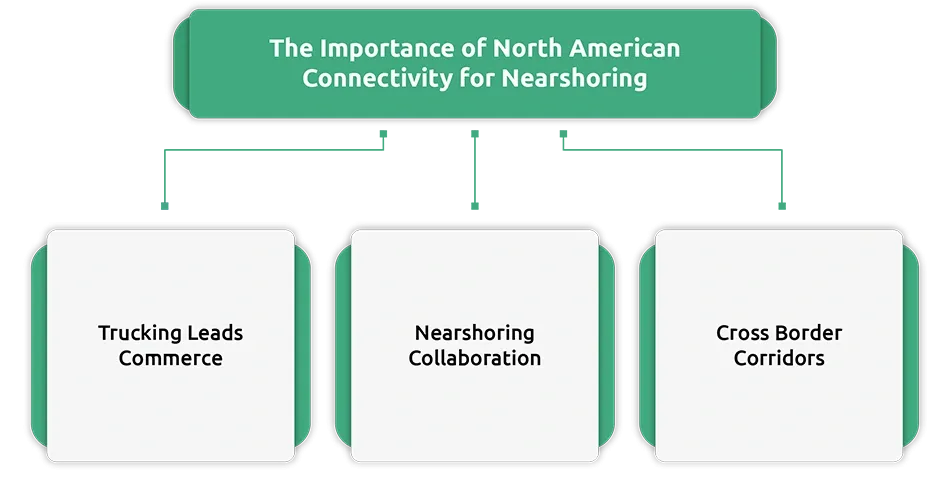
The Importance of North American Connectivity for Nearshoring
Manufacturing & logistics in North America are mainly connected, with nearshoring efforts driving increased collaboration across the region.
Manufacturing & logistics in North America are mainly interconnected, with U.S. borders with Canada & Mexico helping about $3 billion in trade daily & over $1 trillion in annual cross-border trade. U.S. trade with Canada & Mexico represented 30.8% of the country’s total global trade, matching $1.57 trillion in freight flows & 2,484.7 million tons in weight.
Surface transportation modes, mainly trucking & rail, dominated North American commerce, with trucking accounting for 60.1% of total flows with Canada & 72.2% with Mexico, while rail contributed 15.7% with Canada & 12.3% with Mexico.
Benefits: Reducing Logistics & Travel Times
In the busy sector of logistics, proximity can change operational efficiency into a complete advantage. This change minimizes transportation costs by approximately 20% & allowed for fast response times to customer demands, mainly enhancing customer satisfaction. By capitalizing on proximity, it updates its supply chain but also supports its commitment to sustainability through minimizing carbon footprints, showcasing how businesses can progress while being environmentally aware.
Which Industries Are Best Suited for Nearshoring?
1. Manufacturing
The COVID-19 spread created significant issues for businesses across all industries, but one of the most affected sectors was the production industry. As global lockdowns, trade issues, & travel issues were applied, managing businesses had to halt production. The geographical proximity provided by nearshore outsourcing is important in manufacturing because it reduces moving items & goods costs, makes logistics & transportation easier, & even simplifies tax-related legal & regulatory processes.
2. Logistics & Supply Chain Management
Offshore outsourcing offers many advantages for businesses, allowing them to scale up sustainably & enhance their profit margins while minimizing the workload of their in-house employees. Despite the many benefits of offshoring, COVID-19 has exposed a weakness in the logistics & supply chain industry. At the height of the global pandemic, offshore factories were shut down, ports were congested, & cross-border trade was limited & restricted. These problems created supply chain issues that highlighted the importance of geographic proximity for logistics operations.
3. Customer Service
Customer support is one of the most commonly outsourced services onshore, offshore, or nearshore. The nature of the job doesn’t require the caller and the agent to be in the exact location. However, there are important advantages to nearshoring 24/7 services. Compared to offshore workers, nearshore service reps may already be more similar to American customers’ language, lifestyles, customs, communication styles, & other nuances. As such, they may not need as much training as offshore employees.
4. Information Technology
The importance of information technology services cannot be overstated in today’s digital world. Tech companies are facing continued growth in customer demand, while mainly not having enough qualified workers to take on the opportunities. This is where outsourcing & nearshoring, mainly, can be useful.

Conclusion
Nearshoring is fastly changing the structure & efficiency of North American trade routes by moving production & supply chain operations closer to key end markets. As businesses respond to global issues, developing costs, & geopolitical instability, the change toward regional manufacturing hubs mainly across the United States, Mexico, & Canada continues to gain momentum. This change is not only increasing logistics speed & minimizing operational costs but also increasing cross-border economic integration under frameworks like USMCA. While challenges such as network limitations & regulatory differences remain, the long-term outlook suggests a more usable, responsive, & interconnected regional supply chain ecosystem. Mainly, nearshoring is developing as an important pillar that will continue to change the future of trade efficiency & industrial competitiveness in North America.
Did you know?
Costa Rica has also emerged as a notable beneficiary, particularly in life sciences and electronics. In 2025, the country exported $3.8 billion in life science products and $2.4 billion in electronics.
FAQs
1. What is nearshoring in simple terms?
Nearshoring is the practice of moving business operations or manufacturing to a nearby country instead of a distant one, helping companies reduce costs, improve communication, and speed up supply chains.
2. Why is nearshoring growing in North America?
Nearshoring is increasing due to supply chain disruptions, higher shipping costs, geopolitical tensions, and the need for faster and more reliable delivery networks across the U.S., Mexico, and Canada.
3. How does nearshoring impact North American trade routes?
It shifts trade flows toward regional corridors, increases cross-border trucking and rail activity, and strengthens logistics networks between the U.S., Mexico, and Canada.
4. Which countries benefit the most from nearshoring in North America?
Mexico benefits significantly due to its manufacturing capacity and proximity to the U.S., while Canada gains from strong trade integration and advanced industrial capabilities.
5. Which industries are most affected by nearshoring trends?
Key industries include manufacturing, automotive, electronics, logistics, IT services, due to their reliance on efficient supply chains.