
The Shift Reshaping Global Supply Chains
Global supply chains are undergoing a major transformation as businesses face increasing geopolitical tensions, semiconductor shortages, rising freight costs, and transportation disruptions across key trade routes. Events like trade conflicts, port congestion and regional instability have shown how weak centralized sourcing models can be. Industries such as automotive, IT infrastructure, aviation and medical equipment manufacturing have had production delays and inventory shortages because they relied much on a few supplier regions. This made companies rethink their manufacturing and sourcing plans to make supply networks more resilient and flexible.
This changing world has made the argument between offshoring and friendshoring bigger. Offshoring is about cutting production costs by making things in countries where it’s cheaper. On the hand friendshoring is about making and sourcing things from countries that we trust and have similar politics.
Businesses are starting to see that supply chains are not about saving money. They are now about being strong and able to deal with problems having governments and being able to work well over a long time.
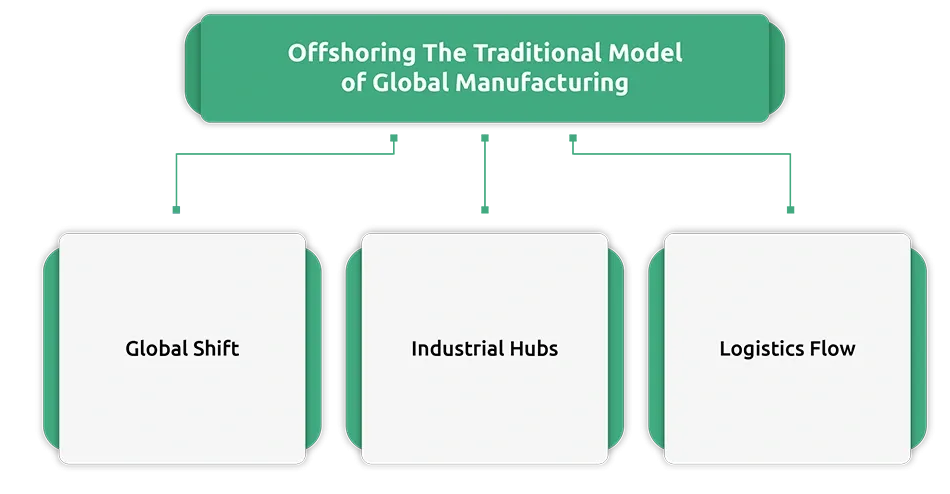
Offshoring: The Traditional Model of Global Manufacturing
Offshoring is when companies move their production, sourcing or operations to countries where it is cheaper to manufacture and there are big factories to help with large-scale production. For decades, businesses across automotive, IT, and medical industries adopted offshoring to reduce operational expenses, improve production efficiency, and access skilled labor markets.
Countries with strong industrial ecosystems became major hubs for automotive electronics production, IT hardware manufacturing, and medical device assembly due to their ability to support mass manufacturing and streamlined logistics operations. Offshoring also enabled companies to build extensive global supplier networks supported by International freight services and advanced Supply chain optimization strategies.
This was important to make sure they always had the components they needed in countries. Inventory and order management systems helped businesses with this. They used Inventory and order management systems to keep track of Inventory and orders.
Friendshoring: Building Resilient Supply Chains Through Trusted Partnerships
Companies are starting to use a way to manage their supply chains it is called friendshoring. With friendshoring companies move their work to countries that they really get along with and trust. Friendshoring is about making sure the supply chain is strong and can withstand problems. It is also about working with countries in a way that is reliable and good for both parties in the long run.
The model promotes collaboration among “trusted partner economies” and strengthens “strategic economic alliances” that prioritize resilience over lowest cost manufacturing. For industries such as automotive, aviation, medical equipment, and IT infrastructure, friendshoring improves compliance visibility, accelerates recovery during disruptions, and creates more stable trade operations.
Businesses adopting this strategy also benefit from smoother Customs clearance processes, stronger Importer of record Service support, reliable exporter of record services, and better regulatory management through the best trade compliance software for import export rules.
Digital Technologies Driving Smarter Supply Chains
Technology is really important for companies these days. It helps them make their supply chain work better. Businesses want to be able to handle problems work well and see what is going on with their goods as they move around the world. Companies use tools that use Artificial Intelligence to predict what might happen with the demand for their products problems with suppliers and issues with transportation.
At the time tracking shipments in real-time and monitoring systems digitally make it clear whats happening across the entire logistics network. This helps make decisions faster and work better together between suppliers, manufacturers and distributors. Platforms that help plan inventory and manage orders also help businesses reduce delays and keep the amount of stock. In industries like automotive, aviation, medical equipment and IT infrastructure having digital visibility is key, to balancing efficiency with reducing risks.
How Import-Export Service Providers Support Modern Supply Chain Transitions
When companies move their work to countries or work with friends, the people who help with getting things in and out of the country are very important. The people in charge make sure everything runs smoothly and that the company does what it is supposed to do. Companies that operate in the IT industry, the aviation industry, and the medical industry need to have international shipments coordinated in a good way, they need to have accurate trade documents and they need to have reliable Customs clearance processes.
Companies that specialize in helping other businesses work in countries provide Importer of record services and Exporter of record services. These services are really helpful because they assist businesses in understanding the rules of countries. Companies use these services to manage their work in countries and it is easier for them to move important equipment and parts from one country to another. This means that companies can quickly change their plans if something unexpected happens, like a problem with a supplier or a change in where companies get their products. This helps companies keep working smoothly when things change around companies and their products and equipment.
Conclusion
There is a discussion going on about friendshoring and offshoring. This conversation is part of a change in the way the world does business and manages supplies. Offshoring is still a way to save money. Friendshoring is becoming more popular because companies want to be safe and sure that they can get the things they need. The future of supply chains is going to be a mix of different approaches. It will balance the need to keep costs with the need to reduce risks and get things from many different places. Companies in the automotive, IT, medical, and aviation sectors need to be able to change and follow all the rules. They also need to work with companies in a smart way to stay ahead in a world where trade is always changing. Global supply chains will really need to think about these things to be successful.
DID YOU KNOW
“Although US manufacturing accounts for only 8% of total employment, the Reshoring Initiative found reshoring created 20% of manufacturing jobs in the last 15 years, ”
FAQS
1. What is the difference between offshoring and friend-shoring?
Unlike friend-shoring, this focuses on domestic self-reliance instead of geopolitical alignment. Offshoring: This involves relocating production to low-cost countries, often to take advantage of cheaper labor or production costs, without necessarily considering geopolitical alignment.
2. What is friendshoring in supply chain?
In supply chain management, friendshoring is the process of moving supply chains away from nations considered economically volatile or politically unsafe to countries perceived as “low-risk.” By engaging in friendshoring, businesses can avoid falling prey to the export controls exercised by unfriendly countries.
3. What are the 4 types of outsourcing?
The 4 primary types of outsourcing, categorized by geographical location and distance, are onshore, nearshore, offshore, and onsite outsourcing. These models help businesses cut costs, access global talent, or improve operational efficiency
4. What are the benefits of Friendshoring?
In addition to enhancing political stability, friendshoring offers greater price stability. friendshoring helps companies work with countries that think about money in a way which makes it easier, for friendshoring to make things more stable.
5. What are the risks of outsourcing?
When a company uses outsourcing it can be at risk for problems, like people getting to its important information losing control of how things are done and not being able to talk to each other.