Introduction
In a developing international economy, free trade agreements are facing renewed review as import policies gain progress in the main economies. Governments are prioritizing domestic industries, updating regulatory frameworks, & introducing selective tariffs & non-tariff issues to cover local markets from external disruption.
How Free Trade Agreements Function
Free trade policy is often developed by a formal & mutual agreement of the nations involved. A free-trade policy may simply be the absence of any trade restrictions, however.
A government doesn’t have to take specific action to promote free trade. This hands-off stance is referred to as trade liberalization.
Governments with free-trade policies or agreements in place don’t necessarily abandon all control of imports and exports or eliminate all protectionist policies. Few free trade agreements (FTAs) result in completely free trade in modern international trade.
Economic Principles of Free Trade
Free trade on the international level is no different from trade between neighbors, towns, or states. It allows businesses in each country or location to focus on producing and selling the goods that best use their resources. Other businesses import goods that are scarce or unavailable domestically. This mix of local production and foreign trade allows countries to experience faster growth while better meeting the needs of their consumers.
Pros and Cons of Free Trade
Free trade comes with both pros and cons.
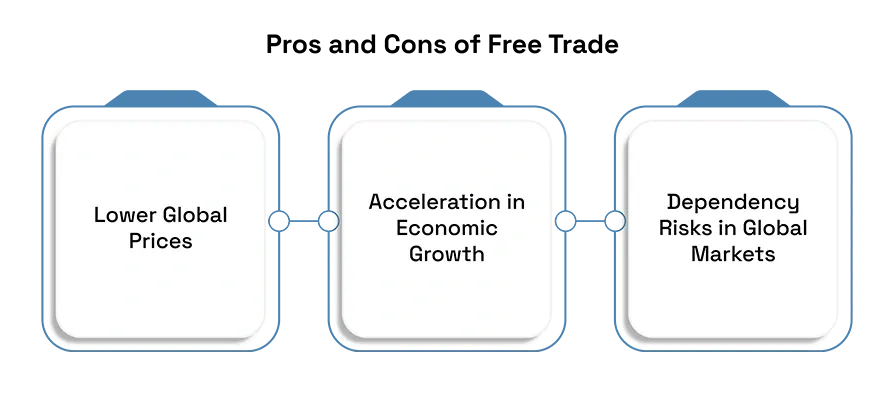
Acceleration in Economic Growth
Free trade has allowed many countries to attain rapid economic growth. Many countries have been able to attract foreign investment capital and provide relatively high-paying jobs for local workers by focusing on exports and resources where they have a strong comparative advantage.
Lower Global Prices
Free trade creates a competitive environment for consumers where countries strive to provide the lowest possible prices for their resources. This, in turn, allows manufacturers to provide lower prices for finished goods and ultimately increases the buying power of all consumers.
Challenges of Unemployment and Business Losses
There are, regardless, some economic losers when a country opens its borders to free trade. Domestic industries might be unable to compete with foreign competitors, causing local unemployment. Large-scale industries might move to countries with lax environmental and labor laws, resulting in child labor or pollution.
Dependency Risks in Global Markets
Free trade can also make countries more dependent on the global market. The prices of some goods may be lower in the world market, but there are strategic benefits for a country that produces those goods domestically. The country might be forced to rebuild these industries from scratch in the event of a war or crisis.
Key Benefits of Free Trade Agreements
FTA benefits for your product may require more record-keeping but can also give your product a competitive advantage versus products from other countries. U.S. FTAs typically address a wide variety of government activities that affect your business:
Reduction or elimination of tariffs on qualified goods. For example, a country that normally charges a tariff of 12% of the value of the imported product will eliminate that tariff for products that originate (as defined in the FTA) in the United States. This makes your products competitive in the market.
Intellectual Property Protection: protection and enforcement of American-owned intellectual property rights in the FTA partner country.
Product Standards: the ability for U.S. exporters to participate in the development of product standards in the FTA partner country.
Selling to the government: the ability for a U.S. company to bid on certain government procurements in the FTA partner country.
Service companies: the ability for U.S. service suppliers to supply their services in the FTA partner country.
Fair treatment for U.S. investors, provided they are treated as favorably as the FTA partner country treats its own investors and their investments or investors and investments from any third country.
Financial Market Perspectives on Free Trade
The financial markets see the other side of the coin. Free trade is an opportunity to open another part of the world to domestic producers. It’s an integral part of the financial system and the investing world. American investors have access to most foreign financial markets and a wider range of securities, currencies, and other financial products.
Completely free trade in the financial markets is unlikely in our times, however. There are many supranational regulatory organizations for world financial markets, including the Basel Committee on Banking Supervision, the International Organization of Securities Commissions (IOSCO), and the Committee on Capital Movements and Invisible Transactions.

Conclusion
Free trade agreements are a basis of global commerce, but their role is mainly evolving in response to developing market protection & geopolitical uncertainty. While FTAs have historically driven economic growth, lower customer prices, & deeper global cooperation, today’s trade environment is mainly changed by national safety concerns, supply chain resilience, & strategic economic priorities. Many agreements are becoming more regional, selective, & mainly focused rather than global in scope. Changing forward, the future of FTAs is unlikely to be defined by their decline, but rather by their transformation, adapting to a world where countries seek to balance the benefits of open trade with the need for greater economic control, stability, & self-reliance.
Did you know?
Trump 2.0 has unsettled India’s external environment—but has not overturned its foreign policy strategy, which continues to rely on diversification, hedging, and calibrated partnerships across a fractured order.
FAQs
1. What is a Free Trade Agreement (FTA)?
A Free Trade Agreement is a pact between two or more countries that reduces or eliminates trade barriers such as tariffs and import restrictions, helping goods, services, and investments move more freely between member nations.
2. Why are Free Trade Agreements becoming less influential in 2026?
FTAs are facing pressure due to rising protectionism, geopolitical tensions, and supply chain disruptions. Many countries are now prioritizing national security, domestic industries, and regional trade partnerships over fully global agreements.
3. How does protectionism affect global trade agreements?
Protectionism increases tariffs, regulatory barriers, and trade restrictions, which can weaken the effectiveness of FTAs and push countries toward more selective or regional trade arrangements instead of broad global cooperation.
4. Are Free Trade Agreements still beneficial for businesses?
Yes, FTAs still provide benefits such as reduced tariffs, improved market access, stronger intellectual property protection, and better investment conditions, even though their scope is becoming more limited and region-focused.
5. What is the future of Free Trade Agreements?
The future of FTAs is expected to be more regional, strategic, and flexible. Instead of large global agreements, countries are likely to form targeted partnerships focused on critical sectors like technology, energy, and manufacturing.