Introduction
Global businesses are mainly changing traditional supply chain strategies as economic uncertainty, geopolitical tensions, & supply chain issues change global trade. For decades, companies have mainly depended on globalized production networks developed to minimize costs & maximize efficiency. Main issues have exposed the risks of depending too heavily on remote suppliers & highly concentrated manufacturing hubs. Many businesses are transforming toward regionalized trade networks that prioritize resilience, usability, & faster market access.
What Are Regionalized Trade Networks?
Regionalized trade networks are economic systems where neighboring countries trade more heavily with each other than with the rest of the world. Formed via localized supply chains & Regional Trade Agreements, they minimize tariffs & simplify logistics to build highly integrated, resilient, & specialized regional markets.
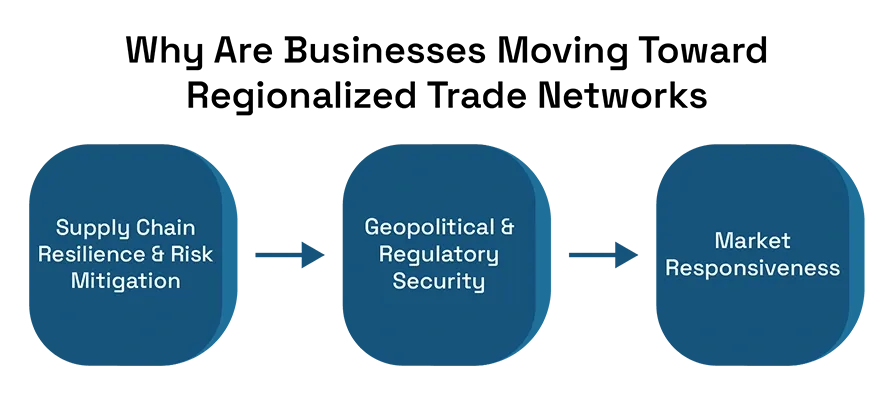
Why Are Businesses Moving Toward Regionalized Trade Networks?
Businesses are changing toward regionalized trade networks to reduce global issues, develop supply chain resilience, & respond faster to market changes. By producing & sourcing closer to end-consumers, companies bypass long-distance shipping delays, avoid unpredictable tariffs, & reduce carbon footprints.
This structural transition is driven by five core factors:
- Supply Chain Resilience & Risk Mitigation
The hyper-globalized models of the past are mainly at risk of issues like geopolitical issues, port blockage, & shipping lane issues. By nearshoring, companies minimize the number of connections in their logistics pipelines, minimizing the impact of many problems.
- Market Responsiveness
Changing production hubs closer to target markets allows companies to adjust quickly to changing customer demands & seasonal variations. Shorter transit times mean faster restocking cycles & leaner supplies, resulting in better cash flow.
- Geopolitical & Regulatory Security
Developing protectionist trade policies, enhancing sanctions, & regional blocs are developing global trade. Businesses are prioritizing “friend-shoring” & local-for-local configurations to ensure strategic autonomy & avoid sudden exposure to geopolitical restrictions or high cross-border tariffs.
- Using Regional Trade Agreements (RTAs)
Governments mainly use RTAs to lower non-tariff barriers, simplify customs procedures, & promote local economic growth. Businesses use these frameworks to access preferential tariffs & streamline cross-border regulatory compliance.
Key Strategies Driving Regionalization
Regionalization is a changeable shift in global business & trade where organizations move from hyper-globalized, centralized operations to decentralized models focused on specific geographies. This “make-where-you-sell” approach is driven by the need to secure supply chains, minimize logistics costs, & adapt to local market dynamics.
Supply Chain Strength, Nearshoring, & Geopolitical Security
Businesses are mainly changing to localized trade networks to improve supply chain resilience and reduce operational risks. Companies are moving away from heavy dependence on single-source global supply chains, & without building multi-regional production networks to minimize risks & avoid supply chain risks. Nearshoring & reshoring strategies have gained momentum as manufacturers relocate production facilities closer to the end customer, helping minimize transportation times, enhance responsiveness, & secure operations from global logistics disruptions. Geopolitical considerations are playing a larger role in supply chain decisions. Developing trade issues, increasing laws, & increasing tariff doubts are promoting businesses to assign managing operations within many trade blocs to minimize compliance risks & manage market access. It is mainly important sectors such as semiconductors, healthcare equipment technology, & defense management, companies are increasingly adopting “friend-shoring” strategies by increasing production within politically aligned countries to update supply safety & minimize geopolitical risk.

Industries Leading the Shift Toward Regionalization
Industries are changing from global to regional production to develop supply chain usability, reduce risk against geopolitical tariffs, & meet local environmental mandates. Driven by huge government incentives, these changes ensure stable production in the whole critical markets.
Semiconductors & Electronics
The semiconductor & electronics industry is becoming one of the strongest examples of the change toward updated trade networks, largely driven by the need for supply security & economic control. Governments & businesses are mainly working to minimize dependence on a single external productive hub by investing mainly in domestic semiconductor production & technology ecosystems. Large-scale initiatives & incentive programs are encouraging companies to expand local manufacturing capabilities, update supply chain usability, & secure access to critical electronic components.
Automotive and Mobility
The automotive & mobility sector is moving toward updated production networks as manufacturers prioritize supply chain agility & adapt to difficult trade regulations. The industry’s reliance on just-in-time manufacturing has made reducing supply chain issues a major priority, encouraging companies to build stronger supplier ecosystems closer to their main customer markets. Many vehicle manufacturers are changing nearshoring strategies by improving production facilities & supplier networks within nearby regions.
Medical Devices
The medical devices sector is mainly changing toward regionalized manufacturing as companies & governments prioritize supply chain resilience, product traceability, & healthcare equipment security. Recent global issues highlighted the risks of mainly depending on many manufacturing hubs for useful medical equipment & important healthcare device supplies.
Conclusion
Regionalized trade networks are quickly becoming an important component of updated business strategy as companies adapt to a more complex & divided global economy. Rather than completely replacing globalization, businesses are increasingly combining global reach with regional production networks to create more easy, usable, & efficient supply chains. Growing geopolitical risks, changing trade policies, supply chain issues, & developing usability demands are advancing this transition across many industries. As companies continue focusing on strength alongside cost efficiency, expansion is expected to play a mainly important role in changing the future of production, trade, & global business operations.
Did you know?
Amid a rapidly evolving global trade environment, Vietnam has emerged as a key manufacturing hub in Asia, positioning itself to move further up the global value chain and strengthen its role in regional and international supply networks.
FAQs
1. What are regionalized trade networks?
Regionalized trade networks are systems where businesses focus production, sourcing, and distribution within specific geographic regions rather than relying heavily on global supply chains. These networks help improve efficiency, reduce risks, and strengthen supply chain resilience.
2. Why are businesses shifting toward regionalized trade networks?
Businesses are moving toward regionalized trade networks to reduce supply chain disruptions, improve market responsiveness, lower transportation costs, manage geopolitical risks, and build more resilient production networks.
3. What is the difference between globalization and regionalization in trade?
Globalization focuses on worldwide production and sourcing networks, while regionalization emphasizes localized supply chains within specific regions. Regionalization prioritizes resilience and flexibility, whereas globalization traditionally prioritized cost efficiency.
4. Which industries are leading the shift toward regionalization?
Industries such as semiconductors and electronics, automotive and mobility, medical devices, and advanced manufacturing are among the sectors actively expanding regional production networks to reduce operational risks and strengthen supply chains.
5. Will regionalized trade networks replace globalization completely?
Regionalized trade networks are unlikely to replace globalization entirely. Instead, many businesses are adopting hybrid models that combine global market access with regional production networks to balance efficiency, resilience, and operational flexibility.