Brief overview of global manufacturing shifts
Global manufacturing is going through a significant change as companies update past production strategies & supply chain models. Manufacturers focus on low-cost production regions to develop efficiency & minimize cost. Increasing geopolitical tensions, supply chain issues, increased labor costs, & economic insecurity have highlighted the risks of depending mainly on a single management location. Production is mainly developing operations in many locations to improve usability, minimize operational risks, & create more flexible supply chains capable of responding to changing market conditions.
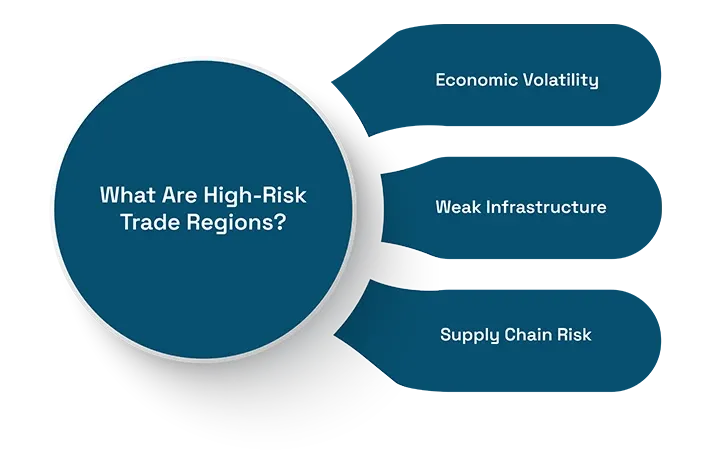
What Are High-Risk Trade Regions?
High-risk trade regions are areas where production & trade operations face important problems due to political instability, economic volatility, weak network, & regulatory unpredictability. These regions often experience political issues or unstable governance that can make risk to production & supply chains, while many changes in trade policies & tariffs make it difficult for producers to plan costs & long-term investments. Poor infrastructure, such as not easy transport systems, power shortages, & logistics issues, further slows down operations & increases cost. Currency fluctuations & high price & financial issues are making it harder for businesses to manage constant pricing & profitability. Unclear regulations & inconsistent compliance requirements create additional legal & operational challenges, making these regions less attractive for global manufacturers.
Why are Manufacturers Leaving China and other regions?
Over the last few decades, China has become the world’s manufacturing hub. With its large production facilities, skilled workforce, and efficient supply chain, it has become the primary destination for manufacturers of all sizes.
In recent years, there has been a noticeable shift & manufacturers are starting to increase outside of China. The reasons depend on the product you make, the industry you are in, & the size of your company, but the start of a migration out of China has clearly begun. While China remains the world’s production floor, manufacturers see several reasons & motivations to outsource products to another Asian country or to re-shore or near-shore.
Raising Costs in China
One of the main reasons why China was so attractive decades ago was its low production costs. For the last few years, the price of labor & overhead has gone up & therefore, the cost of doing business in China has increased as well.
However, is the price increase worth it?
Decades ago, when China was the cheapest, they had big quality problems. However, manufacturers were willing to sacrifice quality for a very low-priced product. As China has improved its quality, its labor & overhead costs have also increased. The risk of manufacturers trying to move production out of China & into another low-wage country is that the quality of the product drops, as well as the price.
Labor Costs Rising
As China’s economy has grown, the wages for employees in the manufacturing sector have also increased. With the economy growing, the workforce has become more skilled, which has caused labor shortages. While the demand for labor is still high, it has caused wage rates to increase for labor, mainly if the production facility is not easily accessible, such as not being by a train station.
Growing Overhead Costs
Wage rates are not the only thing increasing in China. You also have the majority of your operational expenses increasing, such as real estate. China’s growth wave has led to increased competition for land & resources, driving up property value.
Trade Tensions & Tariffs
The development of trade tensions between China & other countries, mostly in the United States, has mainly changed the supply chain network. The growth of tariffs & the growth of trade issues between major trading partners have had profound development for manufacturers, problems in supply chains & increasing costs across many industries. The trade tensions between China & the United States, characterized by reactive measures, have created uncertainty & volatility in global markets. Due to concerns over trade imbalances, academic property rules, & market access, these tensions have led to a period of economic uncertainty.
Diversification of Supply Chain
Tariffs & transportation costs have highlighted the importance of a change in the supply chain. The goal of a changing supply chain is to minimize dependency on any single region or supplier & to build more agile & adaptable supply chain networks capable of responding to issues & uncertainties. Diversifying supply chains involves spreading production facilities, sourcing activities, & distribution channels across many geographic locations, thereby minimizing the risk of businesses to localized issues & systemic risks.
Favorable Business Environments Elsewhere
As production seeks similar to China for their production needs, other countries have developed as compelling destinations giving favorable business environments conducive to manufacturing investment & growth. These nations boast a combination of strategic advantages, including supportive government policies, attractive incentives, & update regulations, making them increasingly attractive to businesses looking to change their production use & reduce risks by connecting with updated supply chains.

Conclusion
Manufacturers are mainly changing away from high-risk trade regions as supply chain resilience, operational stability, & long-term usability become greater priorities than simply minimizing production costs. Rising labor costs, geopolitical tensions, trade issues, regulatory uncertainty, & supply chain issues have exposed the risk of concentrating manufacturing operations in a single region. Businesses are mainly changing strategies, growing into similar markets, & handling more flexible production networks. While high-risk regions may continue to play an important role in global production, the future increasingly belongs to companies that prioritize resilience, adaptability, & risk management when handling their global supply chains.
Did you know?
Global growth will slow to 2.6% in 2025, down from 2.9% in 2024, as global trade and investment face growing pressure from financial volatility and geopolitical uncertainty, according to UN Trade and Development’s
FAQs
1. Why are manufacturers moving away from high-risk trade regions?
Manufacturers are leaving high-risk trade regions because political instability, rising operational costs, supply chain disruptions, regulatory uncertainty, and geopolitical tensions make long-term production planning more difficult and expensive.
2. Why are companies reducing their manufacturing dependence on China?
Many companies are reducing their reliance on China due to rising labor costs, increasing trade tensions, tariff uncertainties, and the need to diversify supply chains to reduce operational risks.
3. What are high-risk trade regions in manufacturing?
High-risk trade regions are areas where businesses face uncertainty from political conflicts, economic instability, weak infrastructure, volatile currencies, changing regulations, and supply chain disruptions that negatively affect manufacturing operations.
4. How does supply chain diversification help manufacturers?
Supply chain diversification helps manufacturers reduce dependency on a single region or supplier, improve resilience against disruptions, minimize risks, and create more flexible production networks.
5. Which regions are becoming alternatives for global manufacturing?
Manufacturers are increasingly shifting production toward regions such as Southeast Asia, India, Mexico, and other emerging markets that offer favorable business environments, lower risks, and stronger supply chain resilience.