
Overview
In global trade, many importers and exporters hope for “same-day clearance,” the idea that goods will pass through Customs clearance the very day they arrive. While this can happen in limited, perfect situations, it is not the standard. International shipping terms, regulatory approval, documentation requirements, and risk authority all play a vital role in slowing the process. Complete knowledge of why same-day clearance is unfamiliar for organizations to plan, reduce delays, and improve the complete supply chain.
What Is Customs Clearance and Why Is It Required for Global Trade?
Complete Customs clearance procedure
It’s the formal processes where officials review imported or exported goods to confirm agreement with laws, safety guidelines, and tax requirements. This process includes verifying documents, inspecting cargo, evaluating duties, and checking the HS code (also known in some countries as the HTS Harmonized Tariff Schedule categorizations).
Why is clearance critical to global logistics?
Customs clearance is necessary for international freight services and global logistics. Without it, cargo cannot legally enter or leave a country. Whether shipments are moving under Incoterms such as DAP or DAPs (Delivered at Place), authorities must confirm the roles of the exporter of record services and the importer of record Service providers before release. Any uncertainty about responsibility, valuation, or approval can stop same-day processing.

The Main Reasons Why Same-Day Clearance Is Rare to Get
Documentation verification
Customs officials depend on complete documentation for trade invoices, packing lists, certificates of origin, licenses, and security. If even one data point does not match, systems standard the shipment. Manual reviews, corrections, or resubmissions can easily push clearance into the next day.
Regulatory and security inspections
Not all cargo is treated equally. Many shipments are selected for manual inspection, goods scanning, or laboratory testing. This is mainly common for devices, medical, electronics, or aviation goods. These checks are vital for national security and consumer safety, but make same-day release unlikely.
Classification, valuation, and duty disputes
Disagreements over HS code categorizations or declared value frequently trigger audits. Customs may request additional proof before applying the correct rate under the HTS Harmonized Tariff Schedule. Until this is resolved, cargo remains on hold.
How to Speed Up Customs Clearance Without Delay
Invest in pre-arrival preparation
Submitting documents before the cargo lands is one of the most effective plans. Pre-filing allows authorities to review information early and raise issues in advance. Strong inventory and order management systems help confirm consistency across invoices, packing lists, and logistics documents.
Work with experienced compliance partners
Professional Importer of record Service and exporter of record services providers understand country-specific regulations. They help confirm product descriptions, values, and categorization align with Customs expectations, reducing the chance of holds.
Use digital tools and supply chain optimization
Modern logistics platforms integrate approval checks, automated document validation, and real-time tracking. These tools support supply chain optimization by identifying risks before goods shipment, which can hugely shorten clearance times even if same-day release is still not confirmed.
Role of Freight Forwarders in Supporting Smooth Clearances
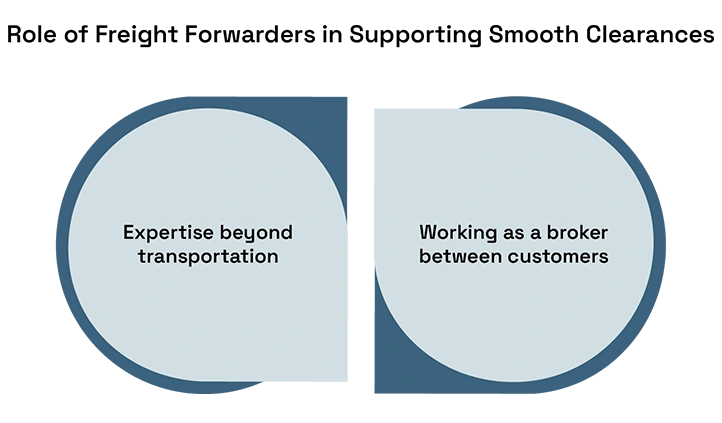
Expertise beyond transportation
Freight forwarding companies near me are often chosen not just for shipping cargo, but for managing the complete approval flow. Experts forwarders work with customs brokers, airlines, shipping timelines, and warehouses to keep shipments in line with local requirements.
Coordinating international freight services
Freight forwarders involved in international freight services confirm that documentation follows the selected Incoterms, whether DAP, DDP, or others. They also guide on routing, port selection, and scheduling to avoid regulatory issues.
Working as a broker between customers
From shippers and carriers to Customs and port operators, forwarders work as the communication hub. This coordination is frequently what stops small issues from becoming multi-day delays.
Conclusion
Same-day Customs clearance is limited because global trade is built on stage-gate guidelines related to protecting economies, consumers, and supply chains. Documentation checks, security inspections, HS code validation, and operational realities all make instant release the exception, not the rule. Also, businesses can still mainly reduce clearance times. Through correct preparation, strong approval support, smart use of international shipping terms, and partnerships with capable freight forwarding companies near me, organizations can ship closer to predictable, effective outcomes. While “same-day” may remain uncommon, smoother and faster clearance is absolutely achievable.
DID YOU KNOW?
According to the Vietnam Customs Department, the rate of customs declarations processed through the green line (exemption from physical inspection of goods and document verification) has increased to approximately 70%.
FAQs:
1. What is customs clearance in international trade?
Customs clearance is the official process where authorities verify documents, inspect goods, assess duties and taxes, and confirm regulatory compliance before cargo is released.
2. Why is same-day customs clearance uncommon?
Because shipments often undergo document verification, risk screening, inspections, and classification reviews, which usually take more than one day.
3. What documents are required for customs clearance?
Common documents include commercial invoices, packing lists, certificates of origin, transport documents, licenses, and regulatory approvals, where applicable.
4. How can companies speed up customs clearance?
By pre-filing documents, ensuring accurate HS codes and valuations, working with experienced IOR/EOR partners, and using digital compliance tools.
5. What role do freight forwarders play in customs clearance?
Freight forwarders coordinate documentation, work with customs brokers, manage compliance processes, and act as a communication link between all service providers to reduce delays.