
Overview
Trade tensions between the United States and China have mostly changed global manufacturing and global trade with the importer of record service. One of the major policy tools used by the United States to protect local industries is anti-dumping duties, with supply chain optimization. The U.S. government has applied anti-dumping duties on many Chinese auto components to stop unfair fees and confirm the importance of American manufacturers. Chinese auto tools have been exported to the United States because of their low pricing and huge manufacturing capacity. Also, organizations working in global trade are tracking regulatory changes and using their shipment strategies. Businesses working with cross-border shipments frequently depend on correct documentation and approval processes that require HS code, HTS harmonized tariff Schedule, and Incoterms to confirm that goods are shipping smoothly through global trade.
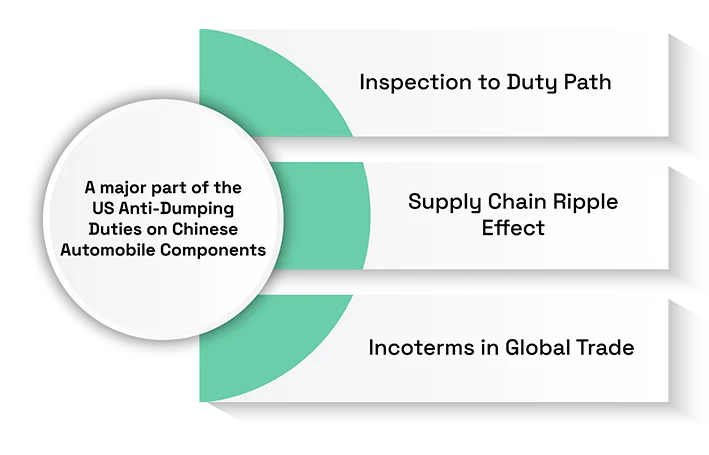
A major part of the US Anti-Dumping Duties on Chinese Automobile Components
Anti-dumping duties on Chinese auto tools are mainly introduced after detailed inspections by U.S. officials. If the inspections see that dumping has occurred, extra duties are imposed on the affected imports. The purpose of these duties is not to block trade but to correct unfair pricing methods and protect local industries. The impact of these duties grows across the complete automotive supply chain. Manufacturers that before depended heavily on Chinese suppliers may be required to reassess their shipping plans. Businesses must also pay close attention to trade documentation, tariff categorizations, and approval processes to confirm that shipments work with international trade terms.
Key Details on US Anti-Dumping Duties
Inspections and Executions of Taxes
The process of using anti-dumping duties mainly starts with a request completed by local manufacturers who believe they are being harmed by unfairly priced imports. U.S. authorities then inspect to show whether dumping has occurred and whether the local industry has sustained huge damage. If both conditions are confirmed, anti-dumping duties are imposed on the imported products. These duties can change mainly depending on the level of price misstatement identified during the investigation.
Impact on Automotive Manufacturers
Anti-dumping duties can have a real impact on automotive manufacturers and suppliers. Importers may face higher costs for affected components, which can change complete production expenses. Businesses involved in global trade frequently work with specialized service providers to manage difficult approval requirements. In some cases, organizations use exporter of record services, Importer of record services, and International freight services to confirm that goods are shipped and documented according to regulatory standards.
Approval and Trade Documentation
Maintaining correct trade documentation is critical when working with anti-dumping duties. Importers must confirm that product categorization and shipping terms are properly documented during inspections. Organizations may also depend on digital platforms and the best trade compliance software for import export rules to manage documentation, track regulatory updates, and maintain correct records. Effective Inventory and order management can further help businesses respond quickly to changes in tariffs and duty systems.
What is the Anti-Dumping Duty on Chinese Goods?
Anti-dumping duty is a trade tariff used by administrations to stop unreasonable pricing methods in global trade. It is applied when imported goods are sold at prices lower than the normal value in the exporting country or below manufacturing cost of the countries. In the case of Chinese auto components, anti-dumping duties are used to confirm that U.S. manufacturers can compete under fair market conditions. The duty rate is mainly calculated based on the margin of dumping, which represents the difference between the export price and the normal value of the product. These duties do not completely block imports but rather adjust the price system so that imported goods are priced in relation to local products.

Conclusion
The execution of U.S. anti-dumping duties on Chinese automotive goods shows an ongoing effort to have fair costs in the automotive sector for global trade. Businesses must have correct documentation, check policy developments, and shipping plans to manage regulatory changes effectively. As global trade continues to develop, capable approval and major planning will remain necessary for organizations to navigate the difficulties of global automotive tools trade.
DID YOU KNOW?
The US government said the settlement ends nearly 10 years of litigation, recovering all lost revenue sought by the United States and more than $30 million in civil penalties.
FAQs:
1. What are anti-dumping duties on Chinese auto components?
Anti-dumping duties are additional tariffs imposed by the United States on imported Chinese automotive components that are sold at unfairly low prices. These duties help protect domestic manufacturers and ensure fair competition in the market.
2. Why does the US impose anti-dumping duties on Chinese auto parts?
The US government imposes anti-dumping duties when investigations show that imported products are sold below their normal value and harm domestic industries. The duties aim to correct unfair pricing practices and maintain fair trade conditions.
3. How are anti-dumping duty rates determined?
Duty rates are calculated based on the dumping margin, which is the difference between the export price of the product and its normal value in the exporting country. The higher the dumping margin, the higher the duty rate may be.
4. How do anti-dumping duties affect automotive manufacturers?
Anti-dumping duties increase the cost of imported components, which can raise production costs for manufacturers relying on foreign suppliers. Companies may need to adjust sourcing strategies or diversify suppliers.
5. Do anti-dumping duties stop imports from China?
No, anti-dumping duties do not completely stop imports. Instead, they increase the price of imported goods so they compete more fairly with domestically produced products.