Overview
The global automotive supply chain is getting a noticeable change as auto parts trade mainly ships from China to Mexico and many Southeast Asian countries. Also, China worked as the vital manufacturing hub for automotive components due to its large industrial base and strong export systems. Manufacturers are now looking for various manufacturing hubs that provide security and the affordability of logistics. Also, Mexico and countries such as Vietnam, Thailand, and Indonesia are growing manufacturing hubs. Trade tariff categorizations, such as the HS code and the HTS harmonized tariff Schedule continue to play an important role in showing how automotive components ship across borders. Businesses working in global shipments mainly manage documentation and delivery terms under Incoterms while working with logistics and the customs clearance processes.
Key Drivers of the Shifting from China to Mexico and Southeast Asia
Many systematic and major factors are causing automotive organizations to reduce dependence on Chinese manufacturing and expand production to other regions.
Trade Policy and Tariff Pressures
When tariffs increase, organizations must know how their components are categorized under the HS code or the HTS Harmonized Tariff Schedule, which directly affects the final cost of imported automotive parts. To maintain competitive pricing, many businesses are exploring changing production locations that provide favorable trade agreements or tariff advantages under programs such as the Generalized System of Preferences (GSP).
Variation of Supply Chains in China
Global disruptions in recent years have shown the risks of concentrating production in a single country. Automotive manufacturers are mostly using Supply chain optimization plans for various production across multiple regions. Also, organizations are improving Inventory and order management systems to have steady production even when the supply chain changes between countries.
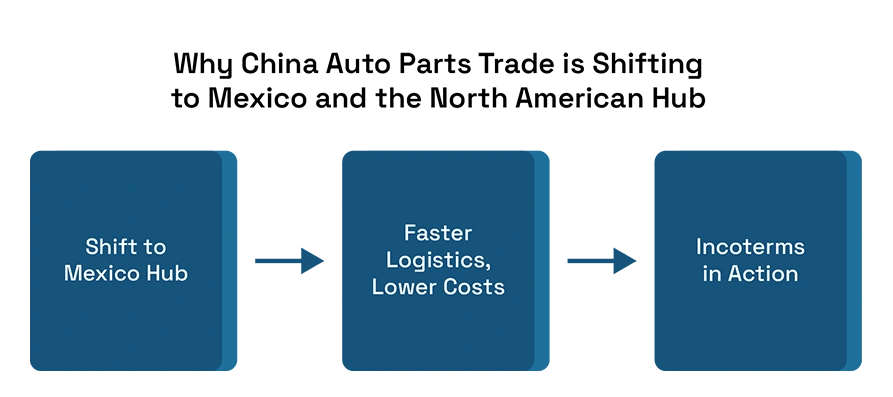
Why China Auto Parts Trade is Shifting to Mexico and the North American Hub
Geographic Advantage and Nearshoring
Mexico’s proximity to the United States allows manufacturers to shorten logistics times and reduce shipping costs between countries. Automotive suppliers shipping to North America frequently use delivery terms such as DAP or DAPs, depending on the agreement under Incoterms. These terms show responsibilities between buyers and sellers during global shipments.
Combined Trade and Approval Systems
Mexico has created a strong trade system that supports a cross-border manufacturing hub. Businesses working in this ecosystem frequently depend on exporter of record services and Importer of record services to confirm regulatory approval when shipping automotive components globally. Organizations must also know whether operational partners can legally manage documentation. Also, many businesses ask whether a freight forwarder can be an exporter of record when managing export documentation or working with International freight services.
Impact on the Auto Sector after Shifting from China to Mexico
Increased Role of Trade Service Providers
As supply chains expand across multiple regions, businesses are depending more heavily on expert trade services. Providers of exporter of record services, Importer of record services, and International freight services help companies guide regulatory systems and shipping requirements across borders. Also, organizations frequently evaluate working questions such as whether a customs broker can handle both import and export documentation to simplify approval processes.
Greater Focus on Efficiency and Risk Management
The change away from a single dominant manufacturing hub has enabled organizations to focus more on dependence and working efficiency. Through improved Supply chain optimization and better Inventory and order management, manufacturers can maintain stable manufacturing of equipment even as locations change.

Conclusion
The shift of auto parts trade from China to Mexico and Southeast Asia shows a broader change in the global automotive supply chain. Rising costs, trade policy changes, and the need for a varied production chain are improving organizations to rethink their conventional sourcing strategies. As these changes continue, automotive companies will increasingly depend on strong approval systems, effective logistics, and dependable documentation processes, developing HS code categorizations, Customs clearance, and well-defined Incoterms such as DAP. Organizations that effectively manage these operational requirements will be better positioned to accept the changing landscape of the global auto parts trade.
DID YOU KNOW?
Taxes on Chinese cars will increase from the current 15-20 percent to 50 percent. In the case of auto parts, the increase will be from the current 0-35 percent to 10-50 percent.
FAQs:
1. Why are auto parts manufacturers moving from China to Mexico?
Auto parts manufacturers are shifting production from China to Mexico mainly because of rising tariffs, supply chain risks, and the advantage of nearshoring to the United States. Mexico’s geographic proximity reduces transportation costs and delivery times, making it an attractive manufacturing hub.
2. Why is Southeast Asia becoming a hub for auto parts manufacturing?
Countries such as Vietnam, Thailand, and Indonesia are attracting automotive manufacturers because of lower labor costs, growing industrial infrastructure, and favorable trade agreements that support global exports.
3. How do tariffs affect global auto parts trade?
Tariffs increase the cost of importing automotive components. Businesses must classify their products under the HS code or HTS Harmonized Tariff Schedule to determine duties, which can influence decisions about where to manufacture and source parts.
4. What role does logistics play in the automotive supply chain shift?
Logistics plays a crucial role in managing international shipments, customs clearance, and delivery terms under Incoterms. Efficient logistics networks help companies maintain steady production and reduce delays across global supply chains.
5. How does supply chain diversification benefit automotive companies?
Supply chain diversification helps automotive companies reduce risks associated with relying on a single country for manufacturing. By expanding production across multiple regions, companies can maintain operational stability and respond quickly to global disruptions.