Introduction
The international growth of Artificial Intelligence infrastructure has changing data centers into the main of modern technological advancement. This infrastructure internationally is no longer just a hardware or logistics challenge it is a difficulties legal & regulatory challenges. Organizations looking to import high-performance AI servers across many regions face a collection of compliance issues, ranging from export controls on cutting-edge silicon to disparate environmental standards, data safty laws, & localized equipment certifications. Navigating this fragmented regulatory landscape need a sophisticated understanding of both global trade mechanisms & changing geopolitical dynamics.
Understanding AI Servers & Their Global Demand
What Is An AI Server?
AI, or artificial intelligence, is changing the way organizations & businesses managed data by incorporating automation of complex calculations, introducing new updated applications, & fulfilling computational demands like never before.
This is where AI server clusters stand out, crafted for HPC , huge amounts of data, & very demanding AI workloads. Some of these operations involve deep learning, image recognition, & natural language processing. From running large language models to perfecting generative AI, a server capable of managing these modern demands is a necessity.
Understanding AI Servers
Similar to the regular server configuration, artificial intelligence servers also include a CPU, GPU, RAM, & storage.
What sets AI servers apart is mainly their capability of managing updated workloads & specialized hardware within them, tailored for specific needs. We’re speaking of high-core count CPUs, & in many cases, many GPUs with high memory, huge amounts of RAM, & , of course, data centers with a high level of care.
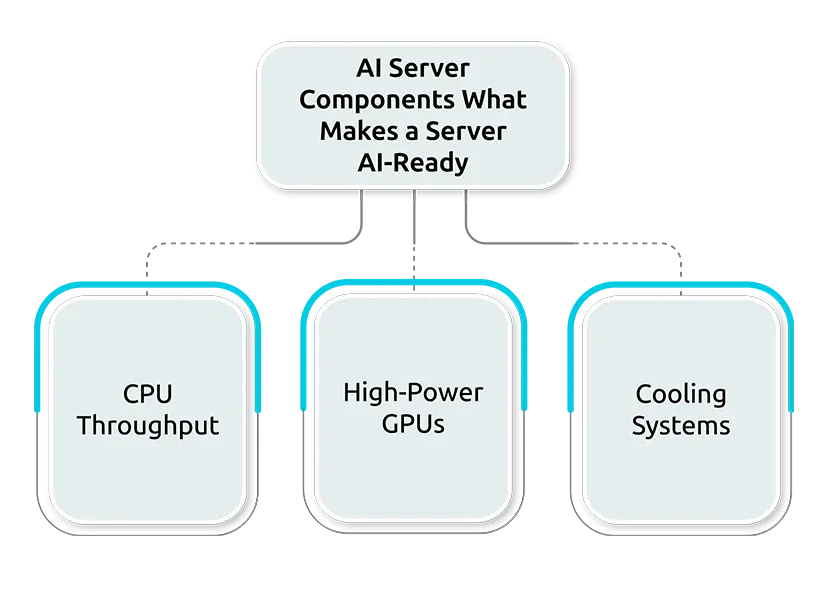
AI Server Components: What Makes a Server “AI-Ready”
To understand the important factors that set AI servers apart from regular server configurations, it’s important to examine their main hardware components.
CPU Throughput:
The most important piece in any server configuration, not only AI servers, is, of course, the powerful CPU, responsible for the calculations. For AI workloads, not every CPU can get the job done, as you need a processor that can run 24/7, be power efficient, support various critical features such as ECC memory, and be powerful enough to handle the load.
Some of the CPUs capable of fulfilling AI workloads are the latest Intel Xeon CPUs or AMD chips from the EPYC series. This is the most important piece from the hardware components that provides the computing power needed to run large models, multiple AI tasks, neural networks, & large datasets.
High-Power GPUs:
The second place is mainly secured by the GPU, or even many GPUs, when it comes to AI servers, due to a specific feature called “AI acceleration“. Even though the CPU is responsible for the main computational force, GPUs can improve many AI workloads like computer vision, generative AI, deep learning, & image recognition via parallel execution. These GPUs can train large-scale AI models faster & enhance AI server changes in many ways. When this is combined with a strong CPU & high-speed networking, an AI server can easily meet the latest demands of AI.
Cooling Systems:
Last but definitely the cooling of hardware running intense computational demands like training large models & running many AI tasks at the same time. Even though server processors are designed for such kinds of utilization, air cooling may not always be enough, which is where liquid cooling comes in.
It’s critical to provide your AI server with the cooling it requires to improve the AI server’s performance & secure potential throttling when the thermal margin is exceeded. Some large-scale AI models & other AI training tasks could push your CPU to the brink of overheating, so deploying a cooling solution that can manage the heat is critical for any computationally heavy AI workload.
Compliance Challenges and Solutions for Importing AI Servers Across Multiple Countries
1. Complex Export Control Regulations
AI servers that include updated GPUs, AI works, or secure technologies may be subject to export control laws. Many locations or end users may need export licenses or additional government approvals, increasing the risk of shipment delays or legal fines.
Review export control needs before shipping, conduct restricted-party & end-user screening, & obtain all necessary export licenses. Work with trade compliance experts to ensure compliance with global export laws.
2. Country-Specific Import Laws
Every country has different customs rules, import permits, & regulatory requirements for IT & AI hardware. Failure to meet these needs can lead to customs holds or shipment rejection.
Research destination-country laws in advance, prepare country-specific paperwork, & partner with experienced customs brokers or Importer of Record providers to ensure compliance.
3. Incorrect HS Code Classification
AI servers often added with many components, making tariff classification complex. Incorrect HS codes can result in inaccurate duty calculations, customs disputes, or financial penalties.
Verify the correct HS code for each AI server verification & review classifications regularly to deal with changing customs laws.
4. Incorrect Customs Documentation
Missing &incorrect transportation documents can delay customs clearance & increase storage costs.
Prepare correct commercial invoices, packing lists, certificates of origin, technical details, & shipping documents before dispatch.

Conclusion
Transporting AI servers in many countries need careful planning & an understanding of international trade laws. Difficulties such as export controls, country-specific import needs, HS code verification, customs documentation, & import taxes can delay shipments & increase costs if not handle properly. By adopting a secure compliance strategy, managing correct documentation, & partnering with experienced logistics providers that give services such as Delivered Duty Paid & Importer of Record, businesses can identify cross-border shipments, minimizes compliance risks, & ensure the timely growth of AI network while meeting developing international regulatory needs.
Did you know?
This AI procurement software analyzed market demand and supplier capabilities, enabling the chain to reduce network distance by 25% and achieve savings of €3.2 million annually.
FAQ
Why do AI servers require special import compliance?
AI servers contain advanced computing and encryption technologies that may be subject to export controls, import licenses, and country-specific regulations.
What documents are required to import AI servers?
Key documents include a commercial invoice, packing list, Bill of Lading/Air Waybill, Certificate of Origin (if required), and relevant import permits.
How can businesses avoid customs delays?
Use accurate HS codes, prepare complete documentation, and comply with the destination country’s import requirements.
How do DDP and IOR services help with AI server imports?
DDP manages duties, taxes, and delivery, while IOR ensures legal import compliance, making international shipments faster and easier.
What should businesses check before importing AI servers?
Verify export controls, import regulations, certifications, HS codes, and applicable duties and taxes before shipping.