Overview
In today’s growing global trade environment, cost visibility has become just as important as the speed of shipments. Import–export businesses working across IT, aviation, medical equipment, and automotive industries face increasing difficulty due to changing tariffs, developing trade agreements, and stronger compliance requirements. Real-time customs duty estimation tools are growing as a necessary digital approach that helps organizations to calculate duties correctly, reduce clearance delays, and improve overall supply chain optimization. Through these tools in daily logistics and procurement planning, businesses gain a competitive edge in global trade.
How Emerging Trade Trends Are Shifting Customs Duty Estimation
Global trade is changing rapidly as governments introduce new tariffs, digital customs systems, or latest trade agreements. Businesses must adjust to these changes by using tools that provide correct & up-to-date duty calculations. Real-time customs duty estimation platforms help companies respond quickly to regulatory updates, improve shipment planning, & reduce the risk of extra costs. They also support better decision-making by providing greater visibility into landed costs before goods are shipped. As global trade continues to become more data-driven, adopting advanced duty calculation tools is becoming important for maintaining compliance, improving working efficiency, & building a more strong global supply chain.
What Is a Duty Calculator and Why Does It Need to Be Used in Global Trade?
Understanding Duty Calculators
A duty calculator is a digital tool designed to estimate customs duties, taxes, and applicable tariffs for cross-border shipments. It uses critical inputs such as the HS code, product value, country of origin, and destination to create a correct cost estimation. Many advanced calculators work calculations with the HTS Harmonized Tariff Schedule, confirming approval with country-specific regulations of the supply chain.
Why Duty Accuracy Is Critical
In global trade, wrong duty estimates can result in unexpected costs, shipment holds, or regulatory penalties. For industries such as aviation and medical devices, where parts and equipment are frequently high-value and urgent, errors in customs clearance can stop complete supply chains. Real-time duty estimation also supports the correct use of Incoterms such as DAP, helping businesses clearly define cost responsibilities between buyers and sellers in the supply chain.

What Are the Real-Time Customs Duty Estimation Tools for the Global Supply Chain?
Technology-using Trade Solutions
Real-time customs duty estimation tools are cloud-based platforms that continuously update tariff rates, trade agreements, and duty exceptions. These tools are used for systems such as the generalized system of preferences (GSP), allowing eligible importers or exporters to benefit from reduced or zero-duty access where applicable during shipments.
Integration with Logistics Operations
Modern tools combined smoothly with international freight services, inventory and order management systems, and customs broker sources. These combinations allow businesses to estimate landed costs before shipment, supporting smarter decisions in international shipping terms and premium delivery service planning. For organizations providing importer of record service or exporter of record services, real-time duty tools confirm regulatory approval across multiple customs officials.
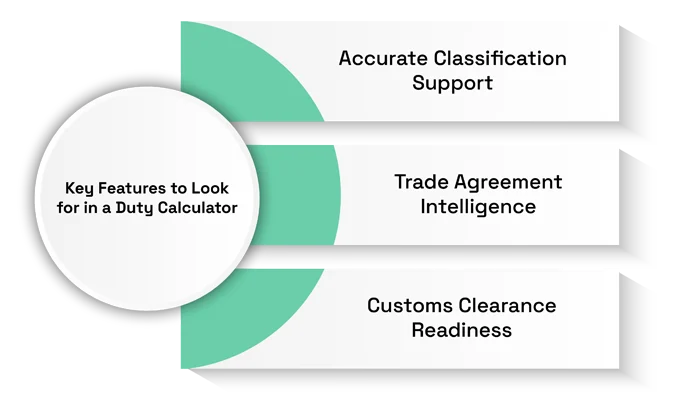
Key Features to Look for in a Duty Calculator
Accurate Classification Support
A dependable duty calculator should support accurate HS code categorization and connect it directly to the applicable tariff rates. This is mainly important in the automotive and IT sectors, where small classification errors can hugely affect duty outcomes.
Trade Agreement Intelligence
Advanced tools automatically factor in duty relief schemes such as the generalized system of preferences (GSP) and other DAPs, confirming businesses do not overpay on eligible shipments.
Customs Clearance Readiness
The best platforms generate duty estimates that work with customs clearance documentation requirements, reducing back-and-forth with customs brokers and authorities.
Benefits of Tariff Simplifying with Duty Calculators
Cost Transparency and Control
Real-time duty calculators provide full visibility into landed costs, helping companies budget more accurately and avoid last-minute problems. This is most valuable for international freight services that manage high-value aviation components or sensitive medical equipment shipments.
Faster Decision-Making
Providing quick duty estimates, businesses can quickly compare origin locations, select exact Incoterms, and improve delivery routes. This supports quick settlements and improved reaction to market demand in global trade.
Improved Supply Chain Optimization
Accurate duty data allows organizations to simplify inventory and order management, reduce port stay time, and plan shipments more effectively throughout the supply chain. Also, this gives a good supply chain dependence and improved customer trust in global trade.
Industry-Specific Duty Estimation
IT and Data Centre Equipment
Servers, GPUs, networking equipment and other data-centre hardware can have different duty rates based on HS classification, origin and destination. Duty estimation helps importers review potential customs costs before shipment.
Aviation Equipment
Aircraft parts and aviation equipment require accurate product classification for customs purposes. Duty estimation helps businesses assess the potential customs cost of a specific part before arranging international transport.
Medical Equipment
Medical devices and healthcare equipment may have product-specific customs treatment and import requirements. Estimating duties before shipment helps importers include potential customs costs in landed-cost planning.
Automotive Equipment
Automotive parts and equipment can receive different tariff treatment based on classification and origin. Pre-shipment duty estimation helps businesses review these costs before finalising the shipment.
Conclusion
Real-time customs duty estimation tools have become indispensable for modern import–export businesses working in difficult, regulated industries such as IT, aviation, medical equipment,, and automotive. Using correct HS code categorizations, new tariff regulations, and smooth logistics, these tools simplify customs processes. As global trade continues to develop, businesses that use quick duty calculators will be well-positioned to control costs, fast customs clearance, and create more flexible global supply chains.
DID YOU KNOW?
In 2025, the World Customs Organization (WCO) updated its Time Release Study (TRS) Guide to improve cargo release times, highlighting the importance of accurate customs data and digital duty calculation tools
FAQs:
1. What is a real-time customs duty estimation tool?
A real-time customs duty estimation tool is a digital platform that calculates import duties, taxes, and tariffs using live trade data, HS codes, origin, and destination details.
2. Why are duty calculators important in global trade?
Duty calculators help businesses avoid unexpected costs, reduce customs clearance delays, and confirm approval with international trade regulations.
3. Can duty calculators estimate landed costs before shipment?
Yes. Many duty calculators estimate landed costs by combining customs duties, taxes, freight charges, and other import-related expenses, helping businesses plan shipments more accurately.
4. Can duty calculators account for trade agreements?
Yes. Depending on the destination and origin, duty calculators may use applicable preferential tariff arrangements, rules of origin, exemptions, and other customs measures when estimating import costs.
5. Which industries benefit most from real-time duty estimation tools?
Industries such as IT, aviation, medical devices, and automotive benefit mostly due to high-value shipments and strong regulatory requirements..3