Supply chains have changed mainly in recent years. Many companies focused mainly on minimizing costs. In order to send goods fast and effectively, they used established shipping routes, kept inventories low, and sought out cost-effective suppliers.
Cost is still significant nowadays, but it is no longer the main consideration.
Additionally, companies must ensure that their supply chains can function even in the event of unforeseen issues. The flow of goods can be impacted by shipping delays, supplier shortages, tariffs, severe weather, geopolitical unrest, and evolving legislation.
Because of this, supply chain resilience is now more crucial than before. But creating a robust supply chain is also more expensive.
What Is Supply Chain Resilience?
Supply chain resilience is the capacity of an organization to foresee disruptions, respond quickly to problems, and continue with normal operations.
A company that depends on a supplier for an essential component may face serious problems if the provider stops producing. Another supplier may be able to provide the identical part to a stronger company.
A company may employ multiple delivery routes, maintain excess goods, or run warehouses in various locations.
Although these tactics can reduce risk, they can raise expenses.
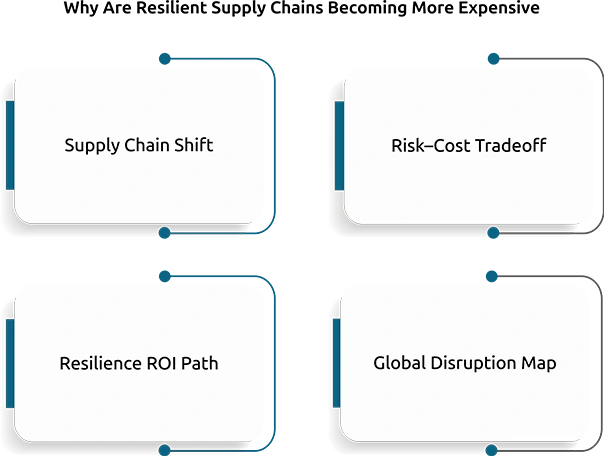
Why Are Resilient Supply Chains Becoming More Expensive?
Businesses are shifting away from supply chains created just to cut costs, which is a significant factor.
For a long time, businesses favored production facilities and suppliers with the lowest prices. When international trade was comparatively stable, this strategy was effective.
However, current problems have demonstrated that a low-cost supply chain can also be problematic.
Companies are now prepared to spend extra for backup plans and flexibility.
Using Multiple Suppliers Costs More
Instead of depending on one supplier, organizations may work with two or more suppliers from different countries or regions. If one supplier has an issue, another supplier can continue providing materials.
This can make the supply chain more usable, but the second supplier may charge higher prices.
Businesses also need to spend time & money checking new suppliers, testing their products, negotiating contracts, & ensuring they meet quality & compliance needs.
Even when the second supplier is not used regularly, managing that relationship creates an additional cost.
Nearshoring Can Increase Production Costs
Some companies are also moving production closer to their customers. This strategy is often called nearshoring.
For example, a company may move some manufacturing from a distant country to a location closer to its main market.
Nearshoring can reduce transportation distances and make supply chains easier to manage. It can also reduce dependence on one country.
However, production costs may be higher in the new location. Labor, energy, property, and operating expenses can all increase.
Companies therefore have to decide whether the additional cost is worth the lower supply chain risk.
Tariffs & Trade Changes Add More Costs
Changing trade restrictions also affect supply chain costs.
The cost of purchasing items from specific countries may rise due to geopolitical tensions, import limitations, tariffs, and customs regulations.
When this happens, businesses may need to find similar suppliers or move their manufacturing facilities.
It’s not always easy to switch vendors. Product specifications, country-of-origin requirements, customs classifications, and other compliance issues may need to be reviewed by businesses.
Both the direct cost of goods and the cost of supply chain management may rise as a result of these modifications.
Technology Is Becoming Essential
The stability of supply chains is mainly influenced by technology.
Businesses are investing in artificial intelligence, predictive analytics, warehouse management systems, supply chain management software, & real-time shipment tracking.
These solutions assist companies in tracking product whereabouts, seeing potential delays, & making quicker decisions. If a cargo is expected to arrive late, a business can set up a different mode of transportation or modify inventory before the delay has an effect on customers.
But technology also need funding. Software, integration, data handling, cybersecurity, & skilled personnel are all costs that businesses must cover.
The cost can be high, but better visibility can help companies avoid even larger losses during major issues.
The Cost of Being Unprepared Can Be Higher
Although resilience need investment, companies also need to consider the cost of not being prepared.
An important supply chain issues can stop production, delay customer orders, increase transportation costs, & lead to lost sales.
If a critical component is unavailable, a company may have to purchase it from an emergency supplier at a higher price & transport it using expensive express freight.
The cost of the issues can be much higher than the cost of managing a backup supplier or additional inventory.
This is why supply chain resilience should not be viewed simply as an extra cost. It can also be an investment in business continuity.

Finding the Right Balance
Businesses do not need to spend money securing every part of their supply chain.
Instead, they should identify their most important risks.
An important component that can stop a whole production line may need a backup supplier & additional inventory. A less important product may not need the same level of protection.
Companies can use risk assessments, supplier reviews, inventory planning, & scenario planning to decide where resilience investments will have the greatest impact.
The goal is not to create a supply chain with zero risk. The goal is to create a supply chain that can respond quickly when something goes wrong.
Conclusion
Supply chain resilience is becoming more costly because businesses are no longer focusing only on the lowest possible cost. They are also paying for flexibility, backup suppliers, additional inventory, alternative transportation, technology, & stronger compliance processes.
These investments can increase operating costs, but they can also protect businesses from much larger losses caused by supply chain issues.
The most successful companies will be those that find the correct balance between cost efficiency & resilience.
Did you know?
2025 Supply Chain Risk Survey, 45% of companies affected by tariffs increased inventory, 39% pursued dual sourcing, and 33% explored nearshoring or onshoring to reduce supply chain risk. These resilience measures can improve flexibility, but they can also increase inventory, sourcing, and operating costs.
FAQ
Why is supply chain resilience becoming more expensive?
Supply chain resilience is becoming more expensive because companies are investing in backup suppliers, additional inventory, alternative transportation routes, technology, and compliance processes to reduce disruption risks.
What are the main costs of supply chain resilience?
The main costs include inventory storage, supplier diversification, alternative transportation, regional manufacturing, supply chain technology, risk management, and regulatory compliance.
Does supplier diversification increase supply chain costs?
Yes. Working with multiple suppliers can improve resilience, but businesses may face higher purchasing, supplier management, testing, and compliance costs.
Is nearshoring more expensive than offshore manufacturing?
Nearshoring can be more expensive because labor, property, energy, and operating costs may be higher in locations closer to the final market. However, it can reduce transportation risks and improve supply chain flexibility.
Is supply chain resilience worth the additional cost?
For many businesses, yes. A resilient supply chain can help reduce the financial impact of production stoppages, shipment delays, shortages, and emergency transportation when major disruptions occur.