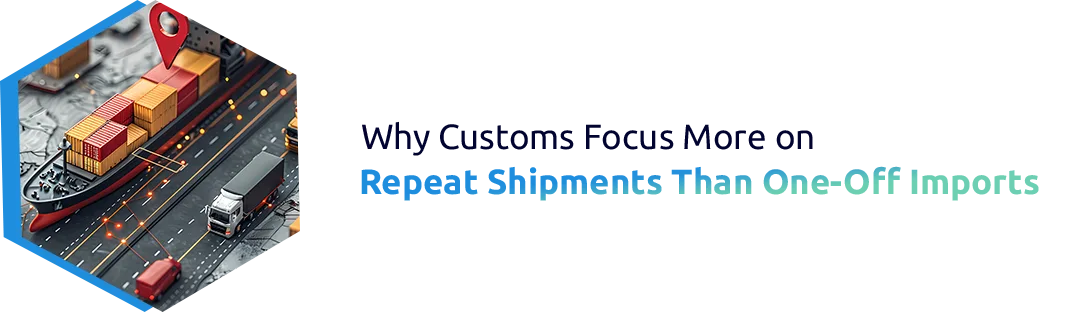
Customs authorities inspect millions of shipments every year. Since they cannot check every container in detail, they rely on risk-based screening to decide which shipments need closer attention. One main factor in this process is whether a shipment is repeated or one-off. In most cases, repeat shipments receive more extra verification than single, occasional imports. Understanding why customs focuses more on repeat shipments helps importers stay compliant & avoid delays.
What Are Repeat Shipments?
Repeat shipments are imports that arrive regularly from the same supplier, with similar products, values, & routes. These shipments often involve the same HS codes, country of origin, & importer of record. Because these shipments form a pattern, customs authorities can easily track them over time. Any inconsistency becomes more visible.
What Are One-Off Imports?
One-off imports are occasional or unique shipments. They may involve a new supplier, a special project, or a single purchase. These shipments do not create a long-term pattern & are often seen as low-frequency trade activity. While one-off imports can still be inspected, they usually attract less ongoing attention unless other risk factors are present.
Customs Uses Risk-Based Assessment
Customs agencies operate under risk management systems. These systems analyze shipment data to identify possible non-compliance, fraud, or revenue loss. Repeat shipments provide more data points, making them easier to assess. Customs systems automatically compare current entries with previous ones to spot differences in value, weight, description, or classification.
Patterns Help Customs Detect Errors
One major reason customs focuses on repeat shipments is pattern analysis. If an importer repeatedly declares the same product, customs expects consistency. When values suddenly drop, weights change, or HS codes shift, it may signal misclassification, undervaluation, or incorrect origin claims. These red flags are easier to detect in repeat trade.
Revenue Protection Is a Priority
Customs authorities are responsible for collecting duties & taxes. Repeat shipments that are undervalued can lead to significant revenue loss over time. A small error in a single shipment may not cause concern. But the same error repeated across multiple shipments can result in large duty losses, making repeat importers a higher financial risk.
Compliance History Matters
Customs maintains a compliance profile for frequent importers. This profile includes past audits, fines, verifications, & voluntary disclosures. Importers with strong compliance records often benefit from faster clearance & fewer inspections. On the other hand, repeat shipments from importers with past issues are more likely to be examined. One-off importers usually lack enough history for detailed profiling.
Repeat Shipments Increase Fraud Risk
Fraud is rarely a one-time action. It usually happens through repeated practices, such as incorrect classification or false valuation.
Customs focuses on repeat shipments because ongoing trade offers more opportunity for systematic fraud. Continuous management helps customs identify intentional infractions rather than honest mistakes.
Use of Automation and Data Analytics
Modern customs systems depend heavily on automation & data analytics. These tools work best when there is consistent data over time. Repeat shipments feed customs databases with usable information. Automated systems can then compare current & past declarations to identify irregularities quickly & easily. One-off imports do not provide enough data for advanced analysis.
Supply Chain Transparency
Repeat shipments involve established supply chains. Customs expects importers to fully understand their suppliers, product specifications, & documentation. If repeated shipments contain inconsistent invoices, certificates, or product descriptions, customs may question the credibility of the supply chain & increase verification.
Why One-Off Imports Face Less Focus
One-off imports are often treated as isolated transactions. Unless they involve high-risk goods, restricted items, or unusually high values, they may not justify long-term monitoring. Customs prioritizes resources where they can have the greatest impact, which is usually in recurring trade activities.

How Importers Can Reduce Scrutiny
Importers managing repeat shipments can minimize customs focus by following best practices:
- Use correct HS codes consistently
- Declare accurate values & quantities
- Maintain complete & clear documentation
- Conduct regular internal compliance checks
- Work with experienced customs brokers
Strong compliance builds trust & minimizes verification frequency.
Conclusion
Customs focuses more on repeat shipments because they reveal patterns, carry higher revenue risk, & provide better data for analysis. Regular imports allow customs to track consistency, detect errors, & prevent long-term non-compliance. While one-off imports may receive less attention, repeat importers benefit from maintaining accurate, transparent, & consistent practices. In a system driven by data and risk management, compliance over time is the key to easier customs clearance.
Did you know?
In today’s interconnected world, the import and export of goods and services play a crucial role in global trade. However, navigating the complexities of customs clearance can often be a daunting task for businesses of all sizes. This blog post will delve into the significance of efficient import and export customs clearance, exploring its impact on global trade and providing valuable insights to help businesses navigate this crucial process seamlessly.
FAQ
1. Why do customs authorities focus more on repeat shipments?
Customs focuses on repeat shipments because they show patterns over time. Regular imports make it easier to spot changes in value, classification, or documentation that may indicate non-compliance.
2. Are one-off imports ignored by customs?
No. One-off imports can still be checked, especially if they involve high-risk goods or unusual values. However, they usually receive less ongoing attention because there is no trade pattern to monitor.
3. How do repeat shipments increase customs risk?
Repeat shipments increase risk because small errors, when repeated often, can lead to large duty losses. Customs monitors frequent imports to protect revenue and prevent ongoing mistakes or fraud.
4. Does past compliance affect customs inspections?
Yes. Customs keeps a compliance history for regular importers. Companies with a clean record often face fewer inspections, while those with past issues may see more checks on repeat shipments.
5. How can importers reduce customs scrutiny on repeat shipments?
Importers can reduce scrutiny by using correct HS codes, declaring accurate values, keeping clear documents, and reviewing compliance regularly. Consistency and transparency help build trust with customs.