Overview
In international logistics, few updates create more confusion than seeing a shipment marked “Cleared by Customs.” Many importers suppose this status means the delivery is on the way to their location. In reality, customs clearance is only one milestone in a much longer global shipping process. After clearance, shipments still move through bonded warehouses, local goods, and the complete delivery chain. How international shipping terms, Incoterms, documentation, and local supply complete together help businesses avoid delays, extra costs, and inventory issues.
Why Is My Package Stuck in Customs after Cleared?
Documentation and classification issues
One of the most common reasons packages slow down is an incorrect or incomplete document. Customs authorities depend on accurate HS code categorizations under the HTS Harmonized Tariff Schedule to support duties and taxes. Even a small mismatch in good description, value, or country of origin can take inspections or requests for clarification, pausing the shipment.
Duties, taxes, and trade programs
Shipments may also stall when duties are unpaid or when eligibility under programs like the generalized system of Preferences (GSP) is unclear. Customs may hold goods until brokers confirm whether reduced or zero-duty treatment applies. If commercial invoices or certificates don’t support the claim, the cargo remains in customs despite physically arriving at the port or airport.
Incoterms and responsibility gaps
Another overlooked cause is a misunderstanding of delivery responsibilities. Under DAP or DAPs (Delivered at Place) Incoterms, sellers deliver goods to the given destination, but import clearance and final delivery work can still involve multiple steps. If the Importer of record Service is not clearly designated, shipments may wait until dependability and payment issues are addressed.
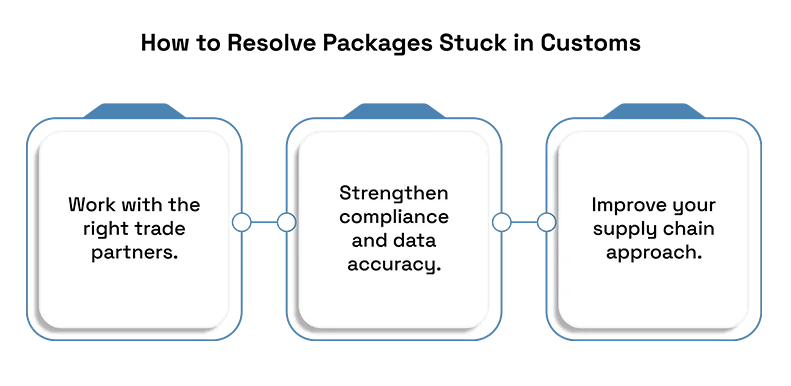
How to Resolve Packages Stuck in Customs
Work with the right trade partners.
Engaging experienced brokers and freight forwarding companies near me can mainly reduce clearance time. These professionals manage filings, communicate with authorities, and work with carriers across borders, confirming that international freight services continue moving once goods are released.
Strengthen compliance and data accuracy.
Proactive inventory and order management systems help maintain continuous good descriptions, valuation methods, and HS Code categorizations. When shipment data, such as invoices, packing lists, and logistics documents, customs processing becomes faster and more predictable.
Improve your supply chain approach.
Long-term success depends on supply chain optimization, not a one-time approach. This includes pre-classification of products, centralized document control, and clear designation of exporter and importer roles. Businesses that combine approval into daily operations face fewer clearance surprises and post-clearance issues.
What “Cleared by Customs” Signifies and Why It’s Not “Delivered”
Clearance is a regulatory checkpoint, not the finish line
When a shipment is cleared, customs officials allow it to enter the country. This confirms that duties are final, documents are approved, and regulatory requirements are met for shipments. Also, the goods may still be in a bonded warehouse, port station, or airport cargo zone awaiting handover to local trade.
Post-clearance logistics still matter.
After clearance, logistics take over. Cargo must be released by port operators, scheduled with trucking partners, and routed through the supply chain. Depending on your service level, standard delivery or a premium delivery service, this stage can take hours or many days.
Delivery depends on commercial terms.
Your chosen Incoterms and trade agreements determine who controls this last phase. Even under DAP arrangements, sellers may depend on third-party carriers to complete delivery. Until the shipment reaches the final goods and proof of delivery is recorded, “cleared” does not equal “delivered.”
How One Union Solutions Helps You
End-to-end customs and trade support
One Union Solutions completes the gap between clearance and delivery by combining exporter of record services and Importer of record services. Managing dependability, documentation, and product classification centrally, they reduce the risk of customs holds and post-clearance delays.
Integrated international freight services
Their global international freight services coordinate air, ocean, and ground transport, confirming that once goods are cleared, they transition smoothly into local supply. This combined approach reduces errors that frequently slow shipments after customs release.
Conclusion
“Cleared by Customs” is an important stage, but it is not the end of the shipping process. Clearance confirms regulatory approval, not delivery. Delays can still grow from documentation gaps, Incoterms misunderstandings, unpaid duties, or post-clearance logistics challenges. Working with expert providers, using expert importer and exporter services, and focusing on supply chain optimization, businesses can move beyond clearance to achieve faster, more dependable global deliveries.
DID YOU KNOW?
In 2024, more than 22 million people used the preclearance service, with Canadian travelers making up the largest share. This accounted for nearly 16% of all commercial air traffic to the United States last year.
FAQs:
1. What does “cleared by customs” actually mean?
It means customs authorities have approved the shipment’s entry, verified documents, and finalized duties and taxes. The goods are legally allowed into the country, but they are not yet delivered.
2. Why is my package still stuck after customs clearance?
Common reasons include port congestion, bonded warehouse procedures, missing delivery instructions, unpaid local charges, or delays in arranging domestic transport.
3. Can documentation problems delay a shipment even after it’s cleared?
Yes. Post-clearance audits, valuation questions, or release documentation issues can still pause cargo before it is handed over to the carrier for final delivery.
4. How do Incoterms affect delivery after customs clearance?
Incoterms define who is responsible for transport, risk, and costs after clearance. If importer or carrier responsibilities are unclear, shipments may wait until roles and payments are confirmed.
5. How can businesses reduce post-customs delivery delays?
By ensuring accurate HS classification, complete documentation, prepaid duties, and working with an importer of record and international freight service providers.