Trade Compliance – Why it Matters to Aerospace Fasteners and Specialty Tools
The value of trade compliance in the aerospace sector is impossible to overlook because precision and safety are vital issues. Aerospace fasteners and special tools are essential infrastructural elements that must comply with different import/export policies, tariff authority regulations, and safety norms. Failure to comply with these regulations may result in delays at huge costs, fines, and even seizure of goods. Knowledge and adherence to rules are essential for companies involved in international trade within the aerospace industry.
What Is Trade Compliance?
Trade compliance is a process in which all the goods, including the aerospace fasteners and specialty tools, are imported to and exported out of the country without contravening the laws and requirements of the respective countries. Such a process is legitimate documentation, classification, tariff compliance, and safety standards. Industries such as the aerospace industry need compliance, especially given how controlled the components are.
Trade compliance also helps prevent delays, fines, and legal issues that could arise from incorrect documentation or non-compliant shipments. It ensures that all imported and exported parts meet international safety and quality standards. By following compliance procedures, aerospace companies can maintain smooth supply chains and avoid operational disruptions. Additionally, strong trade compliance builds trust with regulators and partners, supporting long-term business growth and reliability.
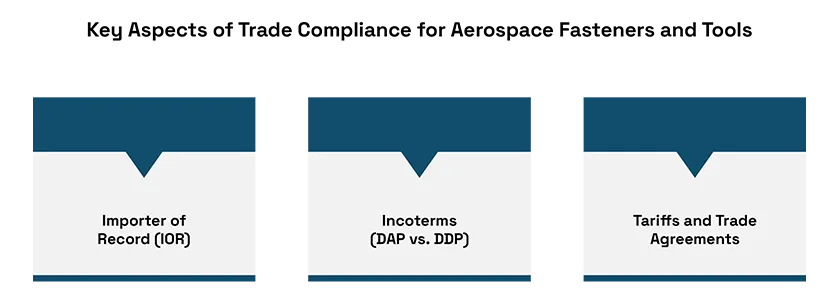
Key Aspects of Trade Compliance for Aerospace Fasteners and Tools
1. HS Codes and Harmonized Tariff Schedules
The HS code (Harmonized System Code) is an internationally accepted code for classifying goods for customs purposes. In the case of aerospace fasteners, or any other parts of such, a special type of tool or any related part must be effectively classified under the right HS or HTS Code. The proper classification implies correctly using tariffs, duties, and taxes. The result of the wrong classification may be fines, delays, and seizure by customs.
As in the cases of assemblies in the aerospace industry, the aerospace components are likely to have some special HS codes. It can distinguish them from the normal manufacturing components. Hence, proper classification is critical to simplify the fast clearance through customs.
2. Importer of Record (IOR)
Essentially, the Importer of Record (IOR) takes charge of meeting all the conditions of trade compliance within the importation process. The IOR has to do with submitting documents, paying duties & taxes, & ensuring that the goods are safe and meet the required safety and regulatory requirements.
In aviation, the IOR must ensure that fasteners and tools are used properly to a standard stipulated by the regulatory authority, such as the FAA (Federal Aviation Administration) in the US or the EASA (European Union Aviation Safety Agency). This involvement ensures that parts are fit in aircraft and meet the international aviation safety requirements.
3. Incoterms (DAP vs. DDP)
Incoterms provide buyers and sellers with sale and shipment terms. The most common terms for aerospace fasteners and tools in international trade are DAP (Delivered at Place) and DDP (Delivered Duty Paid).
DAP: Under DAP, the seller meets the price of transporting the goods to the requested place, whereas the buyer pays import duties and taxes when the goods arrive. Customs clearance, in this instance, would be done utilising the IOR.
DDP: DDP implies that the seller takes full responsibility for the goods, whereby the seller covers all duties, taxes, and delivery costs. The buyer’s involvement in customs is minimal, but the seller takes a bigger responsibility.
4. Tariffs and Trade Agreements
Tariffs are charged on imports as duties. It varies according to the goods & the country of origin. Tariffs on aerospace parts can vary based on the code used in the HS code, the nature of the goods & trade agreements between countries. The trade agreements may incorporate the Generalized System of Preferences. Here, they offer preferential tariff rates on importing the contained goods. Monitoring the variation in the tariffs & capitalizing on trade agreements will be rewarding, as this will ensure the cost is maintained at a minimum and the customs clearance process is simplified.
5. Safety Certifications & Standards
The aerospace parts, such as fasteners & special tools, must satisfy high safety and quality standards. Associations such as the FAA or EASA specify standards that must be met and certified. A serious test should be done on components, including proving that they are safe to use in aircraft; failure can lead to product recalls or safety complications.
Trade compliance defines the process of ensuring that the exportation and importation of goods are done with the appropriate certification. It may involve presenting evidence that meets the ISO standards, FAA certification, or any other regulatory authority.
The Benefits of Trade Compliance in Aerospace
There are various important merits of compliance with the trade standards. It allows businesses to eliminate delays in the case of legal and customs problems since they cannot be seized. It simplifies workflows with routine, easy submissions. Cost savings may be experienced through proper trade agreements and tariff classification. Also, showing willingness to be compliant enhances the company’s reputation to clients, associates, and advisory agencies.
How to Ensure Compliance for Aerospace Parts
The aerospace industry needs businesses to comply with specific steps. First, they must classify goods using the right HS codes. In the second step, they are supposed to consider paperwork and duties associated with the customs brokers. Some of this sensitive equipment also requires the purchase of export permits before exportation. Lastly, conducted periodically, audits will recognise and correct compliance failures before they can cause delays or fines.
Conclusion
Compliance with trade activities is vital to companies importing and exporting aerospace fasteners and special tools. Knowledge of the most important details, such as HS codes, Incoterms, and importer of record duties, precludes the mistakes that can be quite costly and guarantees secure goods delivery on time. At One Union Solutions, we expertly handle trade compliance in the aerospace industry and assist you in navigating the industry’s intricacies. We see to it that your business transacts very well across borders.
Did You Know,
The aerospace & defence industry worldwide is expected to increase at a CAGR of 3.6% by 2028 to $1.4 trillion, driven by the impact of technology and higher defence expenditure.
FAQs
What does an Importer of Record (IOR) do in aerospace trade?
An IOR ensures that all imports comply with laws and regulations, including customs documentation, tariffs, and safety certifications for aerospace parts.
Why are HS codes important for aerospace fasteners?
HS codes classify aerospace parts for tariffs and regulatory purposes, helping prevent customs delays and fines.
What is the difference between DAP and DDP in international trade?
DAP means the buyer pays duties and taxes when the goods arrive. DDP means the seller handles all duties, taxes, and delivery responsibilities.
How are safety certifications used in aerospace trade compliance?
Safety certifications ensure imported parts meet industry quality and safety standards, preventing non-compliant or unsafe products from entering the supply chain.
What are the benefits of trade compliance for aerospace businesses?
Trade compliance reduces risks, speeds up customs clearance, saves costs, and builds a strong reputation with regulators.