Overview
Global supply chains link organizations with suppliers, production, or customers across multiple countries, creating new advantages for growth. However, they also face risks such as supplier delays, shipping delays, changing rules, trade barriers, & climate change. These challenges can increase costs, delay deliveries, & affect business working stability.
Supply Chain become major problems. It offering possible risks across every stages of the supply chain before they become major problems . It offering better clarity into suppliers, logistics networks, or compliance requirements,helping businesses to build effective risk management plans.
What Is Supply Chain Risk Assessment?
Supply Chain Risk Mapping is the process of finding & analyzing possible risks across the supply chain to improve transparency, minimize delays & support smoother businesses operations.It provides transparency into suppliers, logistics, shipping customs, or regulatory requirements.
By mapping potential risks, businesses can identify weaknesses , support better decision develop backup plans ,& build a more stronger & efficient global supply chain.
Common Risks That Affect Global Supply Chains
Every global supply chain faces multiple categories of risk. Recognizing these risks is the foundation of an effective supply chain risk mapping plan.
Supplier and Operational Risks
Vendors play an important role in every supply chain. Production delays, quality issues, labor shortages, production halts, & cybersecurity factors can affect operations. Organizations should regularly assess supplier performance, financial stability, & security practices to reduce these risks.
Logistics and Transportation Risks
Global shipments pass across multiple shipping networks before reaching their destination. Delays at ports, customs inspections, damaged cargo, weather delay, & carrier capacity limitations can all affect delivery schedules.
Risk mapping helps businesses identify alternative shipping routes, backup logistics providers, or backup shipping plans.
Regulatory & Customs Risks
Each country follows different import rules, Documentation requirements, product standards. Incorrect customs documentation, inaccurate HS code classifications, missing permits, or compliance failure can strongly delay shipments.
Companies importing valuable products should regularly monitor shifting customs rules & make sure documentation remains correct across the shipping process
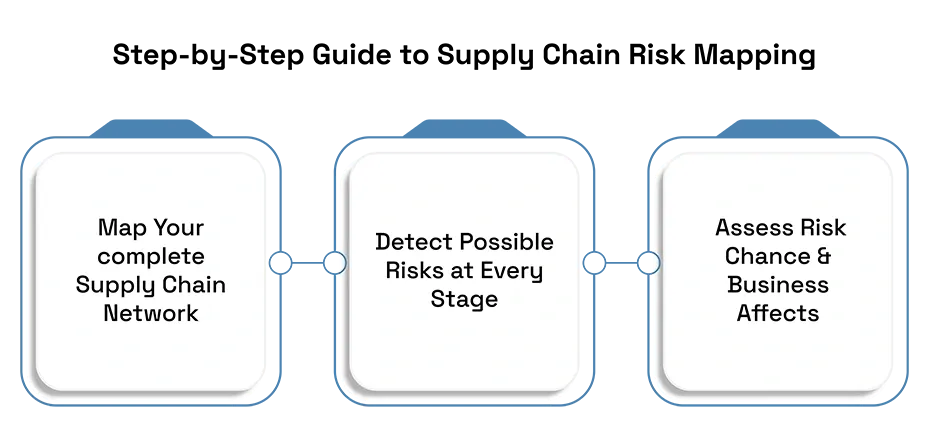
Step-by-Step Guide to Supply Chain Risk Mapping
Step 1: Map Your complete Supply Chain Network
Start by reviewing every part of your supply chain, involves suppliers, productions, warehouses, logistics providers, & shipping routes. Complete clarity helps identify critical dependencies & possible delay points.
Step 2: Detect Possible Risks at Every Stage
Assess each stage of the supply chain to detect risks such as supplier delays, transport delays, & customs issues. First review helps businesses plan effective response planning.
Step 3: Assess Risk Chance & Business Affects
Assess how likely each risk is to happen & the extent of impact it could have on processes. Addressing high-risk areas helps companies assign resources more efficiently.
Step 4: Develop Risk Reduction Planning
Create backup plans to reduce delays by growing suppliers, keeping safety stock, using options shipping routes, & tracking regulatory updates. A proactive approach improves supply chain capability.
Step 6: Use Technology for Real-Time Supply Chain Visibility
Use digital platforms, AI, & planned insight to monitor shipments, supplier performance, & inventory in real time. Better clarity allows faster decision-making & reduces delays.
Step 7: Continuously Checks & Update Your Risk Map
Review your supply chain risk map frequently to show changes in suppliers, rules, logistics networks, or global markets conditions. Constantly following helps organizations stay ready for increasing risks.
The Role of Import Compliance in Supply Chain Risk Mapping
Import adherence is a key component of effective supply chain risk mapping, as every global shipment must meet the destination country’s customs rules, documentation requirements, duties, taxes, or product standards. Companies importing IT equipment, telecom hardware, medical devices, aviation components, or industrial machinery frequently face extra regulatory requirements that growing compliance risks. By including import compliance into their risk mapping plans, companies can minimize customs delays, improve documentation accuracy, avoid regulatory penalties, make sure timely deliveries, & maintain a more strong global supply chain.
Why Importer of Record (IOR) Services Minimize Global Supply Chain Risks
Working with an expert Importer of Record (IOR) service provider is an efficient way to minimize risks associated with global trade. An IOR make sure that imported goods follow with local customs rules by handling import documentation, permits, duties, taxes, & other country-specific requirements. This support is especially valuable for businesses importing controlled or high-value equipment, shipping to countries where they do not have a legal entity, or handling temporary imports. By makes sure compliance & reducing customs delays, IOR services help businesses maintain effective, reliable, & smooth global supply chain operations.
How One Union Solutions Supports Global Supply Chains
One Union Solutions helps businesses simplify global trade with reliable Importer of Record (IOR) & Exporter of Record (EOR) services across 190+ countries. We manage customs documentation, import compliance, duties, taxes, and country-based legal requirements, allowing businesses to import goods without creating a local legal entity. With experience supporting industries such as IT, telecom, medical devices, aviation, data centers, or industrial equipment, we help minimize compliance risks, avoid customs delays, & keep global supply chains moving effectively.
Conclusion
As global supply chains become more complex, businesses must be prepared to identify or handle risks before they affects operations. Supply chain risk mapping provides the clearity needed to monitor supplier connections, shipping challenges, customs requirements, & regulatory compliance. By integrating proactive risk management with expert Importer of Record IOR services, businesses can strong supply chain flexibility & make sure smoother global trade. One Union Solutions helps companies simplify global imports with reliable IOR/EOR services, minimizing compliance risks or keeping cross-border shipments moving effectively.
Did You Know?
Nearly 38% of U.S. industries depend heavily on products sourced from a single country, increasing supply chain risk exposure. This dependency highlights the importance of supply chain risk mapping, supplier diversification, and proactive planning to improve resilience against potential disruptions.
Frequently Asked Questions
What is the difference between supply chain risk mapping & supply chain risk control?
Supply chain risk mapping focuses on analyzing risks across the complete supply chain network, while supply chain risk management includes implementing plans to monitor, reduce, or respond to those detected risks.
Which industries benefit the most from supply chain risk assessment?
Industries such as IT, telecom, medical device, aviation, automotive, production, electronics, & data centers benefit strongly because they depend on complex global supplier networks & strict import regulations.
How frequently should organizations update their supply chain risk map?
Businesses should review & update their supply chain risk maps at least annually or whenever there are important changes such as integrating new suppliers, entering new markets, shifting logistics providers, or addressing to new trade rules or international events.
Can supply chain risk mapping help reduce customs delays?
Yes. Involves customs documentation, import regulations, HS code classification, & country-based compliance requirements in the risk mapping process helps companies prepare correct documentation & reduce border clearance delays.
Why is supplier expansion important in supply chain risk mapping?
Depending on a single supplier increases the risk of production delays. Expanding suppliers across different regions improves supply chain flexibility & make sure business continuity if one supplier faces working challenges.