Definition of real-time compliance monitoring
Real-Time Compliance management refers to the continuous, automated tracking of customer connections, like calls, chats, & emails, to ensure regulatory & privacy policy compliance. When issues occur, helping businesses cover them quickly & avoid fines. The platform uses real-time analytics to detect compliance risks during live calls, ensuring agents stay connected with industry law & regulations.
Real-time management is the quick observation & verification of ongoing processes or events. In contact centers, it added tracking live conversations, agent behaviors, & customer mood to ensure quality & compliance. Real-time tools like Convin give alerts when policy variations or important terms are needed.
Compliance management is added with checking business activities against legal, regulatory, or internal standards. This ensures agents follow management reports, avoid risky language, & manage important data properly. When done in real time, it mainly minimizes compliance risk.
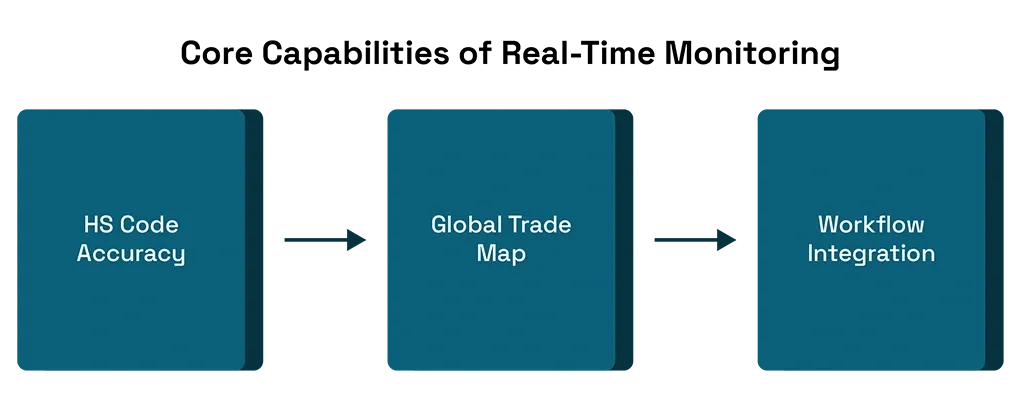
Core Capabilities of Real-Time Monitoring
Automated screening mainly checks trading partners & end-users against global Restricted Party Lists to secure illegal transactions, while license & quota tracking automatically decrements license balances & flags when permit limits or expiration dates are approaching. It also enables Harmonized System (HS) code classification to ensure goods are taxed correctly, minimizing classification errors & navigating supply chain delays. Regulatory updates mainly feed live changes in global trade laws, tariffs, & sanction directly into operational workflows, helping organizations stay updated in real time.
Why Importers & Exporters Need Continuous Visibility
It helps organizations avoid some fines by securing heavy fines, cargo confiscations, shipment delays, & even the loss of export or import rights that can result from violations of difficult trade control regulations. It also significantly minimizes manual errors by reducing reliance on human-driven processes & minimizing data entry mistakes commonly found in spreadsheet-based auditing, thereby improving accuracy & audit readiness. It enables faster customs clearance by pre-validating shipping documentation in advance, ensuring easy processing at ports of entry and helping organizations avoid costly issues, detention fees, & operational issues. Beyond these core advantages, it strengthens whole trade compliance by enhancing visibility across shipments, improving decision-making through real-time validation, & supporting easier cross-border operations in increasingly difficult international supply chains.
Key Technology Solutions & Platforms
For businesses looking to connect real-time compliance systems, modern software solutions offer extensive automation features to secure supply chain operations. PwC Navigate offers the Navigate Customs & Trade platform, which leverages import and export data to support efficient customs risk management & improved decision-making. Regulatory portals streamline government filing processes by digitizing license claims, certifications, & other regulatory submissions, helping organizations improve accuracy, speed, & whole compliance efficiency.
Local Regulatory Focus:
Operating locally under the Reserve Bank of India & the Directorate General of Foreign Trade, Indian importers & exporters must mainly reconcile physical shipments with financial realizations. The Export Data Processing & Monitoring System (EDPMS) & Import Data Processing and Monitoring System (IDPMS) actively monitor this flow to ensure FEMA (Foreign Exchange Management Act) compliance. Automating your internal compliance workflows prevents mismatches on these portals, protecting your business from being placed on the RBI’s “caution list”.
Future of Real-Time Compliance in Global Trade
The future of real-time compliance management is starting to be developed by updated technologies such as artificial intelligence, machine learning, & predictive analytics. These developments will change compliance systems from reactive management to proactive risk security, allowing businesses to predict regulatory issues before they need to.
Blockchain connectivity is also expected to play a main role by improving clarity & traceability across global supply chains, ensuring that every transaction is verifiable & tamper-proof. AI-driven automation will further minimize manual development by intelligently classifying goods, validating documents, & identifying high-risk transactions in real time.
As global trade continues to develop & regulations become more difficult, organizations that adopt intelligent compliance systems will gain a significant complete advantage through faster decision-making, lower operational risk, & improved regulatory confidence.

Conclusion
Real-time compliance management has become an important need for importers & exporters managing in today’s highly regulated & fast changing global trade environment. By enabling continuous visibility into transactions, automated regulatory screening, & quick risk alerts, organizations can mainly minimize compliance risks, financial penalties, & time delays.
As global supply chains grow more difficult & regulations change rapidly, depending on manual checks is no longer sufficient. Real-time systems bridge this gap by developing regulatory intelligence, HS classification accuracy, & automated validation into everyday trade operations. This not only strengthens adherence to global trade laws but also enhances efficiency, transparency, & decision-making across the whole supply chain.
Did you know?
Maersk Container Tracking lets customers follow their cargo from factory to final destination, but it is not a universal solution for every shipper.
FAQ
1. What does real-time compliance monitoring mean in global trade?
It refers to continuously tracking import and export transactions using automated systems to ensure they follow customs laws, trade regulations, and internal compliance rules as they happen.
2. How does real-time compliance monitoring help importers and exporters?
It helps businesses detect violations instantly, reduce regulatory risks, avoid penalties, and ensure smoother cross-border movement of goods with fewer delays.
3. What systems are usually integrated for compliance monitoring?
It typically connects ERP platforms, customs databases, shipment tracking tools, and regulatory watchlists to validate trade transactions in real time.
4. What types of issues can be detected in real time?
It can identify incorrect HS code classification, restricted party matches, missing documentation, license violations, and regulatory mismatches during transactions.
5. Is real-time compliance monitoring useful for Indian exporters and importers?
Yes. It supports compliance with DGFT, RBI, EDPMS, and IDPMS requirements by ensuring accurate reporting, reducing mismatches, and preventing regulatory penalties.