The developing world of eCommerce is changing the global environment, with businesses growing from their local markets to reach customers worldwide. Handling the difficulties of cross-border trade can be difficult. From handling many-currency transactions & global tax compliance to improving transportation logistics & delivering localized customer experiences, businesses face many challenges when entering global markets.
What are Cross-Border API Integrations?
Cross-border API development is the process of connecting different software systems, tools, & services through APIs to update & automate operations in global eCommerce. These developments enable businesses to manage difficult processes, such as multi-currency transactions, worldwide shipping, tax calculations, & localized customer experiences effectively. By linking the gap between platforms, adding eCommerce stores, payment gateways, logistics providers, & tax compliance systems, cross-border API integrations make selling across borders more easy, usable, & cost-friendly.
The main purpose of cross-border API integrations is to update & automate the difficult processes involved in handling global eCommerce operations. These developments enable seamless connectivity between many platforms, tools, & systems, allowing businesses to easily expand their reach into global markets.
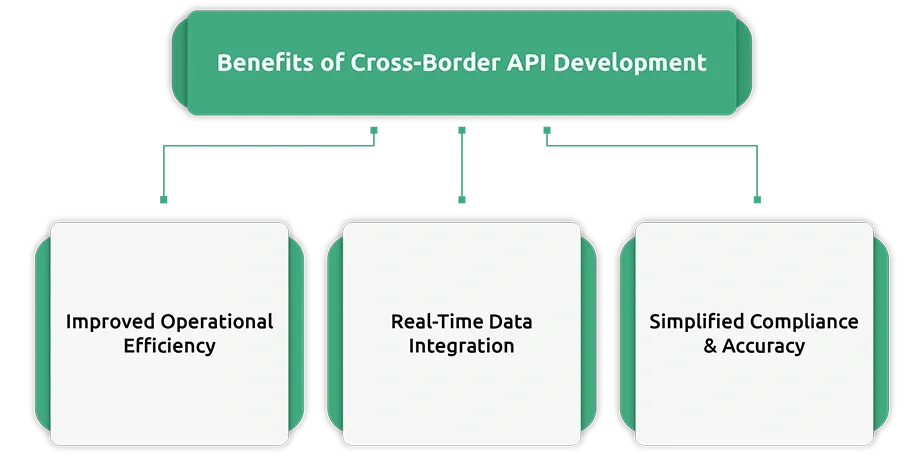
Benefits of Cross-Border API Development
Cross-border API development is useful for businesses planning to develop their e-commerce operations worldwide. They provide the technological backbone to manage difficult global processes easily, improve operations, & enhance customer experiences. Here are the main benefits of cross-border API integrations:
1. Improved Operational Efficiency
Improved operational usability is one of the main advantages of API-connected customs systems. These systems automate important processes such as order processing, tax & duty calculations, transportation documentation, & shipping logistics, mainly minimizing manual effort & reducing the risk of human error. By updating workflows & enabling seamless communication between customs platforms, logistics providers, & enterprise systems, API integrations reduce data system errors & ensure faster, more correct information exchange across the supply chain. This improved connectivity helps organizations enhance trade operations, improve productivity, & achieve easier cross-border transactions.
2. Real-Time Data Integration
Real-time data development enables businesses to manage correct & mainly updated information across many systems & platforms. By automatically updating data such as changing levels, order statuses, shipment details, & customer information in real time, organizations can minimize errors & improve accuracy. This constant flow of updated information provides better visibility into supply chain actions & supports faster, more updated decision-making. Businesses can respond quickly to market changes, improve customer service, & whole operational efficiency in cross-border trade environments.
3. Simplified Compliance & Accuracy
Simplified compliance & improved accuracy are the main benefits of API-connected customs systems in global trade operations. These systems automatically calculate taxes, VAT, GST, tariffs, & import duties for global transactions, minimizing the likelihood of manual errors & ensuring more correct financial issues. They also update customs documentation by automatically managing & verifying country-specific trade documents, helping businesses meet regulatory requirements. Correct declarations & compliance with global trade laws, organizations can minimize shipment delays, avoid penalties, & improve the whole usability of cross-border transactions.
4. Scalability & Growth
API-connected networks support usable & future-ready trade operations by enabling businesses to grow into new platforms, & global regions without completely changing their existing network. This flexibility allows organizations to adapt quickly to transforming market demands while managing operational continuity. As businesses grow, these systems can easily develop into additional tools, services, & technologies, ensuring long-term usability & improved operational speed. This future-ready approach helps companies support global development while managing efficiency, compliance, & constant performance across growing supply chain networks.
5. Cost Savings
API-connected systems help minimize labor costs by automating same & time-intensive tasks such as data entry, customs processing, tax calculations, & shipment tracking. This automation allows businesses to allocate resources more easily toward strategic growth initiatives & customer-focused operations. By using workflows & minimizing manual errors, these systems also reduce operational inefficiencies & unnecessary expenses connected with delays, compliance issues, & rework. organizations can achieve more cost efficiency while improving the speed & accuracy of cross-border trade operations.
Cross-border API development is required for businesses looking to scale globally. By automating processes, ensuring real-time data connectivity, & delivering localized customer experiences, these development update operations & develop efficiency. For companies aiming to succeed in the complete global eCommerce landscape, investing in robust cross-border API development is a strategic step toward sustainable growth & success.
Key Functions of Cross-Border API Integrations
API-connected systems play an important role in supporting global eCommerce & cross-border trade operations by automating multi-currency transactions, added with currency conversion & payment processing in local currencies. They also improve global shipping & logistics by connecting eCommerce platforms with major shipping providers such enabling automated label generation, shipment tracking, & customs documentation. These systems update with tax compliance platforms like Avalara & TaxJar to automatically calculate VAT, GST, tariffs, & import duties across many countries.
Beyond compliance & logistics, API development enhances localized customer experiences by supporting content translation, region-specific payment methods, & customized delivery preferences for global customers. They also update inventory & order management by synchronizing stock levels, warehouse data, & order details across many sales channels worldwide, ensuring better operational visibility & more easily global commerce management.

Conclusion
Cross-border API development is improving the way eCommerce businesses handle the difficulties of global markets. By easily connecting platforms, automating processes, & ensuring compliance with countries requirements, APIs simplify the difficulties of cross-border trade & unlock huge growth potential. For businesses planning to manage globally, investing in fast API solutions is a strategic necessity. These developments provide the foundation for easy inventory management, update shipping, accurate tax managing, & a consistent customer experience across borders.
Did you know?
A total of approximately 3.84 crore filings have been made. And, the security and confidentiality of information submitted are ensured by adhering to ISO 27001 standards and multi-factor authentication to verify the identity of users accessing the system.
FAQs
What are API-connected customs systems?
API-connected customs systems are digital platforms that enable automated communication between customs authorities, logistics providers, freight forwarders, and businesses through real-time data exchange.
How do API-connected systems improve cross-border trade efficiency?
They reduce manual paperwork, accelerate customs processing, minimize data errors, and enable faster shipment clearance through automated information sharing.
What types of trade data can APIs exchange?
APIs can exchange shipment details, customs declarations, invoices, tariff classifications, duty calculations, tracking updates, and regulatory documentation in real time.
Why are API integrations important for global trade compliance?
API integrations help businesses maintain accurate records, ensure timely regulatory reporting, and reduce compliance risks by automatically validating trade data against customs requirements.
Can API-connected customs systems support real-time shipment visibility?
Yes. These systems provide continuous tracking and status updates across supply chains, helping businesses monitor cargo movement, identify delays, and improve operational decision-making.