Insight
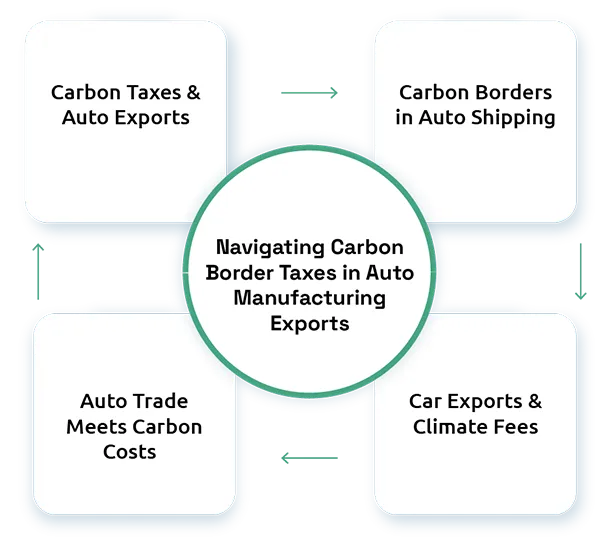
In response to the growing international concern about the need to fight climate change, governments worldwide are enacting new environmental regulations that have far-reaching effects on industries in various sectors. A carbon border tax is one such policy, as it is a regulatory policy that acts to level the playing field amongst countries with varying environmental regulations. Carbon border taxes are also becoming a major factor to consider by automakers participating in international trade, as far as exporting vehicles and parts is concerned. The guide discusses how the automotive OEMs (Original Equipment Manufacturers ) may overcome such carbon border taxes and how such transformations will affect the future of the automotive industry across borders.
What Are Carbon Border Taxes?
Carbon border taxes (CBTs) are the duties imposed on products imported into a country based on the related carbon emissions used to create that product. These taxes will focus on influencing companies in industries that produce large amounts of carbon to minimize the amount of carbon they release through heavily taxing products imported, depending on their carbon footprint. In essence, a CBT is meant to avert the concept of carbon leakage whereby industries move their operations to those nations with lax laws on environmental protection and render any international strategy on climate change futile.
The impact of carbon border taxes can be major in the automotive industry. Imports of vehicles, parts, and components to regions with carbon taxes, e.g., the European Union, might be more expensive if their production process fails to comply with the region’s standards in this respect. This may impact manufacturers’ competitiveness in lower-carbon policy countries.

Impact of Carbon Border Taxes on Automotive OEMs
Carbon border taxes are also being established, and even the automotive OEMs must now accommodate the carbon footprint of their vehicles and existing parts in their innovation. Vehicles manufactured in states with high emission standards will be impacted when sold in another country like the EU, as they will be taxed more, impacting the price, profitability, and ability to compete. This will encourage the OEMs to invest in green materials, such as cleaner production, alternative energy, and electric cars, to reduce their carbon punch and avoid paying tax.
Moreover, the global supply chains under the international supply chain rules may also experience rearrangement due to carbon border taxes that may initiate relocation of production by OEMs to destinations of low emissions or societies with favorable environmental standards. As consumers’ demand shifts to using sustainable products, particularly in the European and North American markets, the automotive players will have no choice but to contemplate the implementation of an eco-friendly approach in a bid to compete effectively.
Navigating Carbon Border Taxes: Key Strategies for Automotive OEMs
The first thing automotive OEMs should do is comprehend the regional laws on pricing and carbon emissions in the markets where they sell their products, like the European Union, the United States, and Canada, where carbon border taxes are underway.
The next step in anticipating policy changes is to keep in touch with developing policies. By being aware of the changes, the OEMs can adjust their manufacturing processes & supply chains beforehand.
To ease the impact of such taxes, OEMs could assume renewable energy, energy-saving technologies, and invest in the production of electric vehicles, which is also consistent with sustainability objectives on the global level. Moreover, national flexibility on carbon credits permits businesses to mitigate the risk of carbon taxes by buying carbon credits, optimizing OEMs to have a low carbon footprint, and reducing the burden of carbon border taxes without being disadvantaged in the global markets.
Market Research Insights
The International Energy Agency (IEA) predicts that CO2 emissions in the transport sector around the globe are likely to increase by 16 percent throughout the 2019-2040 period, which makes it one of the largest sources of emissions globally. To that extent, carbon border taxes act as a hot policy instrument. The Carbon border tax is likely to be instrumental in mitigating or reducing greenhouse gas or net greenhouse gas emission of at least 55% in the European Union as per the so-called Fit for 55 package by 2030. Vehicle manufacturers driving to markets like the EU must adapt to these regulatory shifts and operate their processes to meet more restrictive environmental requirements.
As a result, automotive manufacturers need to closely measure and report the carbon footprint of their vehicles and production processes. Investing in cleaner energy sources, low-emission materials, and sustainable supply chains will become increasingly important. Companies that fail to adapt may face higher costs, limited market access, or reduced competitiveness in carbon-regulated regions. Early compliance can help manufacturers protect their market position and support long-term growth.
Conclusion
Automotive OEMs that trade globally find it more necessary to negotiate their way in the carbon tax at the borders. Such taxes may have major consequences on the cost of production, supply chain, and pricing approaches. However, they are a chance for the automotive manufacturers to invest in cleaner technologies and sustainability and gain a better competitive status in the market. OEMs can overcome carbon taxes at the border and succeed in the changing world marketplace by keeping their heads above water in terms of regulatory changes, investing in reducing their carbon footprint, and using carbon credit systems. One Union Solutions also comprehends how this new regulated environment burdens automotive companies, and we are determined to assist industries by optimizing global trade processes and reducing their environmental profile.
Did You Know that,
The proposed carbon border tax in the European Union would increase the cost of imported merchandise, such as that on automotive products, by up to 10%-20%. The tax will affect industries with high carbon output, keeping the producers using cleaner production techniques to cut down the expenses.
FAQ’s
Q1: How do carbon border taxes work, and how do they affect automotive exports?
Carbon border taxes are applied to imported goods based on the carbon emissions created during manufacturing. For automotive exports, this can increase costs when selling to regions that price carbon emissions, such as the European Union.
Q2: What can automotive OEMs do to reduce the impact of carbon border taxes?
OEMs can lower emissions by using cleaner technologies, improving production efficiency, and purchasing carbon credits to offset their carbon footprint.
Q3: Which countries have introduced or plan to introduce carbon border taxes?
The European Union has already introduced carbon border measures. Other countries, including the United States and Canada, are expected to consider similar policies.
Q4: What are carbon credits, and how can they help automotive OEMs?
Carbon credits represent reduced greenhouse gas emissions. OEMs can buy these credits to balance their emissions and meet carbon pricing rules, helping reduce the impact of carbon border taxes.
Q5: How will carbon border taxes affect the global automotive supply chain?
Carbon border taxes may push OEMs to move production to lower-emission countries, adjust sourcing strategies, and invest in greener manufacturing to avoid higher tax costs.