Insight
The introduction of Carbon Border Taxes (CBTs) is changing global trade by increasing import duties and tariffs on carbon-intensive goods. These environmental levies impact global freight logistics services, as organizations must now factor in carbon-related costs when planning supply chain work. Understanding the Exporter of Record service becomes necessary in this context, as exporters are responsible for agreements with environmental and customs regulations during cross-border logistics. As CBTs change sourcing and distribution plans, businesses that use sustainable logistics and cleaner production practices will gain a competitive edge in global trade.
What Are Carbon Border Taxes?
Carbon Border Taxes are tariffs levied on imports by countries according to carbon emissions that go into producing goods. These taxes prevent companies from relocating their production facilities to regions with less strict environmental regulations and motivate cleaning up and more sustainable production procedures.
The idea of CBTs involves the wider process of tackling climate change and the belief that every nation can play its fair role in curbing global emissions. Although the sharpest lodestone is on the carbon-intensive industries, the taxes will likely have far-reaching effects on global trade and supply chain activities.

The Global Impact on Supply Chains
Increased Costs for Carbon-Intensive Imports
Among the major impacts of the CBTs, the escalation of imported goods costs is the leading cause. Carbon-intensive industries like energy generation will be forced to pay higher tariffs upon exporting to countries with the CBTs. Such expenditures will most probably be transferred to the consumer side, leading to a rise in prices of goods in the targeted industries.
This causes new complexities in the case of global supply chains. Global manufacturers might have to reconsider their sourcing policies and seek solutions to minimize their products’ carbon footprint to remain competitive. The companies will also be required to estimate the cost consequences of such taxes when planning international trade routes.
Change of sourcing policies
As CBTs increase, companies will prefer sourcing products in countries with higher environmental regulations to evade the tax’s financial implications. Consequently, the production centres in the world market might change as the producers relocate to those places where the environment allows them to exercise these stronger environmental requirements or switch to a more environmentally friendly way to lessen their carbon usage.
Indicatively, automobile manufacturing and IT industries can consider sourcing materials and components in countries that focus on clean energy and carbon reduction technologies, eventually driving the establishment of factories and assembly lines worldwide.
Green Technology and Adoption of Innovation
Industries will have to innovate and embrace green technologies to prevent or lessen the outcomes of CBTs. In areas like aviation, cars, and information technology, this may imply an even more rapid transition to electric cars (EVs), power-efficient information centres, and zero-carbon aviation fuels.
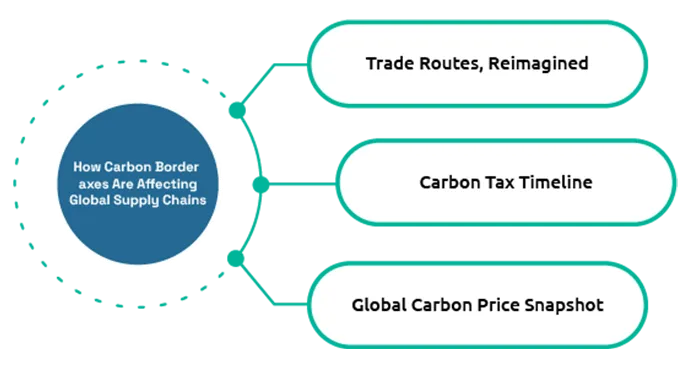
Key Hubs Affected by Carbon Border Taxes
Carbon Border Taxes (CBTs) have crucial effects on the aviation and automobile manufacturing sectors, I T/data centres, and the medical equipment industries. One of the most carbon-intensive industries, aviation, is vulnerable to countries such as the European Union and the U.S. to cut emissions, contributing to sustainable aviation fuels (SAFs) and aircraft fuel efficiency. On the same note, the car industry, especially in Europe, Japan, and the United States, is gradually moving to electric car technology (EVs) and hybrid vehicles to avoid carbon-intensive cars, which attract fines.
The factor demanding data centres to adapt to an alternative energy supply, particularly in the carbon-heavy regions, is the increased tax they will be required to pay on importing new technology. The trend of green power projects has started gaining popularity in some of the biggest technological hubs, such as Silicon Valley. The last of all is the medical equipment industry, which has to do its part to become compliant with the new rules to make sure that it does not get penalized, and that too by switching to more environmentally friendly production methods, including the usage of environmentally friendly materials and cleaner production processes as well.
Conclusion
The emergence of the Carbon Border Tax is shifting the global supply chain, specifically for carbon-intensive industries, such as aviation, automobiles, IT, and medical equipment. These taxes are not just escalating the expenses. Still, they are also opening up new possibilities for companies willing to be innovative and environmentally friendly. One Union Solutions is aware of the necessity of our society making these changes and assisting businesses in maintaining in line with regulations & succeeding in the age of environmental awareness.
By adopting greener technologies and sustainable practices, companies can reduce their carbon footprint and lower tax liabilities. This also helps improve brand reputation and meet customer expectations for environmentally responsible operations. Strategic planning and expert guidance make it easier to navigate these changes without disrupting the supply chain. Ultimately, businesses that act proactively can turn environmental compliance into a competitive advantage.
Did You Know,
The carbon border adjustment mechanism – CBAM offered by the European Union might cover more than 40% of the global imports. In 2021, the EU witnessed a 108% growth in the sales of electric automobiles, fueled by improved emissions standards and potential carbon-related tariffs.
FAQs
1. What does a Carbon Border Tax mean?
A Carbon Border Tax is a levy on imported goods based on the carbon emissions generated during their production. Its goal is to ensure fair competition between countries with different environmental standards.
2. How will Carbon Border Taxes affect global supply chains?
These taxes increase the cost of importing goods made through carbon-heavy processes. Companies will need to adopt cleaner production methods to stay competitive and reduce tax liabilities.
3. Which sectors are likely to be most impacted?
Industries with high carbon output, such as aviation, automobile manufacturing, IT/data centers, and medical equipment, will feel the biggest impact from Carbon Border Taxes.
4. What strategies can companies use to reduce the impact of these taxes?
Businesses can invest in renewable energy, energy-efficient technologies, and low-emission vehicles. Using greener production methods helps lower carbon output and reduces the taxes they have to pay.
5. Why is investing in green technologies beneficial beyond tax savings?
Green technologies not only reduce costs but also ensure regulatory compliance, improve a company’s brand image, and encourage innovation. They help businesses stay competitive in a market increasingly shaped by carbon regulations.