Introduction
The global economy in the modern world deals with trade policies as one of the most significant factors that influence the mode of operation of industries. The automobile parts industry is not different. The ability to change tariffs, frequently depending on the government’s trading business, affects how businesses import auto elements and organise their delivery chains. These changes affect how parts are priced, available, and require more business flexibility & strategies to operate smoothly. The key to overcoming the challenges of import and distribution may lie in understanding how these changes affect the industry. The change of the global supply chain inter-connectivity is becoming more intertwined, with alterations in tariffs being both a burden and an advantage. Companies must evolve to keep up with demand, simplify their supply chain, and save money.

Service Overview
As far as auto parts imports are concerned, companies are to cope with a series of issues & challenges: soaring tariffs, changing customs regulations, and growing prices. Importers must consider new market opportunities, replace suppliers, and reconsider their transportation policies. It is no longer only about the price of the part itself; it is about the entire supply chain ecosystem. A new partner that is trusted & strategic is needed to find their way around these complexities and limit the consequences of tariff changes. Businesses require an all-inclusive service model that covers all supply chain management issues, including sourcing and transportation. This includes:
- Working with complicated regulations on imports and exports.
- The timely deliveries of goods.
- Being transparent in every process.
- Providing affordable services to help counter the increase in tariffs.
- Under such conditions, an alliance partner with good knowledge on dealing with a tariff change becomes priceless.
Key Hubs for Auto Parts Imports
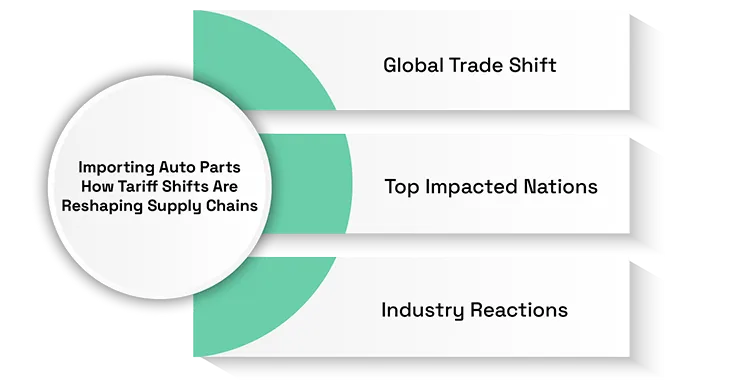
Importation of the auto parts relies largely on international hubs. North America, Europe and Asia are some major areas where auto parts are imported, notably with the leading countries being China, the United States and Germany, respectively. Ripple effects may occur in these countries because of tariff changes, which affect the supply chain globally.
China: China is a key exporter of auto components, perhaps the most significant contributor to the car component business in the whole automotive industry, and supplies worldwide.
The United States: As local production grows, tariff changes can open-up the possibilities for American auto-makers to obtain more parts from the US or low-tariff countries.
Germany: Germany plays a very important role in the automotive business, so its import/export policies dramatically affect the global supply chain of European auto parts.
Some of these areas require companies to update themselves on the tariff changes to keep the supply chains as efficient as possible.
Main Service Benefits and Features
Logistical expertise is not sufficient when it comes to importing autoparts into a rapidly changing tariff environment. It requires good knowledge of trade policies and a flexible and reactive manner. Businesses can take advantage of the appropriate solutions in the following way:
Cost Optimization:
It is possible to optimize cost in terms of imports by analyzing the impacts of tariffs and developing an alternative source to minimize the cost in terms of tariff increases.
More Quick Adaptability toward Market Dynamics:
A dynamic logistics and sourcing procedure allows businesses to adapt to trade policy changes rapidly.
Regulatory Compliance:
Trade regulations are complicated, and to prevent fines and delays incurred by doing the wrong thing, it helps to have an expert on your side.
Better Supplier Relationships:
Building proper relations with the suppliers may bring in better terms, which will help offset some of the extra costs that the rise of the tariffs has brought about.
As tariffs change, adaptability and the capacity to make data-driven changes quickly are the key to keeping a great supply chain flowing.
Conclusion
At One Union Solutions, we know the complexities of importing auto parts and how tariff shifts redefine the world supply chain. We assist companies in meeting the ever-changing trade environment, offering cost-efficient solutions and providing timely deliveries using our expertise. Thereby, by being on top of regulatory changes & taking care of good supplier relations, we ensure that our clients can still stay in the competitive market.
We also help businesses plan by evaluating suppliers, optimizing transportation, and managing documentation to avoid delays. Our team monitors trade policies closely, ensuring clients remain compliant with all regulations. With our support, companies can reduce costs, prevent supply chain disruptions, and maintain smooth operations. This proactive approach allows clients to focus on growth while we handle the complexities of importing auto parts.
Did You Know that,
A 10% increase in tariffs on imported auto parts could lead to a 2% increase in the final cost of a vehicle. This increase not only affects vehicle pricing but also trickles down to impact the consumer market and the overall economy.
FAQs
1. How do tariff changes affect the cost of auto parts?
Tariff changes increase the cost of imported goods by adding taxes. This makes auto parts more expensive to import and sell.
2. How can a logistics partner help with tariff changes?
A logistics partner can evaluate new suppliers, manage transportation costs, and ensure regulatory compliance to help businesses adapt to changing tariffs.
3. How can companies stay competitive despite higher tariffs?
Companies can reduce the impact of higher tariffs by diversifying suppliers, making smarter purchasing decisions, and maintaining strong relationships with trusted vendors.
4. Do tariff changes only affect auto parts imports?
No. Importing auto parts is also influenced by customs rules, transportation regulations, and potential supply chain disruptions.
5. How can companies stay compliant with changing trade policies?
Collaborating with legal experts, trade specialists, and reliable logistics partners helps businesses stay updated on trade policy changes and remain fully compliant.