We live in a world where everything is connected to each other. This means that any business can now do trade with businesses, around the whole globe. When we do business in industries things can get really complicated. This is especially true when we try to figure out who is in charge of the Incoterms. Incoterms are like a set of rules that everyone follows. They make it clear what the buyer and the seller are responsible for when it comes to shipping goods. Incoterms define who pays for what when goods are being shipped and they help us know who is responsible for transportation costs. The terms also show who takes the risk during shipping. They break down the costs at each stage of moving goods from one place to another. Incoterms play a role in global trade because they help buyers and sellers understand their responsibilities.
What Are Incoterms and Why Do They Matter?
Incoterms are like a set of rules that everyone follows. The International Chamber of Commerce makes them. These rules help prevent confusion when countries do business with each other.
In international trade, it is crucial to clearly define who arranges transportation, who pays for freight and insurance, when the risk transfers from the seller to the buyer, and who is responsible for customs clearance. These factors directly impact the cost, control, and risk associated with a shipment. Without a proper understanding of these responsibilities, businesses may face shipment delays, unexpected expenses, and serious compliance issues that can disrupt the entire supply chain.
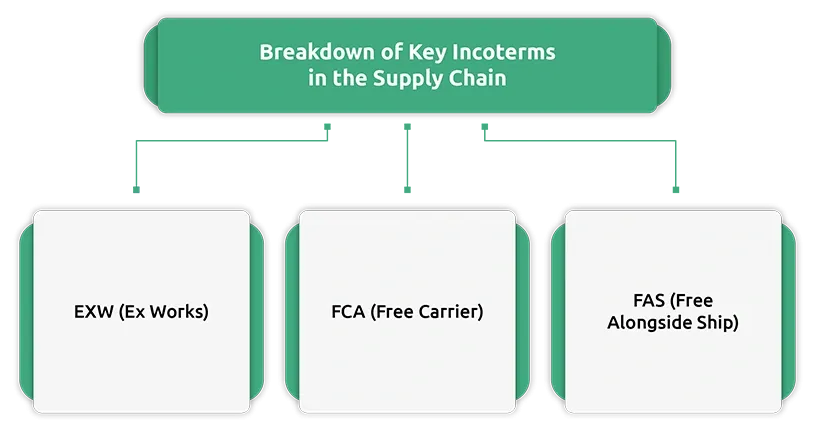
Breakdown of Key Incoterms in the Supply Chain
EXW (Ex Works) – Maximum Responsibility for Buyer
Under EXW, the seller makes goods available at their premises. The buyer handles everything—from pickup to export documentation, international freight services, and delivery.
This term requires strong logistics coordination and often involves hiring an Importer of Record Service or customs expert.
FCA (Free Carrier) – Shared Responsibility
The seller delivers goods to a carrier or designated location. After that, the buyer takes over.
FCA is commonly used in multimodal transport and works well with modern supply chain optimization strategies.
FAS (Free Alongside Ship) – Port-Based Delivery
The seller places goods alongside the vessel at the port. The buyer manages loading, freight, and risk thereafter.
This is widely used in bulk shipping industries such as agriculture and raw materials.
FOB (Free On Board) – Risk Transfers at Loading
Here, the seller is responsible until goods are loaded onto the vessel. Once loaded, risk shifts to the buyer.
FOB is one of the most widely used terms in international freight services, especially for sea shipments.
CFR / CIF (Cost and Freight / Cost, Insurance, Freight)
CFR: Seller pays for transport, but risk transfers at shipment.
CIF: Seller also includes insurance coverage.
These terms simplify shipping for buyers but require sellers to manage more complex exporter of record services.
DAT (Delivered at Terminal)
The seller is in charge of getting the goods to a place, at the port where the buyer is. This special place is called a terminal. When the goods get to the terminal the buyer takes over.
This term is useful when businesses want partial control over delivery without managing full inland transport.
DAP (Delivered at Place)
Under DAP, the seller delivers goods to a specified destination, but the buyer is responsible for import duties and taxes.
This term is frequently used in e-commerce and high-value shipments where inventory and order management must be precise. They have to make sure their inventory and order management is done right. This term is really important for inventory and order management, in these situations.
DDP (Delivered Duty Paid) – Maximum Responsibility for Seller
DDP places the highest responsibility on the seller, including delivery, duties, taxes, and customs clearance.
It’s ideal for buyers who want a hassle-free experience but requires sellers to have strong expertise in customs clearance and compliance.
The Role of Compliance and Documentation
International trade isn’t just about moving goods—it’s about following regulations. Documentation like HS code classification and the HTS harmonized tariff Schedule determines duties, taxes, and legal requirements.
Businesses often want to know: can the person who helps us with customs called a customs broker handle the paperwork for both import and export of that country?
The answer is yes—many experienced brokers and service providers manage both sides, ensuring smooth transactions and regulatory compliance.
To further simplify operations, companies are now adopting the best trade compliance software for import export rules, which automates classification, documentation, and risk assessment.
Logistics and Supply Chain Efficiency
Choosing the right Incoterm plays a critical role in determining overall logistics efficiency and cost distribution in international trade. For instance, EXW minimizes the seller’s responsibility but shifts the entire burden of transportation, risk, and documentation onto the buyer, often increasing complexity. On the other hand, DDP offers maximum convenience to the buyer by placing nearly all responsibilities, including duties and delivery, on the seller—though this significantly raises the seller’s costs and compliance requirements. Meanwhile, terms like FOB and CIF provide a more balanced approach, distributing responsibilities between both parties and making them popular choices for managing risk and cost effectively in global shipments.
Modern businesses are integrating supply chain optimization tools to select the most cost-effective and risk-efficient Incoterms.
Importance of Importer and Exporter Roles
Every international shipment involves two key roles:
Exporter of record services: Responsible for compliance in the exporting country. Importer of record Service: Handles with all the rules and fees for bringing things into the country and they also take care of the paperwork for the international shipment
These roles are really important when we are talking about shipping things such as IT equipment, medical devices, or automotive components.
Generalized System of Preferences (GSP) and Trade Benefits
The generalized system of preferences (GSP) is a trade program that allows certain goods from developing countries to enter markets with no tariffs or less tariffs.
Understanding Incoterms and how they work with programs like these can help businesses save money and improve competitiveness in global markets.
Challenges in Managing Incoterms
Despite their benefits, Incoterms can be misused or misunderstood. Common challenges include:
- Incorrect selection of terms
- Misalignment with contracts
- Lack of clarity on risk transfer
- Poor coordination in international freight services
This is why businesses must combine Incoterm knowledge with strong inventory and order management systems and compliance strategies.
Conclusion
Incoterms are really important for trade. They are not big words that people use in business. Incoterms are the foundation of how countries trade with each other. From EXW, to DDP each Incoterm explains when the seller is no longer responsible and the buyer takes over.
The world of trade is changing really fast so you have to understand Incoterms. This is not something you can ignore, it is necessary for doing in this field. Understanding Incoterms is crucial for customs clearance and it is really important to get it right.
DID YOU KNOW
“Incoterms are a set of 11 globally recognized trade rules that clearly outline the responsibilities of buyers and sellers in international transactions.”
FAQs
What are Incoterms and why are they important in international trade?
Incoterms are standardized trade rules that define the responsibilities of buyers and sellers in global transactions. They clarify who handles transportation, risk, insurance, and customs clearance, helping avoid disputes and delays in logistics operations.
Which Incoterm is best for minimizing risk for buyers?
DDP (Delivered Duty Paid) is often the best option for buyers because the seller handles almost everything, including shipping, duties, and customs clearance. However, it may increase overall costs compared to terms like FOB or FCA.
How do HS code and HTS harmonized tariff Schedule impact shipments?
The HS code and HTS harmonized tariff Schedule are used to classify goods internationally. They determine applicable duties, taxes, and compliance requirements, making them essential for smooth Importer of record Service and export processes.
Can a customs broker handle both import and export documentation?
Yes, many customs brokers offer end-to-end support and can manage both import and export documentation. This is especially useful for businesses using exporter of record services and International freight services, ensuring compliance across borders.
How do Incoterms support supply chain optimization?
Choosing the right Incoterm helps businesses balance cost, control, and risk. When combined with efficient inventory and order management and the best trade compliance software for import export rules, Incoterms play a key role in effective supply chain optimization.