Overview
Governments globally are increasingly using advanced data analytics to identify undervaluation in cross-border trade. Under-valuation occurs when imported or exported goods are declared at prices lower than their true market value, reducing payable duties and taxes. This method stops fair competition, weakens revenue collection, and creates approval risks across the global logistics chain. Modern customs administrations now depend on intelligent platforms that combine customs clearance records, international freight services, and importer profiles to highlight irregularity in declared values. This change allows governments to move from reactive execution to proactive risk-based tracking.
Key Applications and Mechanisms to Identify Under-Valuation
Data Integration Across Trade Ecosystems
One of the primary applications of data analytics is to combine information from multiple sources. Governments connect customs declarations with shipping, inventory, and order management systems, and commercial invoices to create a combined trade intelligence system. This allows authorities to compare declared values against historical imports, global pricing standards, and commodity-level averages.
Risk Scoring and Automated Targeting
Governments mostly use risk-scoring methods to prioritize inspections. These models assess variables such as importer history, shipment frequency, routing behavior, and valuation trends. Organizations working as an Importer of Record Service or using exporter of record services can be evaluated in real time, allowing authorities to focus resources on transactions with the highest probability of under-valuation.

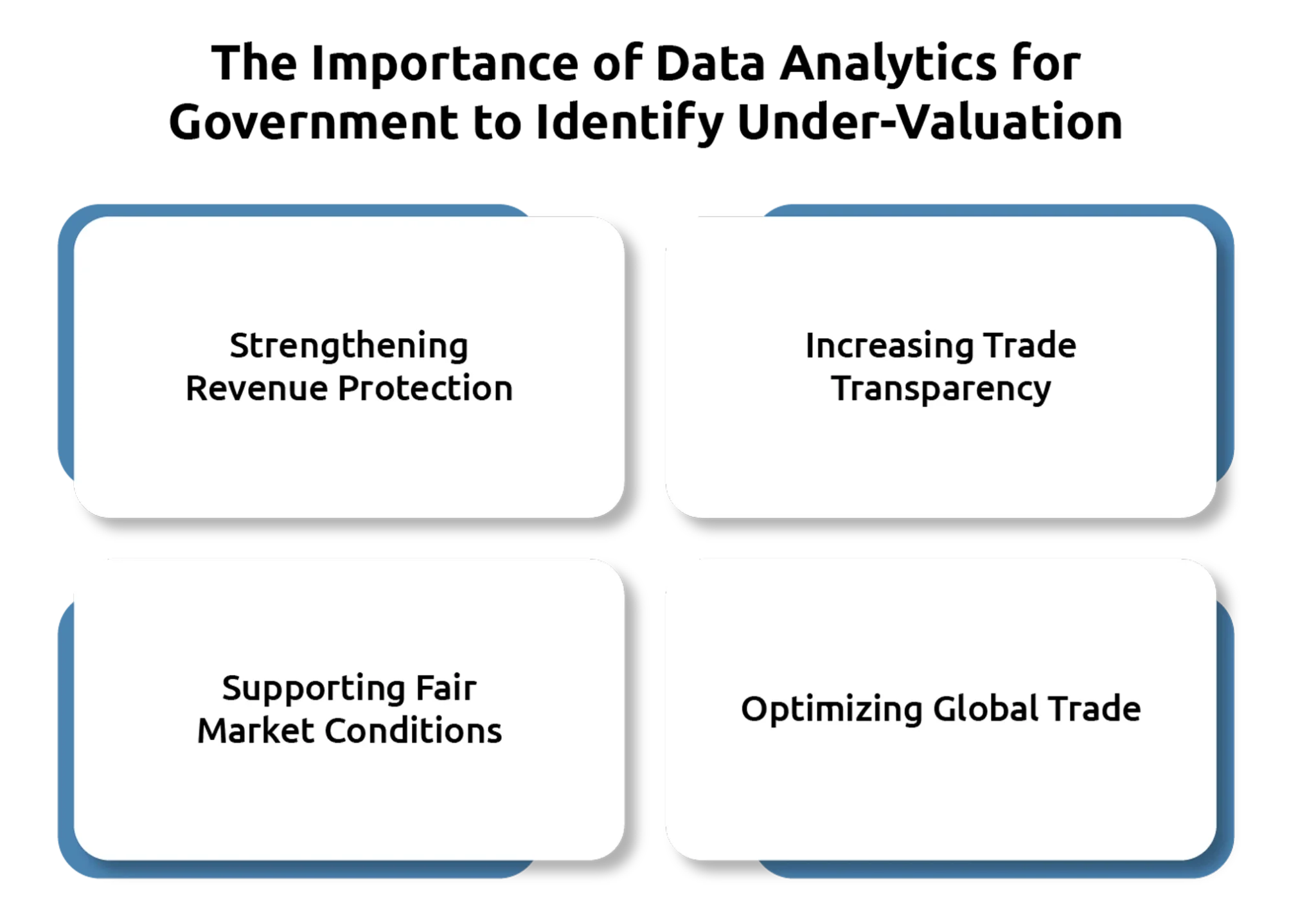
The Importance of Data Analytics for Government to Identify Under-Valuation
Strengthening Revenue Protection
Accurate valuation is necessary for safeguarding public revenue. Data analytics allows governments to quickly identify undervalued shipments that may otherwise pass through customs clearance unchecked. Automating valuation checks, authorities reduce dependency on manual audits and improve recovery of lost duties and taxes.
Increasing Trade Transparency
Advanced analytics advance clarity across global trade passage. Tracking data from logistics providers, port systems, and international freight services, governments gain a clearer view of end-to-end shipment processes.
Supporting Fair Market Conditions
Under-valuation twisted competition by allowing non-compliant traders to undercut legal businesses. Analytics-driven execution protects compliant companies, such as freight forwarding companies near me and regulated logistics providers, confirming that lawful trade practices are not undermined by pricing changes.
The Role of AI and Machine Learning to Identify Under-Valuation
Predictive Modeling and Continuous Learning
Artificial intelligence increases data analytics by allowing systems to learn from historical outcomes. Machine learning methods study previously confirmed under-valuation cases and develop predictive profiles that develop. As new data enters the system, these methods refine their accuracy and improve efficiency.
Behavioral Analysis of Trade Participants
AI systems go beyond static thresholds. They evaluate behavioral patterns of importers, exporters, and intermediaries involved in international shipping terms and documentation workflows. Sudden shifts in declared values, routing strategies, or transaction volumes can trigger alerts, even when individual shipments appear routine.
Real-Time Decision Support
Integrating AI into customs platforms allows governments to support officers with real-time insights. When shipments connected to certain inventory and order management inconsistency or valuation irregularity arrive, inspection teams receive prioritized alerts, accelerating enforcement without slowing legal trade.
Challenges of Implementing Data Analytics to Know Under-Valuation
Data Quality and Integration Issues
Effective analytics depends on accurate and systematic information. Disparate systems across ports, customs, and the logistics chain frequently reduce system compatibility. Inconsistent documentation formats and incomplete records can weaken the dependability.
Technical and Institutional Readiness
Deploying advanced analytics requires a skilled trainer, a secure infrastructure, and expert partnership. Many administrations face challenges aligning legacy systems with modern AI-driven tools, mainly when working with external logistics and customs clearance.
Balancing Enforcement and Trade Facilitation
Governments must confirm that increasing tracking does not create unnecessary friction. Over-reliance on automated banners can slow cargo shipment if not calibrated carefully. Successful implementation balances fraud detection with the requirements to support effective international freight services and compliant trade operations.
Conclusion
Governments’ use of data analytics to identify under-valuation represents a critical evolution in modern trade executives. Combining large-scale data, applying AI insights, and automating risk evaluation, authorities can detect valuation for greater precision and speed. As analytics ability continues to grow, governments will be better positioned to protect borders, support the legal logistics chain, and maintain trust across global trade.
DID YOU KNOW?
However, there is a clear sense that progress needs to be accelerated, as 58% of respondents believe that the government and the public sector need to implement this process more quickly.
FAQs:
1. What is under-valuation in international trade?
Under-valuation occurs when goods are declared at prices lower than their real market value to reduce customs duties and taxes, creating revenue loss and unfair competition.
2. How does data analytics help governments identify under-valuation?
Data analytics integrates customs records, shipping data, and historical pricing to compare declared values with benchmarks, helping authorities detect irregular patterns.
3. What role does AI play in customs under-valuation detection?
AI and machine learning analyze past fraud cases, monitor behavioral trends, and generate predictive risk scores that support real-time inspection decisions.
4. How do risk-scoring systems improve customs enforcement?
Risk-scoring models prioritize high-risk shipments based on importer history, routing behavior, and valuation trends, allowing efficient allocation of inspection resources.
5. What challenges do governments face when implementing data analytics?
Major challenges include poor data quality, system integration issues, limited technical expertise, and balancing strong enforcement with smooth trade facilitation.