Insight
Companies operating within the aviation sector face various difficulties in global trade, including managing increasing import expenses and customs process complexity. Implementing Free Trade Zones (FTZs) creates an effective solution that decreases such costs. Business operations within FTZs obtain a strategic framework that helps them reduce import taxes while expediting supply chains and meeting international trade requirements. Jet operators that use Free Trade Zones obtain significant financial benefits, enhanced operational effectiveness, and improved position in the global market.
What Are Free Trade Zones (FTZs)?
Free Trade Zones / FTZs are designated areas that enable businesses to import and manufacture goods without customs duties, simplifying international trade. Airplane maintenance businesses especially can utilize FTZs through price control mechanisms that lower costs on imported parts and materials and local content calculation, which assists companies in meeting tax benefits through local sourcing requirements. Finally, FTZs lessen operational expenses, simplify logistics operations, provide a competitive edge, and are an invaluable source of cost-cutting operations, making them essential resources for cost-efficient aviation businesses!
FTZs also allow companies to store goods for longer periods without immediate tax liability, improving cash flow management. They provide flexibility in supply chain planning, helping businesses respond quickly to market changes. By streamlining customs procedures, FTZs reduce delays and minimize compliance risks. Businesses can combine local and imported materials efficiently, maximizing production and export potential. Overall, FTZs help aviation companies save costs, improve efficiency, and stay competitive in the global market.
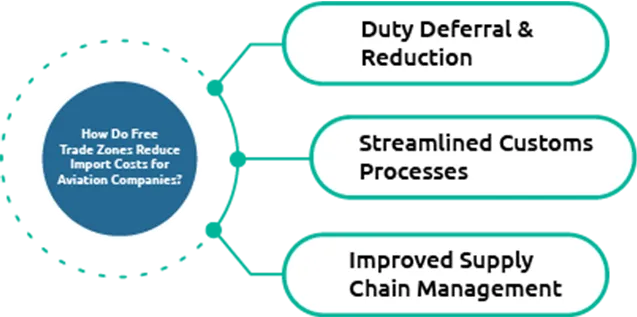
How Do Free Trade Zones Reduce Import Costs for Aviation Companies?
Duty Deferral & Reduction
Most production activities pay significant fees or taxes when using customs hubs or FTZs. For importers, FTZ (Foreign Trade zones) may defer paying duty on imports until they pass through the domestic market or re-export. It can benefit cash flow and drive down import costs even further through trade agreements holding where they are in the FTZ.
Streamlined Customs Processes
FTZs facilitate customs clearance by providing pre-approved zones where goods can be processed quickly without extensive documentation or long wait times, expediting parts and equipment clearance time and shortening market delivery for aviation products. Customs officers are stationed within FTZs to monitor clearance activities while facilitating smooth imports.
Improved Supply Chain Management
The application of FTZs enhances aviation company warehouse operations. The supply chain becomes more efficient because FTZs enable the storage of goods before their required use, reducing unnecessary storage expenses. Through economies of scale, companies reduce shipment costs by consolidating their deliveries, reducing the expense and time required for numerous smaller packages.
Warehouse Logistics and Inventory Management
Within FTZs, companies can store inventory with deferred customs duties until the goods undergo transfer for utilization. The unlimited storage benefit finds particular value in the aviation industry due to the need to import expensive equipment and components regularly. FTZs enable businesses to store goods indefinitely without being charged for extra storage expenses for upcoming demand duration.
Foreign Trade Investment Incentives
The operating businesses in FTZs receive government financial support through benefits, including tax exemptions, reduced customs duties, and development funds for international trade programs. FTZ operations become more appealing to aviation companies because of the incentives that lower their business expenses connected to aviation goods processing.
Compliance and Risk Reduction in FTZs
The regulations of aviation companies can be safely managed by choosing to operate in a free trade zone. FTZs follow foreign trade policies to simplify customs clearance processes; thus, companies stay compliant without experiencing procedural delays. Using free trade zones helps aviation companies avoid fines, penalties, and shipment delays. FTZs enable aviation firms to benefit from the Generalized System of Preferences (GSP) because this system provides preferential tariff treatment based on products’ origin countries. FTZs provide additional savings to aviation operations by reducing purchasing expenses for necessary imported aviation components.
The Role of FTZs in Global Trade and Tariff Uncertainty
FTZ facilities protect aviation businesses from trade tariff uncertainties in the global marketplace. An FTZ location provides companies with an operational buffer that minimizes the effects when tariffs rise unexpectedly. The FTZ enables companies to keep goods in storage to avoid unnecessarily high tariff expenses when changing market tariffs.
Conclusion
Free Trade Zones act as essential resources for aviation companies that want to cut import expenses while upholding compliance regulations for international trade. FTZs enhance aviation businesses by implementing reduced import duties while simplifying customs procedures and extending supply chain adaptability, which reduces operational costs. The increasing complexity of global trade makes FTZs important tools that assist companies in maintaining pricing competitiveness, reducing their tariff exposure, and improving logistics operations. One Union Solutions specializes in leading businesses through FTZ utilization and international trade advantages implementation practices to achieve efficient and cost-efficient operations.
Did you know,
According to recent market research, over 3,000 FTZs are operational worldwide, offering various benefits to companies involved in global trade.
FAQs
What types of goods can be stored in Free Trade Zones?
FTZs can store many types of goods, such as aviation parts, machinery, electronics, and production components. Customs duties are only applied when the goods leave the FTZ to enter the domestic market.
How do Free Trade Zones help businesses reduce tariffs?
FTZs allow companies to import goods for production or export without paying immediate tariffs. This helps reduce costs on imported inputs used in manufacturing or re-export.
Do Free Trade Zones improve supply chain management?
Yes. FTZs lower storage costs, allow longer storage periods, and make supply chains more flexible. This simplifies warehouse management and helps aviation companies respond faster to market changes.
How do Free Trade Zones help with compliance?
FTZs simplify customs procedures, making it easier to meet international trade standards. They reduce risks of fines, penalties, and shipment delays caused by non-compliance.
Why do businesses benefit from operating in an FTZ?
Governments often offer tax incentives, reduced tariffs, and grants for companies in FTZs. These benefits lower import costs and encourage businesses to set up operations within these zones.