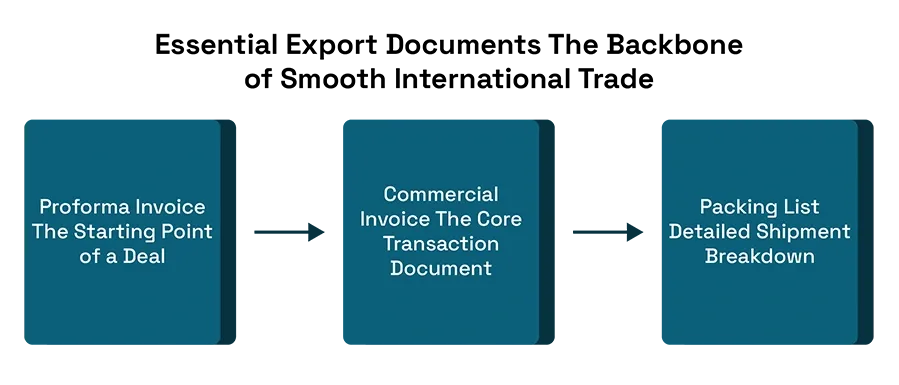
When we talk about trade the paperwork is really important. It is not something we have to do, it is the base that makes sure everything goes smoothly when we send things to other countries. Global trade needs documentation to work properly. Whether you are a first-time exporter or an experienced trader, understanding essential export documents is critical to avoiding delays, penalties, and compliance risks. The image above highlights the most important documents required in export transactions, each playing a unique role in the shipping process.
Proforma Invoice: The Starting Point of a Deal
A proforma invoice is a document that the exporter shares with the buyer before they confirm the shipment. It outlines product details, pricing, payment terms, and delivery conditions. Buyers often need a proforma invoice to get permits or financing for the product. A proforma invoice is very important, for both the buyer and the exporter.
Commercial Invoice: The Core Transaction Document
The Commercial Invoice is one of the most important documents in export. It acts as proof of sale between the buyer and seller and includes details such as product description, value, quantity, and terms of trade. Authorities use it during customs clearance to assess duties and taxes.
Packing List: Detailed Shipment Breakdown
A Packing List provides a detailed description of how goods are packed, including weight, dimensions, and packaging type. This document is for customs officials, freight forwarders and warehouse teams to check shipments. It helps them ensure everything is correct and manage inventory well. The document has all the information needed to verify a shipment. Customs officials and freight forwarders use packing lists to do their job.
Certificate of Origin: Verifying Product Source
The Certificate of Origin certifies the country where the goods were manufactured. It is essential for determining eligibility under trade agreements such as the generalized system of preferences (GSP) and ensures accurate duty calculations based on the HTS harmonized tariff schedule.
Bill of Lading: Proof of Shipment
The Bill of Lading (B/L) is issued by the shipping carrier and serves as a receipt for goods, a contract of carriage, and a document of title. It is widely used in sea freight and plays a key role in International freight services.
Air Waybill: For Air Shipments
The Air Waybill (AWB) is similar to the Bill of Lading but is used for air cargo. It provides shipment details and tracking information, ensuring smooth coordination in time-sensitive shipments.
Shipping Bill: Export Clearance Document
The Shipping Bill is a mandatory document filed with customs authorities for export clearance. This document has information about the goods. The Shipping Bill also has details about the exporter and where the goods are going.
The Role of Compliance in Export Documentation
Getting the paperwork right is really important when you are exporting. If you do not do it correctly your shipment might be late. You might have to pay a fine. You need to make sure you use the HS code so that your goods are put in the right category. The HTS harmonized tariff schedule is also very important because it helps figure out how duty you have to pay on the goods you are sending. Using the HTS tariff Schedule and the HS code correctly is crucial, for avoiding shipment delays and penalties on your goods.
Businesses often rely on exporter of record services and Importer of record service providers to handle compliance and documentation efficiently. A common question arises: can a customs broker handle both import and export documentation?
Yes, experienced professionals can manage both processes, ensuring seamless coordination across borders.

Technology and Efficiency in Documentation
Exporters are using trade compliance software to follow import and export rules. This software helps them make documents automatically which means they make mistakes. It also helps them work better and faster. The software works with systems that help with getting goods from one place to another. This means businesses can do things easily and spend less money. Exporters like this because it helps with import and export rules.
Conclusion
When we talk about trade export documentation is really important. It is like the backbone that holds everything together. We have to start with the Proforma Invoice. Each export document is crucial because it helps to make sure that goods can move from the exporter to the buyer without any problems. Export documentation is what makes trade work.
By managing these documents businesses can improve their logistics this helps them to follow the rules and be trusted by partners. Mastering it is key to long-term success in markets, with export documentation. It is essential for businesses to understand export documentation.
DID YOU KNOW
“A commercial invoice should clearly outline the product details, pricing, country of origin, agreed terms, and buyer information. Without this essential document, an international shipment cannot be processed or legally transported.”
FAQs
1 Why are export documents important in international trade?
Export documents ensure that shipments comply with international regulations and move smoothly across borders. They help in customs clearance, reduce delays, and act as proof of transaction between buyers and sellers.
2. What is the difference between a Proforma Invoice and a Commercial Invoice?
A Proforma Invoice is a preliminary document shared before the deal is finalized, while a Commercial Invoice is the final bill used for payment and customs purposes during export.
3. Which documents are mandatory for export shipments?
Key mandatory documents include the Commercial Invoice, Packing List, Shipping Bill, Bill of Lading or Air Waybill, and Certificate of Origin. Additional documents like Insurance, Inspection, or Health Certificates may be required depending on the product and destination.
4. Can a customs broker handle both import and export documentation?
Yes, experienced brokers can manage both import and export processes. They often work alongside exporter of record services, Importer of record Service, and International freight services to ensure compliance and smooth operations.
5. How can businesses simplify export documentation?
Businesses can use the best trade compliance software for import export rules along with efficient inventory and order management systems. This helps reduce errors, improve logistics, and support better supply chain optimization.