
Modern automotive supply chains are being reshaped by real-world disruptions that go far beyond routine operational challenges. Semiconductor shortages have halted production lines, port congestion has delayed critical shipments, and fluctuating freight capacity has made delivery timelines increasingly unpredictable. For companies engaged in cross-border automotive trade, even a minor delay in one component can disrupt entire assembly operations, leading to financial losses and missed market demand. These pressures have exposed the limitations of traditional, efficiency-focused supply models that depend on perfectly synchronized deliveries. As a result, businesses are no longer viewing inventory strategies as simple operational choices but as critical tools for risk management and continuity planning.
Just-in-Time (JIT) and Just-in-Case (JIC) have emerged as strategic responses to this uncertainty. JIT aims to streamline operations by minimizing inventory and aligning production closely with demand, but it requires highly reliable and stable supply networks. On the other hand, JIC prioritizes resilience by maintaining buffer stock to absorb disruptions, ensuring production can continue even when supply chains are strained. In today’s volatile global trade environment, companies are increasingly balancing these two approaches to build supply chains that are not only efficient but also adaptable and resilient.
What is Just-in-Time (JIT) in Cross-Border Automotive Trade?
In cross-border automotive trade, Just-in-Time (JIT) is a strategy built around lean inventory and tightly synchronized production, where components arrive exactly when they are needed on the assembly line. This approach minimizes storage costs and improves efficiency, but it depends heavily on accurate demand forecasting and the smooth, uninterrupted movement of goods across international borders. Even small disruptions in transit or supplier delays can impact production schedules.
What is the Just-in-Case (JIC) Strategy?
In contrast, the Just-in-Case (JIC) strategy focuses on maintaining buffer stock to safeguard against such uncertainties. By holding additional inventory of critical components, businesses can continue operations despite delays, supply shortages, or volatility in global trade routes. While JIT emphasizes efficiency and cost control, JIC prioritizes risk mitigation and continuity, making both strategies highly relevant in today’s unpredictable automotive supply chain environment.
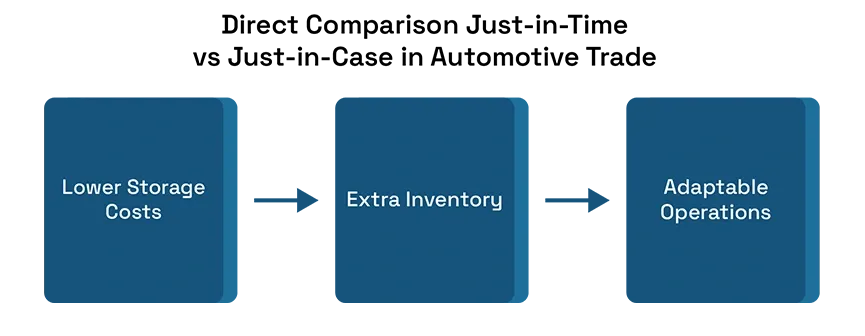
Direct Comparison: Just-in-Time vs Just-in-Case in Automotive Trade
When evaluating inventory strategies in cross-border automotive operations, the choice between Just-in-Time (JIT) and Just-in-Case (JIC) comes down to balancing efficiency with resilience. JIT operates with minimal inventory levels, ensuring that components arrive only when needed, which significantly reduces storage costs but increases risk exposure if there are delays in international shipments. This makes JIT highly dependent on stable supply environments and predictable transit timelines.
The company does things a bit differently with JIC. They keep a lot of inventory on hand with JIC. This helps them when things do not go as planned with JIC like when suppliers do not deliver or there are problems at the ports. While this approach leads to higher carrying costs, it offers greater flexibility and adaptability during disruptions, allowing production to continue without interruption. The downside to having all this inventory with JIC is that it costs more to store it.. With JIC they can make changes quickly when things are not going smoothly. This means they can keep making things without stopping with JIC.
Cross-Border Challenges in Automotive Supply Chains
In the automotive trade small delays can really change up the whole production process. This makes it a lot harder to do business across borders than it is to do in our country. One big problem is getting the approvals from the government. You see, different countries have rules about what can be imported and companies have to follow all these rules. This can slow down the delivery of parts that the automotive trade needs to keep running smoothly. The international automotive trade has to deal with a lot of rules and regulations which is why it is so difficult.
Documentation dependencies make things more complicated. Incomplete or inaccurate paperwork can cause shipment delays or customs issues. Coordinating with suppliers from countries needs careful timing and communication. Parts usually come from areas before reaching the final assembly point. This complexity increases because paperwork problems can lead to shipment holds. Customs delays happen when paperwork is not accurate.
Port congestion and unpredictable transit timelines are a problem. They make it really hard to know what is going to happen especially when it is time for shipping or when there are big problems around the world. The automotive supply chains that cross borders are really affected by these things. So businesses need to come up with plans that can deal with delays. Port congestion and unpredictable transit timelines are an issue for automotive supply chains that cross borders.
Hybrid Inventory Strategy in Modern Automotive Supply Chains
Automotive companies are changing the way they do things because the world is an uncertain place right now. They are not just doing one thing or the other. Instead they are using a mix of two ways to manage the things in the automotive sector. This new way combines the things about Just-in-Time and Just-in-Case. Automotive companies use Just-in-Time for the parts they need a lot of. That they know they will always need. This helps them save money and make things efficiently. These are the things that can really mess up the process if they do not have them when they need them. The automotive supply chain is changing. Now companies do not just want to save money they also want to be strong and able to deal with problems. They want to be able to handle things when they do not go as planned. Automotive supply chain management is about being ready for anything that might happen. This way they are not affected much by problems with trade around the world.

Conclusion: The Future of Automotive Supply Chains
The future of -border automotive supply chains is really heading in the direction of systems that are good at dealing with problems. This is because things do not always go as planned and companies need to be ready for that. Cross-border automotive supply chains need to be able to change when things get tough. They are using things like in-Time and Just-in-Case together to make a plan that works well for cross-border automotive supply chains. This way cross-border automotive supply chains can be ready for anything. Companies need to be able to adapt these days. This means they have to be able to change sourcing, inventory, and transportation strategies in real time. For example we can now track things in time, use special tools to predict what will happen and use digital platforms to manage how things get from one place to another. All of this is helping companies make decisions and see what is going on in their networks all around the world. It helps them adjust their strategies for getting things, storing things and transporting things in time.
Strategic partnerships with suppliers are really helping, service providers and trade experts are also important. These partnerships make the automotive supply chain more flexible. The supply chain ecosystem is changing because of these partnerships. They help the automotive industry adapt to situations.
DID YOU KNOW
“The historical roots of Just-in-Time (JIT) manufacturing can be traced back to post-World War II Japan, a country striving to rebuild its economy. ”
FAQ
What’s the difference between Just-in-Time and just in case?
JIC is a counterpoint strategy that addresses the limitations and potential risks of JIT, which primarily focuses on minimizing inventory levels. JIC is more commonly used in industries where disruptions in the supply chain, long lead times, or unpredictable demand patterns are common.
What are the 4 types of inventory management?
The four main types of inventory management are just-in-time management (JIT), materials requirement planning (MRP), economic order quantity (EOQ), and days sales of inventory (DSI).
What is a Just-in-Time strategy?
`Just-in-time’ is a management philosophy and not a technique. It originally referred to the production of goods to meet customer demand exactly, in time, quality and quantity, whether the customer’ is the final purchaser of the product or another process further along the production line.
What skills are needed for JIT?
Just-in-Time (JIT) delivery workers need 5 essential skills to excel: technical proficiency, time management, organizational skills, adaptability, and problem-solving. JIT is a supply chain strategy that minimizes inventory by delivering materials exactly when needed.
What is the difference between JIT and AoT?
AOT compiles before execution, providing faster startup, smaller binaries, and better production performance. JIT compiles during runtime, offering dynamic optimization, flexibility, and faster development cycles, but often has slower startup and higher memory usage