Introduction
The global change toward sustainable growth is developing global trade, and climate policies introduced by major economies are increasingly affecting how exporters work. India, which has strengthened its position in global trade through various manufacturing capabilities, now faces new challenges under growing environmental agreement norms. As global trades demand smooth production and clear reporting, exporters must adapt to remain competitive. The growth of green trade guidelines has also made Impactful regulations a major factor in pricing, supply chain optimization, and long-term market access.
Why the Carbon Border Adjustment Mechanism is a risk for Indian exporters
The European Union’s Carbon Border Adjustment Mechanism has grown as one of the largest climate-linked trade measures of this decade. Mainly described as a climate tax on carbon-intensive imports, CBAM requires exporters to disclose emissions embedded in their products and eventually pay a tax based on those emissions. This directly impacts Indian exporters in sectors such as IT, automotive, aviation, and medical, where production processes conventionally generate higher emissions. For businesses working in India, this means re-evaluating manufacturing practices, improving environmental reporting, and confirming greater clarity across their operations. As CBAM becomes more deeply combined into EU regulations, its impact will extend to production planning, real-time shipment tracking expectations, and the overall cost competitiveness of Indian goods in European markets.

Major Green Trade risks for Indian exporters
Beyond CBAM, global green trade demands introduce many additional risks for Indian exporters. Many importing nations are integrating sustainability into their tariff system, import duties, and future market-entry rules. This increases agreement costs and may require advanced supply chain optimization plans to meet evolving standards. Organizations that depend on outdated production methods or conventional sourcing face challenges in terms of carbon reporting, energy efficiency, and environmental certification. Indian exporters may also encounter disruptions if buyers change toward low-emission suppliers or demand greater visibility across stages, such as Delivered Duty Paid service, shipment handling, and environmentally compliant packaging. These pressures collectively show a change from price-based competition to sustainability-based qualification.
As the EU’s green trade rules kick in, India works on policy change.
With the EU implementing strict climate-related import rules, India has begun adapting its trade and local industrial policies. The government is focusing on industrial guidelines with global expectations, improving smooth manufacturing technologies, and strengthening environmental tracking mechanisms for exporters. Many industry bodies have started awareness programs to help businesses understand the reach of emissions reporting and how it affects global freight services, trade support, and long-term export planning. India is also improving long-term and multilateral work to confirm that green trade rules do not unfairly disadvantage developing economies. These policies are used to help businesses change smoothly while maintaining India’s export competitiveness.
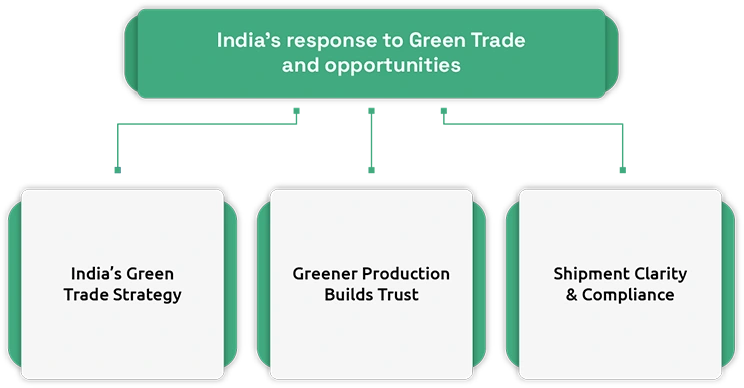
India’s response to Green Trade and opportunities
India’s major response to green trade challenges combines regulatory reforms with opportunities in growing sectors. While approval may seem demanding, using greener production methods can increase brand dependability, support global trade, and attract environmentally aware buyers. Industries are increasingly exploring renewable energy usage, cleaner technologies, and better tracking tools to work with global sustainability norms. Organizations improving clarity in shipment processes, importer-of-record responsibilities, and compliant export work are likely to benefit from long-term growth. The push toward greener trades also opens new changes in green technologies, sustainable goods, and low-carbon manufacturing, allowing India to position itself as a dependable global partner in weather-aware trade.
Conclusion
Green trade is no longer a policy trend; it is changing the future of global trade. While climate measures such as CBAM pose huge risks for Indian exporters, they also create an urgent opportunity for developed countries. Businesses that in advance use cleaner methods and combine sustainability throughout production and supply will be better positioned to grow in a low-carbon global economy. India’s ability to adapt to these growing dynamics is necessary not only for maintaining export competitiveness but also for strengthening its role in the world’s change toward sustainable trade.
DID YOU KNOW?
It is the second largest export hub in India, accounting for nearly 17.5 percent of total exports (European Commission n.d.).
FAQs:
- What is the Carbon Border Adjustment Mechanism (CBAM)?
CBAM is an EU policy that applies a carbon tax on imported goods based on the emissions generated during their production. Exporters must disclose embedded emissions and eventually pay a carbon cost.
- Why is CBAM considered a major risk for Indian exporters?
Many Indian industries, such as steel, aluminum, chemicals, and manufacturing, have traditionally high carbon footprints. CBAM increases compliance costs and could reduce price competitiveness in the EU market.
- How do global green trade rules affect Indian exporters?
Green regulations require cleaner production, transparent carbon reporting, energy-efficient processes, and sustainable supply chains. Non-compliance can result in loss of buyers or restricted market access.
- What steps is India taking to respond to these climate-related trade changes?
India is upgrading industrial policies, improving emissions tracking, promoting cleaner technologies, and negotiating globally to ensure fair green trade practices for developing countries.
- Are there opportunities for Indian exporters in this green trade shift?
Yes. Businesses that adopt renewable energy, low-carbon manufacturing, and better environmental reporting can gain a competitive edge, attract eco-conscious buyers, and access emerging green markets.