

Introduction
China’s export performance in late 2025 has boosted global trade, displaying a level of dependence that exceeds earlier projections. Despite the ongoing pressure from U.S. tariffs and slowdowns in some conventional trades, China has managed to maintain a slow momentum by varying its export destinations and increasing efficiency across multiple industries. The change in global demand, combined with China’s ability to guide difficult trade environments, has changed how businesses view international freight services and supply chain optimization as necessary suppliers of growth in global trade.
China’s Exports Defy Expectations Amid Tariff Truce
Customs data shows that China’s exports increased in November, marking a huge rebound from previous months. The temporary tariff stop with the United States gives renewed market trust, allowing organizations to ship goods more freely and adjust pricing plans accordingly. While shipments to the U.S. remained under pressure because of high import duties and tariffs, exporters shifted more heavily toward regions such as Southeast Asia, Africa, and Latin America. This variation allowed Chinese goods to remain competitive even without the preferential benefits of systems such as the generalized system of preferences (GSP). The renewed stability also allows organizations to simplify processes related to import export documentation, confirming faster agreement and smoother global movement of goods.
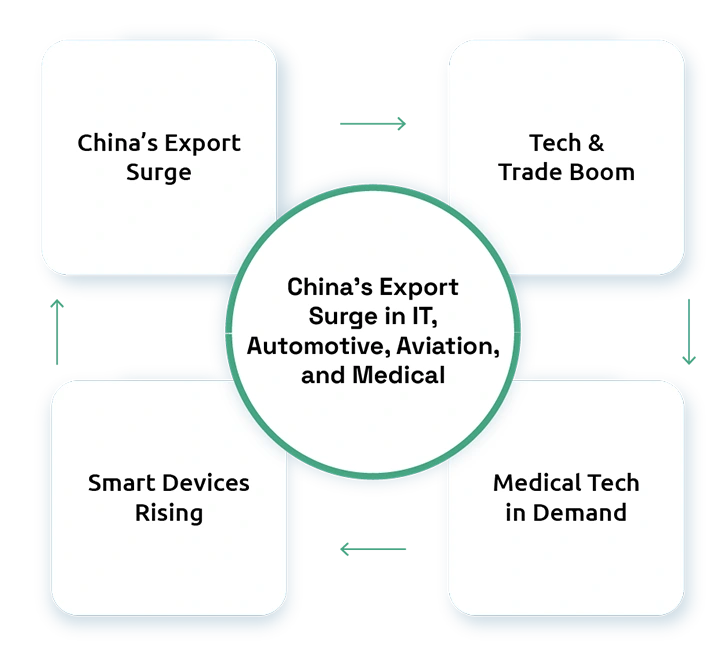
China’s Export Surge in IT, Automotive, Aviation, and Medical
The most important growth appeared in the IT, automotive, aviation, and medical sectors. China’s automotive exports grew as global demand for electric vehicles, engines, and affordable passenger cars continued to grow. The country’s IT and electronics industries saw a similar growth, with strong orders for hardware, smart devices, and critical components. Aviation and medical equipment exports also recorded substantial growth, showing the increasing global requirement for advanced technology and high-quality healthcare solutions. Exporters in these sectors depend heavily on real-time shipment tracking systems, effective last-mile delivery services, and Delivered Duty Paid service methods to strengthen their competitiveness. Many exporters also use Incoterms mainly to provide flexibility to overseas buyers, while importers depend on IOR services and clear Importer of Record responsibilities to confirm a compliant cross-border shipment of high-value goods.

China Trade Surplus Beats Forecasts as Exports Rebound Sharply
China’s trade surplus expanded hugely in November as exports and imports rose by a wide margin. The increase in outbound shipments, combined with slowly but modest import growth, created one of the largest monthly surpluses of the year. Factors such as stabilized global demand, reduced shipping issues, and improved logistics support contributed to this outcome. Chinese exporters have become more used to managing difficult requirements such as HS code categorizations, the HTS harmonized tariff schedule used, and Exporter of Record definition procedures, which have helped them avoid delays at global ports. The overall growth confirmed that China remains a vital hub in global trade, even as geopolitical variation continues to change.
China’s Exports grew at the Fastest Pace in Six Months Despite U.S. Tariffs
Earlier in the year, China saw its quick export growth in six months, showcasing strength even at the height of tariff tensions with the United States. This performance highlighted a broader trend: Chinese manufacturers have become mostly capable of guiding tariff trades by improving quality, cutting production costs, and depending on varied shipping channels. The use of Delivered Duty Paid service options and customized supply chain optimization plans confirmed that goods continued flowing effectively to key trades. Many exporters also hold DAP and DAPs delivery methods to provide clear pricing for buyers. These approaches show how working flexibility can offset the challenges imposed by external trade pressures.
Conclusion
China’s export growth in 2025 underscores the adaptability and plan dependence of its industrial and trade systems. From automotive and IT to aviation and medical manufacturing, China’s growing export numbers show the success of a varied market approach combined with strong logistical capabilities. Even with high U.S. tariffs still in place, Chinese exporters continue to outperform expectations by using advanced logistics solutions, smart documentation methods, and globally competitive pricing. As global trade continues to grow, China’s export-driven growth method appears well-positioned to remain strong, changing new trade pathways and setting the stage for continued momentum in 2026 and beyond.
DID YOU KNOW?
Global traders are waiting to see whether the world’s two largest economies can agree on a lasting trade deal by August 12, or whether the rollback of import tariffs exceeding 100% will once again disrupt global supply chains.
FAQs:
- Why did China’s exports surge in late 2025 despite U.S. tariffs?
China diversified its export markets, improved supply chain efficiency, and strengthened key industries like IT, automotive, aviation, and medical equipment. These steps reduced dependency on the U.S. market and supported steady growth.
- Which sectors contributed most to China’s export rebound?
The IT and electronics sectors, automotive manufacturing (especially EVs), aviation components, and medical equipment recorded the strongest growth during the surge.
- How did the tariff truce with the U.S. impact Chinese exports?
The temporary tariff easing improved market confidence, allowed exporters to adjust pricing strategies, and facilitated smoother documentation and shipping processes.
- What role did logistics and documentation play in the export growth?
Advanced logistics solutions such as real-time tracking, DDP/DAP delivery methods, and efficient HS/HTS classification helped exporters avoid delays and improve global competitiveness.
- Will China’s export momentum continue into 2026?
Based on strengthened supply chains, diversified markets, and rising demand in high-tech sectors, China is well-positioned to maintain export momentum into 2026.