Insight
The industry’s ability to thrive in today’s tough competition heavily relies on effective supply chain management. Warehousing capabilities are a critical piece of this leadership that provides a one-stop storage, handling, and transfer location for objects. Warehousing services have become an important part of the supply chain, offering a series of practical methods and physical places for holding and conveying commodities. They serve as fleet warehouses for multiple goods, synthesizing raw materials and finished goods. This blog broadly summarizes the warehousing facility’s relevance to the supply chain system.
The Significance of Warehousing in the Supply Chain
Services by the warehouses are the backbone of the supply chain, offering the operational practices needed to store and transfer objects. Warehouses are crucial in customs compliance for international trade because they guarantee a place where goods are kept and checked-in-contained by local and international law. Warehousing services are required for the supply chain as they act as distribution centres where goods are held & made available. Shipping and Pick-Up warehouses are located close to shipping docks to maximize supply chain efficiency and reduce transportation costs.
What are warehousing services and why are they important in the supply chain?
Warehousing services involve the storage, handling, and management of goods before they are distributed to retailers, businesses, or customers. They are important because they help maintain inventory availability, prevent stock shortages, improve order fulfillment speed, and create a smooth flow of products across the supply chain. Efficient warehousing also reduces delays and supports better customer satisfaction.

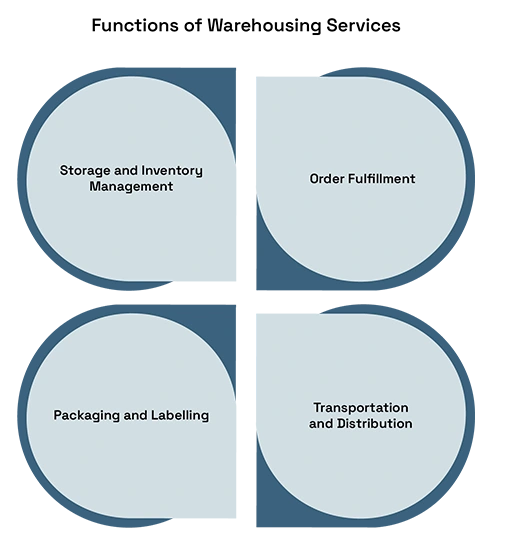
Functions of Warehousing Services
1. Storage and Inventory Management
Warehousing services provide storage amenities for commodities, allowing corporations to manage inventory and preserve a steady supply efficiently. These services utilize progressive inventory management strategies to track commodities, facilitate order fulfillment procedures, and monitor stock levels.
2. Order Fulfillment
Warehousing is necessary for processing orders. The warehouse staff pack and send products to customers after receiving order requests. A central system makes it simpler for businesses to simplify things, speed up deliveries, and improve customer service.
3. Packaging and Labelling
Warehousing services play a necessary role in packaging and labeling commodities. With their specialization and equipment, warehouses guarantee secure packaging and accurate labeling, defending commodities during transport and minimizing the possibilities of damage or client displeasure.
4. Transportation and Distribution
Warehousing services not only store items but also control their transport and allotment. They cooperate with logistics supporters to guarantee the smooth movement of commodities from the warehouse to various distribution channels, such as e-commerce fulfillment centers and retail stores. This integration of transport and distribution services enables firms to enhance efficiency and reduce expenditures.
Advantages of Utilizing Warehousing Services
a) Cost Savings
Warehousing services provide price savings by centralizing item storage. This allows for economies of scale, enabling warehouses to negotiate low transportation expenses. Efficient inventory management also lessens the hazard of stockouts and overstocking, minimizing carrying expenses.
b) Enhanced Efficiency
Warehousing services enhance supply chain effectiveness by centralizing warehouse and inventory management. This allows corporations to have greater control over stock levels, leading to enhanced order fulfillment rates and shorter lead times. By streamlining procedures and utilizing progressive technology, warehouses can optimize the flow of goods, eventually enhancing operating efficiency.
c) Boosted Customer Service
Warehousing services are significant for improving client service. Corporations can fulfill orders quickly and accurately by having commodities available in warehouses, resulting in short delivery duration, fewer misconceptions, and higher fulfillment. Warehousing also allows companies to offer additional services like customization or bundling, enhancing the client experience.
Why Inventory Management Is Important in Warehousing
Inventory management helps businesses keep the correct products in the warehouse at the correct time. It helps track stock, avoid running out of products, and avoiding storing too many products. It also makes it easier to find products and send orders quickly. Good inventory management saves time, reduces costs, and increases customer approval. It also alerts businesses when new supply is required, allowing regular tasks and deliveries to run smoothly.
Impact of Warehousing on Supply Chain Efficiency
Warehousing services play a major role in improving supply chain efficiency. By storing products in strategic locations close to key markets, businesses can reduce shipping distances, cut transportation costs, and speed up delivery times. This helps companies serve customers faster and stay competitive. Modern warehouses use advanced technology like automation, barcode scanning, RFID tagging, inventory software, and real-time tracking systems. These tools help manage stock accurately, reduce human error, and ensure products move in and out smoothly. With better visibility, businesses always know their exact inventory levels and can avoid stockouts or overstock situations.
Warehousing also supports better planning. Companies can store seasonal goods, manage bulk shipments, and keep safety stock ready for unexpected demand. It improves order processing by allowing faster picking, packing, and dispatching of products. Additionally, many warehouses offer value-added services such as labeling, repackaging, kitting, quality checks, and handling returns. This reduces workload on businesses and ensures products reach customers in perfect condition. Overall, warehousing leads to lower costs, faster deliveries, better accuracy, and higher customer satisfaction. It helps businesses scale smoothly, manage demand fluctuations, and maintain a strong supply chain.
Conclusion
Warehousing services are vital to the supply chain as they provide a centralized location for storing, managing, and transporting goods, including those in high demand. This ensures product availability when needed, while delivering cost savings, greater efficiency, and improved customer service. As the logistics sector develops, warehousing will be more pivotal in supply chains. Working with a reliable provider like One Union Solutions enables companies to remain competitive and effectively meet market needs.
Did you know
The Warehousing Market is valued at USD 1.18 trillion in 2025 and is projected to grow at a CAGR of 7.5% to reach USD 2.27 trillion by 2034.
FAQs
1. Do warehousing companies offer custom services for different industries?
Yes. One Union Solutions provides flexible warehousing that can be tailored to the unique needs of any industry, including custom storage, stock management, and extra handling services.
2. How do warehouse services meet industry standards in a global market?
We offer the tools and support businesses need to manage global supply chains. Our tailored warehousing solutions help companies stay compliant, stay organized, and grow internationally.
3. Why choose One Union Solutions for warehousing services?
We create customized warehousing options that improve supply chain performance, reduce costs, and support smooth global operations.
4. How do warehousing services make operations more efficient?
Centralized storage, automation, and real-time tracking help manage inventory accurately, reduce mistakes, speed up order processing, and improve customer satisfaction.
5. How do warehousing services support global trade?
Warehouses store and process goods according to international rules, reduce shipping expenses, streamline supply chains, and help businesses reach customers worldwide.