
Introduction
The global auto industry is entering a new geopolitical era, one that many observers now call the EV tech cold war. As nations race to secure critical automobile industry, advanced battery components, and cleaner technologies, China’s strong control over major materials has become a defining force. Over the past decade, the country has built a powerful manufacturing base, backed by long-term industrial planning, deep investments in battery technology, and an export system that once encouraged wider access to its raw materials. These policy changes are open at the same time as governments reassess global trade preferences, such as the generalized system of preferences (GSP), and apply new methods, such as Delivered Duty Paid service systems, to keep goods moving efficiently despite growing strategic global conflict.
Key Impacts on Global Supply Chains
China’s restrictions are changing the supply chain from Asia to Europe and North America. Automakers that depended heavily on steady Chinese inflows of battery parts are now facing delays, higher Import duties and tariffs, and the pressure to vary partners as fast as possible. Even established procurement systems, combined with HS code classifications or HTS harmonized tariff Schedule rules, must accept changing export approvals and updated classifications for battery-grade parts. In many cases, organizations re-evaluate their internal processes, such as the reviewer role of the Importer of Record responsibilities, to confirm agreement with new rules growing from both China and its trading partners. What once looked like a predictable flow of EV components has turned into a constantly developing web of new suppliers, alternative trade lanes, and fresh approval requirements.

Will China Take Over the Global Auto Industry?
The question of whether China will control the global auto sector is complex. Also, its control over necessary EV materials and its huge production capacity for lithium-ion cells make it a formidable competitor. Chinese industries continue to expand increasingly, using competitive pricing, a strong technological base, and effective last-mile delivery services to reach major trades. Governments are improving localized production through new tax incentives, trade reforms, and targeted policies related to reducing dependence on a single country. Initiatives that incorporate Incoterms-based agreements, IOR services, or advanced import export documentation systems are becoming necessary for organizations that want to reduce risk while still participating in cross-border EV trade.
How Trade Wars and Tariffs Reshaped the Automotive Supply Chain
Trade issues over the past few years have already changed automotive supply chains, and the current EV tech cold war has increased those changes. The application of new tariffs on Chinese EV batteries and semiconductors has forced manufacturers to look at long-term production plans. Many are now designing regional manufacturing hubs to reduce exposure to import issues, which also work with developing supply chain optimization plans. These tariff environments have changed everything from DAP and DAPs shipping methods to how companies position suppliers under an Exporter of Record definition service when routing goods into sensitive markets. Also, automakers are increasingly mixture of traditional sourcing approaches with digital systems for integration, planning, and agreement.
Advantages of China’s Export Restrictions on the Automotive Market
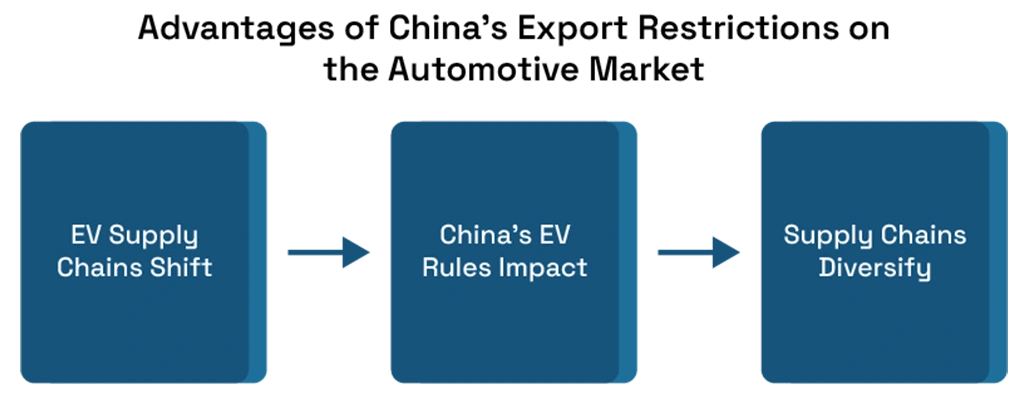
While these restrictions create challenges, they also stimulate competitive advantages in other regions. Countries outside China are now prioritizing local investment in next-generation battery parts and renewable energy integration areas that they previously limited-budget. This variation improves global dependence, giving automakers more options and reducing vulnerability to single-country supply shocks. The push for alternative sourcing has developed innovation in transportation methods that apply Delivered Duty Paid service options to reduce friction when entering new markets. Also, many nations are developing new regulations based on Incoterms and changing logistics guidelines, helping organizations to create smooth trade that benefits both importers and exporters.
Conclusion
The EV tech cold war represents a changing point for global automotive supply chains. China’s export restrictions have forced manufacturers to look for production and long-term market strategies. Although the uncertainty has increased costs and introduced fresh agreement layers, it has also major changes, innovations, and renewed investment across multiple regions. As nations compete to secure a place in the electric future, the global supply chain will likely remain varied, interdependent, and defined by the balance between political strategy and industrial capability.
DID YOU KNOW?
The US will impose an additional 100% tax on all Chinese goods from November 1, 2025, in addition to the existing 30% tariff, bringing the total tax burden to approximately 130%.
FAQs:
- What is the EV tech cold war?
The EV tech cold war refers to the growing geopolitical competition over electric vehicle technologies, battery materials, and supply chain control, primarily involving China, the U.S., and Europe.
- Why are China’s export restrictions impacting global auto supply chains?
China controls a large share of the world’s battery materials, EV components, and processing capacity. Restrictions on these exports create delays, cost increases, and force automakers to find new suppliers.
- Will China dominate the global EV and auto industry?
China has strong advantages in large-scale production, advanced battery technology, and competitive pricing. However, other countries are increasing incentives and local production to reduce reliance on Chinese supply.
- How are trade wars and tariffs affecting the EV industry?
New tariffs on Chinese EV components, batteries, and semiconductors have pushed automakers to diversify manufacturing, build regional production hubs, and adopt new supply chain and import-export strategies.
- Are China’s export restrictions beneficial in any way?
Yes. They encourage other nations to invest in local battery manufacturing, diversify sourcing, and innovate in logistics and supply chain technology, leading to a more resilient global EV industry.