
Introduction
Over the past three decades, North America has undergone a deep industrial change, grown largely by stronger regional combination and predictable trade rules. Among the sectors most visibly changed by these changes is automotive manufacturing. With the introduction of NAFTA in 1994, a clearer economic system encouraged organizations across Canada, the United States, and Mexico to build a cross-border production chain. As trade costs fell and manufacturing ecosystems grew, the region saw an era where vehicle parts moved smoothly across borders under stable classifications such as the HS code and the HTS harmonized tariff schedule. These developments laid the foundation for Mexico to develop as a major production center, a change that continues to improve regional strategies for supply chain optimization and the design of modern Incoterms used in global logistics agreements.
How Did NAFTA Affect the Economies of the Get Involved Countries?
Its biggest contribution was the creation of expected trade entry, allowing industries to plan investments with long-term trade. Lower import duties and tariffs reduced production expenses, allowing organizations to build combined industries that specialized in different stages of assembly. The United States benefited from access to competitively priced parts, while Canada improved its position in valuable engineering and parts manufacturing. Mexico saw considerable growth in industrial zones supported by improved import-export documentation systems and smooth DAP or Delivered at Place procedures that made cross-border shipments faster and more dependable. Though debates on trade balances continue, overall trade expansion within the region supported millions of comforting organizations to plan supply chains capable of managing real-time shipment tracking and last-mile delivery services across multiple national borders.

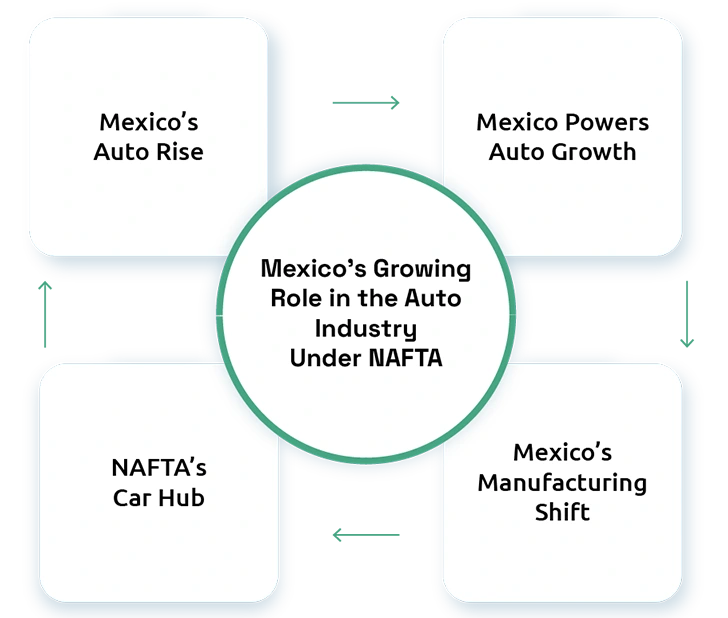
Mexico’s Growing Role in the Auto Industry Under NAFTA
As global carmakers varied their production bases, Mexico became an attractive location due to its cost competitiveness and combined logistics station. Many companies established operations there to simplify International freight services while maintaining access to the U.S. market. Over fifteen years, Mexico moved from being an assembly-focused economy to a major manufacturing hub capable of producing advanced methods. This rise was supported by a structured system, such as the generalized system of preferences (GSP) applied by trading partners outside North America, and by a clearer explanation of Importer of Record responsibilities and Exporter of Record definitions for cross-border movements. Manufacturers depend heavily on DAPs and Delivered Duty Paid service options to confirm the predictable delivery of parts sourced from Asia, Europe, and South America. As Mexico modernized its production service, supply chain optimization naturally became necessary, reducing lead times and strengthening confidence in the country’s long-term automotive capabilities.
Strengthening Security for Mexico’s Automotive Logistics
As Mexico’s automotive sector expanded, securing transport routes became necessary. Growth in cargo volumes is comforting the government and private sector to increase infrastructure and better track vehicle and parts shipments. Companies began using advanced tracking platforms to oversee every stage of shipment, confirming agreement with changing Incoterms and safeguarding the movement of high-value components. The evolution of IOR services also supported global organizations operating without legal presence in Mexico, improving overall trade in border management. These improvements strengthened Mexico’s position as a dependable partner and contributed to the stability of automotive stations linking factories in the United States and Canada.
Impact of Chinese Imports on Mexico’s Automotive Market
The past decade has seen a growing wave of Chinese automotive brands and components entering Mexico, changing the competitive landscape. Affordable Chinese methods have found strong demand, while parts manufacturers have expanded partnerships with Mexican assemblers. This rush has stimulated local organizations to refine their procurement processes and documentation practices, specifically those related to DAP, supply chain optimization, and tariff management. While competition has increased, the overall effect has been useful, pushing Mexican manufacturers to innovate and work more closely with the global quality system.
Conclusion
Fifteen years of data make one fact clear: Mexico has developed into a central pillar of North America’s automotive ecosystem. NAFTA opened the door for combined production, and Mexico seized the opportunity by building modern industries, strengthening logistics systems, and using global best practices in everything from import duties and tariffs to logistics planning and shipment visibility. As trade patterns continue to change, mainly with growing Chinese participation, Mexico’s manufacturing strength remains a defining element in the region’s automotive industry.
DID YOU KNOW?
Under NAFTA, 62.5% of the net price of a vehicle and 60% of the price of spare parts must come from the NAFTA region for those products to gain duty-free entry into the United States.
FAQs:
- How did NAFTA contribute to the growth of Mexico’s automotive industry?
NAFTA eliminated many tariffs and simplified trade processes, allowing automakers to build integrated supply chains across North America. This encouraged foreign investment and boosted Mexico’s automotive production capacity.
- Why did global automakers choose Mexico as a manufacturing hub?
Mexico offered competitive labor costs, favorable trade rules, strong logistics connectivity with the U.S., and improved import-export documentation systems that made manufacturing more efficient.
- How has Mexico improved its automotive logistics and security?
Mexico adopted advanced tracking systems, expanded infrastructure, strengthened border management, and used updated Incoterms and IOR/EOR services to secure high-value shipments.
- What impact have Chinese automotive imports had on Mexico’s market?
Chinese brands and components increased competition, encouraged innovation, and influenced procurement strategies and tariff management among Mexican manufacturers.
- What does the future look like for Mexico’s automotive manufacturing sector?
Mexico is expected to remain a major regional production hub thanks to its modernized supply chain systems, strong trade frameworks, and expanding global partnerships, especially beyond North America.