
Introduction
Vietnam’s recent 9.3% jump in its national budget allocation has become more than an economic headline; it is now a major indication for global organizations depending on the country as a manufacturing support. The government’s increased spending is directed toward strengthening industrial zones, expanding cross-border capacity, and improving trade-related digital systems. Also, organizations depending on Vietnam for sourcing, procurement, or distribution must reassess their current system to work with the country’s developing trade landscape. If your supply chain requires evaluating an HS code for product classification or planning shipments under Incoterms, Vietnam’s changing financial priorities will change how goods move in and out of the country.
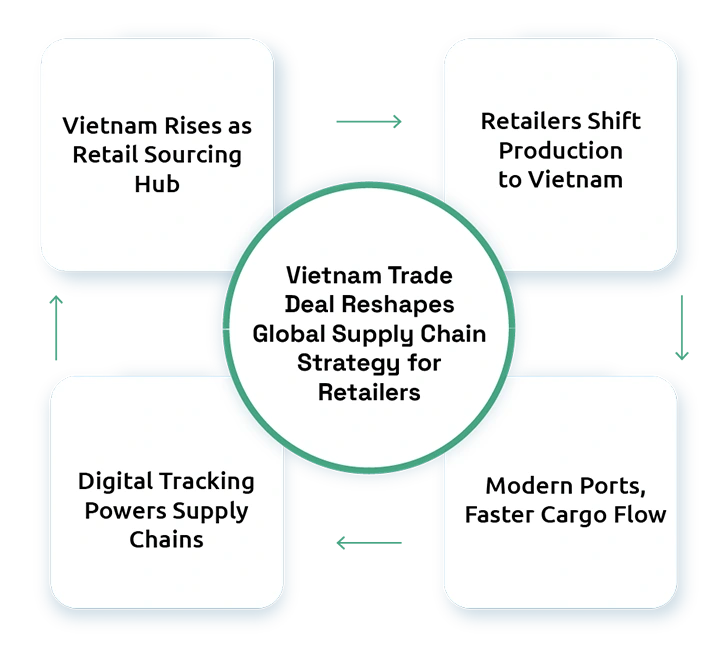
Vietnam Trade Deal Reshapes Global Supply Chain Strategy for Retailers
Vietnam’s expanding trade agreements continue to position the country as one of Asia’s most attractive sourcing hubs. The government’s increased budget reinforces its ability to use trade deals and increase agreements with requirements such as the Harmonized Tariff Schedule (HTS) used by global retailers. These updates allow companies to simplify cost calculations related to import duties and tariffs, and negotiate more precise terms under conditions such as DAP, DAPs, and Delivered Duty Paid (DDP) service systems.
Retailers changing production from other Asian markets increasingly look to Vietnam’s stable regulatory guidelines and modernizing ports. As organizations use data-driven procurement plans, real-time shipment tracking becomes central to their work. Vietnam’s new investments support these digital capabilities, making it easier for businesses to track cargo shipments and improve supply chain optimization without additional administrative load. This change is mainly valuable for companies managing high-volume goods with strict agreement requirements combined with trade preferences such as the Generalized System of Preferences (GSP).

How Vietnam Can Stay Competitive in a Changing Global Trade Environment
Vietnam’s competitiveness is based on a combination of infrastructure development, regulatory improvement, and select reasons for manufacturers. As the global trade environment becomes more unpredictable, the country is prioritizing better connectivity for exporters and international buyers. The increased budget allocation supports upgrades that directly impact international freight services, allowing retailers to shorten shipping times and reduce working issues. Another feature that helps Vietnam stay competitive is smoother management of import-export documentation, an important factor for businesses handling frequent shipments. Simplified government platforms will help importers and exporters meet agreement standards more efficiently, whether guiding certifications, customs submissions, or the responsibilities of an Importer of Record. With many foreign companies depending on IOR services and Exporter of Record support to enter the Vietnamese market, regulatory improvements confirm smoother entry and exit of goods.
Vietnamese Exports Playing a More Important Role Than Ever
Vietnam’s export sectors, electronics and machinery, are now changing global sourcing strategies at a scale previously controlled by China and neighboring ASEAN nations. As its export grows, organizations that depend on last-mile delivery services or cross-border distribution hubs benefit from the country’s improved standards in logistics and warehousing. The government’s new investments also look to increase border checkpoints and digitally combined transport hubs, supporting high-accuracy shipment processing and reducing delays. These improvements make Vietnam even more attractive for companies that depend heavily on predictable timelines and smooth work across multiple interfaces in their global trade.
Why Choose One Union Solutions in Vietnam for Export
One Union Solutions has become a trusted partner for companies expanding into Vietnam’s export market. Their expertise in approval systems, including product classification under HTS codes, support for Importer of Record responsibilities, and handling of difficult documentation, confirms businesses can work confidently. The company’s ability to use international freight services, manage last-mile delivery, and provide customized supply chain optimization plans helps exporters avoid costly delays. If you require end-to-end shipment support, guidance on Delivered Duty Paid service, or support guiding Vietnam’s customs regulations, we provide a complete solution for reliability, transparency, and smooth cross-border trade.
Conclusion
Vietnam’s 9.3% budget increase is more than a policy decision; it is a changing of the country’s role in the global supply chain. With strengthened infrastructure, improved trade agreement systems, and expanding export ability, Vietnam provides retailers with new advantages for purchasing and logistics. Working with expert partners such as One Union Solutions, organizations can guide these changes with greater efficiency and long-term success.
DID YOU KNOW?
Vietnam trade deal reduces tariffs from 46% to 20%, providing immediate relief to major retailers and apparel companies.
FAQs:
- How does Vietnam’s 9.3% budget increase affect global supply chains?
The increased budget strengthens industrial zones, logistics infrastructure, cross-border capacity, and digital customs systems, making Vietnam a more reliable and efficient sourcing and export hub.
- Why are retailers shifting production to Vietnam?
Retailers are choosing Vietnam for its stable regulations, expanding trade deals, modernizing ports, and improved digital freight tracking, all of which help reduce costs and increase predictability.
- How do Vietnam’s trade agreements benefit importers and exporters?
Vietnam’s trade agreements simplify tariff calculations, reduce import duties, improve HTS/HS classification processes, and offer favorable conditions under Incoterms like DAP and DDP.
- What industries benefit most from Vietnam’s improved export infrastructure?
Electronics, machinery, textiles, footwear, and consumer goods benefit significantly due to better warehousing, faster shipping times, and digitally integrated logistics networks.
- How can One Union Solutions support companies exporting from Vietnam?
One Union Solutions provides HTS classification, Importer/Exporter of Record services, customs documentation handling, freight management, and end-to-end shipment support for smooth cross-border trade.