
End-of-Life Vehicle (ELV) Regulations and Their Global Impact
The global automotive industry is entering a new phase where sustainability and regulatory control are shaping how vehicles are dismantled, recycled, and reintroduced into the market. End-of-life vehicle (ELV) regulations have been implemented across major economies to ensure that vehicles reaching the end of their lifecycle are processed in an environmentally responsible manner. These regulations focus on reducing waste, increasing material recovery, and promoting the reuse of automotive components. As governments strengthen environmental policies, the ELV framework is becoming a critical part of international trade discussions, especially for businesses involved in automotive imports and exports.
At the same time, the volume of vehicles reaching end-of-life status is steadily increasing due to rapid urbanization, shorter vehicle lifecycles, and the global shift toward electric mobility. These parts are often traded across borders to meet demand in markets. The vehicles reaching end-of-life status are. This increase is leading to more reusable parts, such as engines and transmissions from vehicles. For import export businesses operating across automotive, IT-integrated vehicle systems, aviation support equipment, and medical transport solutions, transportation this trend is a big deal. The import export businesses have to figure out how to handle these used components from the aviation industries as well as the medical transport solutions in a way that follows all the rules.
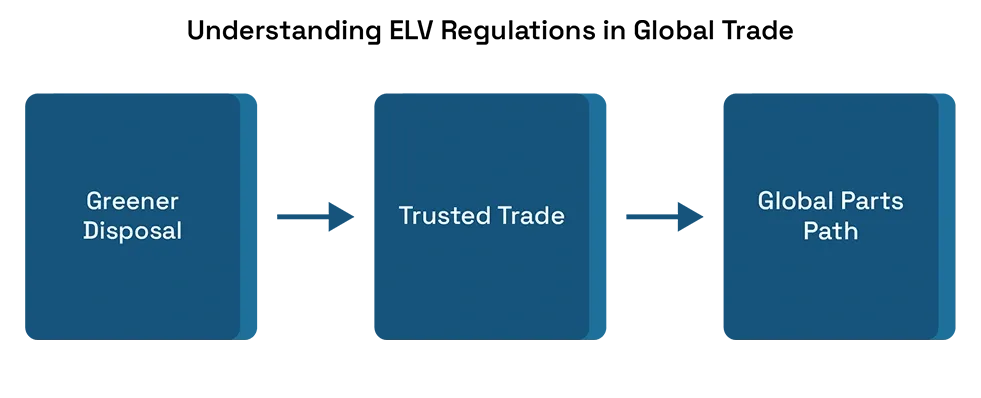
Understanding ELV Regulations in Global Trade
End-of-life vehicle (ELV) regulations are designed to manage how vehicles are disposed of once they reach the end of their usable life, with a strong focus on reuse, recycling, and environmental protection. Instead of treating old vehicles as waste, these regulations promote the recovery of valuable components such as engines, electronics, and metals, enabling them to re-enter the global market. This change helps make the automotive industry better. It also affects how used car parts are moved from one country to another.
A key principle behind ELV regulations is extended producer responsibility (EPR), which places the obligation on manufacturers to ensure that vehicles are properly collected, dismantled, and recycled. This has led to the development of standardized dismantling practices, where certified facilities carefully extract reusable parts and safely dispose of hazardous materials. These processes improve the quality and traceability of components entering the secondary market, making cross-border trade more structured and reliable. As a result, buyers and sellers can operate with greater confidence in the condition and origin of automotive parts.
From Scrap Exports to Structured Component Trade
The automotive recycling landscape around the world is changing. It is moving away from a system where old car parts were shipped out without control. Now it is becoming more organized and focused on getting value from the components. The automotive recycling landscape is really changing in a way. Old cars and the automotive recycling landscape are becoming more important.
This approach created inconsistencies in quality, reduced traceability, and increased environmental and compliance risks. Now the rules for End Of Life Vehicles are getting tougher. It is also making sure that parts from cars that can be used again are sold in other countries in a proper way. It helps people follow the rules. The End Of Life Vehicles rules are making it necessary for people to do things in a formal way.Modern ELV frameworks emphasize systematic dismantling carried out by authorized facilities, where each component is carefully assessed, tested, and categorized before being reintroduced into the supply chain.
This shift of doing things has made a lot of businesses want to buy car parts, like engines and transmissions that they know are good and will work. The ELV frameworks are making this happen. It is changing the market for old automotive parts.
Technology-Driven Transparency in ELV Parts Trade
Technology is playing a pivotal role in transforming how end-of-life vehicle (ELV) components are tracked, verified, and traded across borders. Businesses need to keep track of these parts and make sure they are genuine. They also need to trade them across countries. Because governments are watching businesses closely, companies are using computer systems to track vehicle parts. These systems follow the parts from the time they are removed from vehicles tested, sold again and finally used somewhere else.
Advanced traceability solutions help stakeholders check where each component comes from its condition. This reduces the risk of shipments that are not allowed or do not meet the requirements. Also when these solutions are connected to trade platforms they enable exporters, importers and regulators to share data in real-time. This improves visibility and coordination across the supply chain.
For companies that work with computers and use a lot of data being open and honest, this shift to transparency is good for companies that operate in these kinds of environments and it helps them build trust with other companies when they do business together, especially when it comes to refurbished automotive parts.
Conclusion
The evolution of End-of-Life Vehicle (ELV) regulations has redefined how automotive components move across international markets, shifting the perception of discarded vehicles from waste streams to valuable resource channels. This has affected import exports in countries. Now people think of it as something valuable that can be used again. End-of-Life Vehicle regulations have really changed the way we think about them. What used to be a scrap flow is now a controlled and tracked system is now a regulated, traceable ecosystem where reusable parts contribute to a growing circular economy. For companies trading across borders this change shows they must be flexible in a global market and it helps businesses meet expectations and sustainability goals.
Companies that plan ahead to meet rules make plans and have flexible ways of getting and delivering products will be in a better spot to handle these changes. To succeed in this changing world it’s all about finding a balance, between running things and following the rules. At the time companies need to grab new chances that come from making cars in a way that reuses more things. The reuse-driven industry is changing how things are done. Companies need to adapt to make the most of it.
DID YOU KNOW
“The hazardous substances such as lead, mercury, cadmium, and hexavalent chromium are prohibited in new vehicles, with specific exemptions. ”
FAQs
What is an End-of-Life Vehicle (ELV) in India?
An ELV is a vehicle that is no longer validly registered, is declared unfit through Automated Fitness Centres, or has had its registration cancelled. This includes vehicles that are voluntarily declared as waste by the owner
What is the “15-Year Rule” for Cars in India?
As of 2026, vehicles (private and commercial) that are 15+ years old are considered high-risk for pollution and safety, requiring mandatory automated fitness tests
What is the Directive 2000 53 EC end-of-life vehicles directive?
This Directive lays down measures which aim, as a first priority, at the prevention of waste from vehicles and, in addition, at the reuse, recycling and other forms of recovery of end-of life vehicles and their components so as to reduce the disposal of waste, as well as at the improvement
What are end of life vehicles?
End-of-Life Vehicles (ELVs) are cars, vans, or vehicles that are no longer roadworthy, functional, or legally permitted to drive due to age, severe damage, or failed mandatory testing.
Can ELVs be exported as used vehicles?
Not always. Regulations increasingly include strict criteria to determine whether a vehicle is truly reusable or should be classified as an ELV. Vehicles that are irreparable or unsafe cannot be exported as second-hand goods and must be processed through certified recycling systems.