Understanding Dual-Use in Automotive Electronics and Sensor Technologies
Dual-use refers to things like products and technologies that people make for use but can also be used for military or defense. In the automotive sector, this idea is becoming more important because automotive sectors are getting complicated with electronics and smart systems. Components such as LiDAR, radar sensors, and thermal imaging cameras are primarily developed to enhance vehicle safety, enable autonomous driving, and improve driver assistance systems. However, these same technologies can also be adapted for military reconnaissance, target detection, and surveillance operations, making them subject to heightened regulatory scrutiny.
The microelectronics and embedded systems that are used in vehicles are really important. These include things like control units and processors and communication modules. The microelectronics and embedded systems are important, for how the vehicle performs and how it is connected. They can also be used for other purposes like helping to control unmanned systems and making sure communication networks are secure. We also have navigation and positioning technologies, like GPS that are used in vehicles to help figure out the route and tracking. The GPS can be used for things too like helping guide missiles or navigate drones and it can also be used for military logistics. So microelectronics and embedded systems and navigation and positioning technologies are really useful.
Understanding Multi-Layered Risks in Dual-Use Automotive Electronics Exports
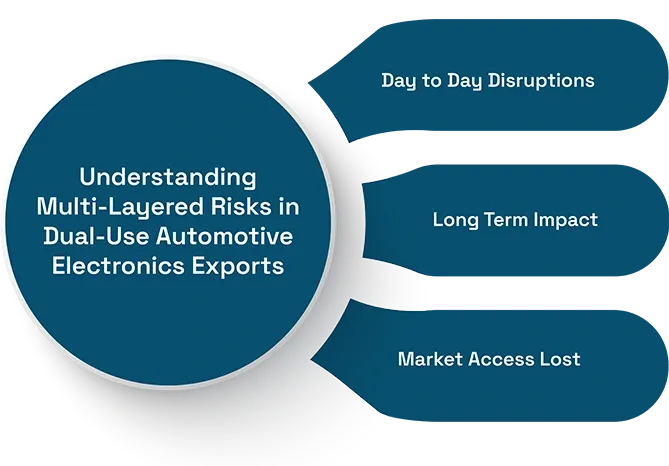
When we talk about exporting electronics and sensor technologies we have to think about the fact that these automotive electronics and sensor technologies can be used for more than one purpose. So exporting these electronics and sensor technologies is not just about doing what we have to do to follow the rules but we have to think about the risks of exporting these electronics and sensor technologies at many different levels. This is because exporters have to deal with rules, getting licenses and changing government laws. Exporters of electronics and sensor technologies have to manage these risks carefully. Delays in obtaining licenses or failure to meet regulatory expectations can result in penalties or shipment holds, directly affecting business continuity. Beyond this, operational risk plays a critical role in day-to-day trade activities. Issues such as shipment delays, incorrect classification of sensitive electronic components, and miscommunication in documentation can disrupt the smooth flow of goods across borders. Even minor errors can lead to inspections or rejections, increasing both time and cost.
At a broader level, strategic risk impacts long-term business sustainability. Companies may lose access to key international markets due to non-compliance or geopolitical restrictions, face over-reliance on limited suppliers, or suffer reputational damage that affects partnerships and customer trust. Addressing these layered risks through proactive planning and strong internal processes is essential for businesses operating in high-tech automotive exports.
Practical Compliance Strategies for Dual-Use Automotive Exports
Managing dual-use concerns in automotive electronics and sensor exports requires a structured, proactive approach rather than a reactive one. Businesses must begin with accurate product classification, ensuring that every component—whether advanced sensors, control units, or embedded systems is properly evaluated against applicable regulatory frameworks. Misclassification can lead to shipment delays, penalties, or even export restrictions. Equally important is verifying the end-use and end-user of the products. Exporters should conduct due diligence to confirm that components are not being redirected toward restricted or unintended applications, especially when dealing with high-risk regions or sensitive technologies.
Consistency in documentation is another critical pillar. Clear, precise, and aligned paperwork across all stages of the shipment process minimizes the risk of compliance issues and ensures smoother cross-border movement. They should check everything regularly and educate them and make sure to follow rules so they can keep up with the changing environment. Working with people who know about trade is also an idea because it can make things a lot simpler for the shipment process and for the companies. This way the companies can work with trade partners. Have a smoother shipment process. These partners are really good at handling shipments. They know how to navigate all the requirements and they are very transparent when they do this. Businesses can use these partners to make sure they do things right. This way businesses can avoid problems. They can also build a strong export system that follows all the rules. The export system will be good when the world trade rules get tougher. These partners and the businesses they work with can make an export framework that is strong and follows all the rules.
Technology Meets Regulation: How Innovation Triggers Dual-Use Scrutiny
The automotive technology is changing fast and this is affecting how governments look at exports. They are especially worried about things that can be used for other purposes. New things like sensors that use intelligence, automotive cars that can drive themselves are not just making roads safer or easier to use. The automotive technology is also useful for defense and spying. Automotive technology can be used in these areas because it is so advanced. For example the sensors that are used in vehicles to get very accurate readings can also be used for navigation in the military or for monitoring things from far away. The artificial intelligence that is used to process data can also be used to help make decisions in situations that are not related to everyday life, such as in the military. Autonomous vehicle sensors can be very useful in these situations.
The businesses are keeping an eye on the technology that is being exported to other countries. They want to make sure that it does not get to the places which it is not meant for. For companies that sell electronics and automotive equipment to countries means increased responsibility to evaluate product capabilities, verify end-use, and stay aligned with evolving compliance requirements. In this landscape, technology is driving growth. It is also changing what is expected from companies when it comes to following the rules.

Conclusion
In the world we live in today the way we do business is always changing. When it comes to the electronics and sensor exports we have to think about dual-use concerns. This is not about following the rules that the government sets, it is about making sure our business can survive and thrive in the future.
Companies that prioritize compliance awareness, invest in accurate product evaluation, and maintain transparency across their exports are less likely to have problems that cost a lot of money and get in trouble. Automotive electronics and sensor exports are a part of this. By being careful, with electronics and sensor exports companies can avoid a lot of hiccups. Proactive risk mitigation helps businesses feel more secure including checking the end use of products and keeping records helps businesses navigate uncertainties with greater confidence. It’s also important for businesses to quickly adjust to export rules and make sure their work follows guidelines. Companies that adapt fast and follow standards have a clear advantage and can navigate uncertainties, with confidence by being prepared.
In industries such as automotive, IT, aviation, and medical equipment, where technology is getting more and more mixed up. The ability to balance ideas with following the rules will be really important in long-term success in international trade.
DID YOU KNOW
“Dual-use technologies are items, software, or knowledge developed for civilian purposes that can also be applied for military, intelligence, or weapon proliferation applications. ”
FAQs
1. Can car sensors be used for surveillance?
Yes, advanced sensors such as LiDAR, radar, and high-resolution camera systems can potentially be used for surveillance. While designed for safety and navigation, their ability to capture detailed environmental data raises dual-use concerns.
2. Do electric vehicles share data with foreign entities?
Electric vehicles often rely on telematics and cloud-based systems, which may involve cross-border data transfers. This has raised concerns about sensitive location and user data being accessed by foreign entities.
3. How does automotive AI differ from defense AI?
Traditionally, automotive AI focuses on driver assistance and autonomous navigation, while defense AI is used for military applications. However, the technologies—especially in image recognition and navigation—are increasingly overlapping.
4. What are the security risks of connected car components?
Connected vehicle systems can be vulnerable to cyber threats, including unauthorized remote access, data breaches, and manipulation of autonomous driving software if not properly secured.
5. Why are automotive electronics considered dual-use items?
Many automotive components, such as sensors and embedded systems, can serve both civilian and military purposes, making them subject to stricter export controls and compliance requirements.