Rising Import Duties on EVs: Why It Matters Now
The global electric vehicle (EV) market is growing really fast. This is because people are becoming more aware of the need to protect the environment. The government is also helping by offering incentives.. Technology for batteries is getting better. Lots of countries are seeing a surge in the rising import of electronic vehicles. These decisions are helping to make electric vehicles available to people quickly and at a lower cost. The electric vehicles market is getting bigger and bigger.
In response to this surge, many governments are introducing or increasing import duties on EVs to strengthen domestic manufacturing capabilities and reduce reliance on foreign imports. These trade protection strategies are designed to encourage local production, attract investment, and build self-sufficient automotive ecosystems. While such policies support long-term industrial growth, they also have immediate consequences for businesses engaged in cross-border automotive trade.
The impact is most visible in three areas: pricing, consumer demand and market accessibility. Higher import duties make electric vehicles more expensive, which affects some buyers. This in turn influences their purchasing decisions. Slows down the adoption of electric vehicles in markets where people are sensitive to prices. At the time limited access to imported models changed the competitive landscape and reduced the choices available to consumers. For companies operating in import export businesses across automotive, IT, aviation, and medical sectors, understanding these shifts is essential to navigating an increasingly policy-driven global trade environment. The changes in import duties and market accessibility affect their operations and profitability.
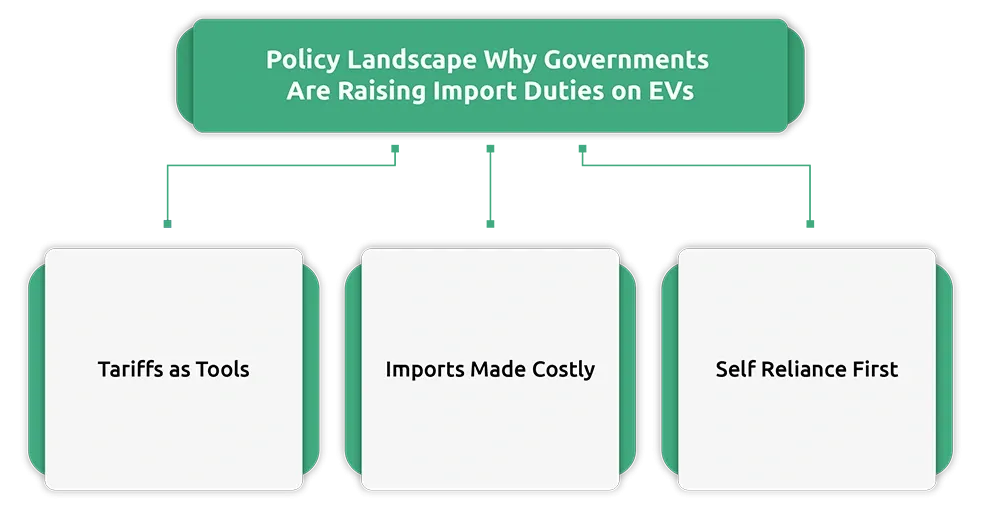
Policy Landscape: Why Governments Are Raising Import Duties on EVs
Governments in countries are using taxes on things they import to help the electric vehicle industry. They do not just see these taxes as a way to get money. The governments are using these taxes to help the companies that make imports and exports in their country. They want to make sure these companies can make vehicles and get better at it. Electric vehicle companies in each country will get a chance to grow because of these taxes. Governments are using taxes on imports to help the electric vehicle industry. By making imported vehicles relatively more expensive, policymakers aim to create a favorable environment for domestic automakers, battery producers, and component suppliers. This approach not only strengthens national industries but also supports long-term economic growth, job creation, and technological advancement.
A key driver behind rising duties is the need to reduce dependency on foreign supply chains, particularly for critical EV components such as batteries and semiconductors. Global disruptions in recent years have exposed the risks of over-reliance on a limited number of international suppliers. As a result, countries are prioritizing self-reliance by encouraging local production and investment. Import duties act as a catalyst in this transition, pushing global manufacturers to establish regional production hubs and align their strategies with domestic market requirements.
Impact of Rising Import Duties on EV Pricing
Rising import duties have a direct and measurable effect on the overall pricing structure of electric vehicles, making them less accessible to a wider consumer base. When tariffs increase, the base vehicle cost immediately rises, especially for fully built imported units. In addition, battery components, one of the most expensive elements in an EV, often rely on global sourcing, and higher duties on these imports further inflate production or procurement costs. The total price that the buyer pays for the vehicle goes up a lot by the time it gets to them. This is a problem in the Electric Vehicle market, where Electric Vehicles are already more expensive than the usual cars that run on gasoline so people are very sensitive to any change in the price of Electric Vehicles.
So when the duty goes up by 10 to 15 percent it can make things more expensive for people who buy them. This means people might think twice before buying something or they might look for something. For automotive import-export businesses they need to think about how they price things, who they buy from and how they can save money. They have to do all this to stay competitive and not lose much money. The automotive import-export businesses have to be smart about how they do things.
Supply Chain Realignment and Evolving Trade Flows
Rising import duties on electric vehicles are forcing OEMs to rethink traditional sourcing and distribution strategies, leading to a noticeable shift in global trade flows. Instead of relying heavily on fully built unit imports, many electric vehicle manufacturers are now using Knocked Down and Semi Knocked Down models. This helps them save money and keep vehicles cheap in places where import duties on electric vehicles are high. Electric vehicle manufacturers like this because it helps them deal with rising import duties on vehicles.
This transition is driving the growth of local assembly units, allowing companies to benefit from lower tariff exposure while maintaining market presence. Also suppliers from the region are becoming more important. They help companies not rely much on one country for supplies. This makes the supply chain stronger.
For businesses that import and export goods this change means both problems and chances. Automotive companies are changing how they import vehicles. The IT sector is getting requests for electronics and software that help electric vehicles work. They are moving components and sub-assemblies across borders to make vehicles. This change is affecting businesses. The import and export of goods is a part of their operations.

Conclusion
Rising import duties on vehicles are changing the industry in a big way not just by making them more expensive. Higher costs are affecting how much retailers charge, making electric vehicles less affordable in markets where people’re careful about spending money. Higher landed costs are directly influencing retail pricing, making EVs less accessible in price-sensitive markets while pushing consumers toward locally manufactured alternatives or delayed purchase decisions. Higher import costs for vehicles are a problem for the industry.
At this time global trade flows are changing. Manufacturers and import export businesses are adjusting their sourcing strategies, supplier networks and operational models. They are doing this to stay competitive. These changes are not just problems. They show a change in how the electric vehicle market works across different countries.
As governments align trade policies with industrial goals the global Electric Vehicle ecosystem will become more regional and structured. In this environment businesses that understand changes anticipate market movements and adapt fast to policy-driven dynamics will secure long-term growth and competitive advantage with Electric Vehicles. They will be the ones that adjust quickly to policies and changes, in the Electric Vehicle market.
DID YOU KNOW
“The 1st quarter of 2025 was off to a great start, with over 4 million EVs sold worldwide – 35% more than in 2024. By the end of the year, the IEA projects over 20 million new electric cars sold.”
FAQs
How are tariffs affecting EVs?
Tariffs are taxes placed on imported goods, and when applied to electric vehicles (EVs) and their components, they can raise prices, disrupt supply chains, and impact both automakers and consumers.
Is India cutting import duty on EVs to 15% to attract global automakers?
This significant reduction aims to attract global automakers, notably Tesla, to establish a presence in India. Key Highlights of the Proposed EV Policy: Reduced Import Duties: Premium EVs priced above $35,000 (approximately ₹30 lakh) will see import tariffs slashed from 110% to 15%.
Why are EV tariffs cheaper?
The main financial advantage of a TOU EV tariff is charging when electricity is cheapest. Consistently charging during off-peak hours can lead to substantial savings. This difference can save hundreds of pounds annually, making your EV even more cost effective than a traditional car.
What happens to an EV after 8 years?
As EVs get older, the batteries progressively degrade. It is expected that at around 75% of the battery’s original capacity, it has reached the end of its life in an EV.
What is the import duty on BYD EV cars in India?
The Ministry of Heavy Industries has finalised a new EV policy dubbed ‘Scheme to Promote Manufacturing of Electric Passenger Cars in India’ (SPMEPCI), which allows the import of electric cars at a lower 15 percent customs duty. Otherwise, the rate is 110 percent.