Introduction
In the modern global economy, companies are continuously trading internationally to get access to new markets and a variety of resources. However, there are several laws, rules, and compliance requirements to navigate while importing items over international boundaries. The importer of record, or IOR, is a key player in this process and is in charge of ensuring that commodities enter a nation legally and under all applicable rules and regulations.
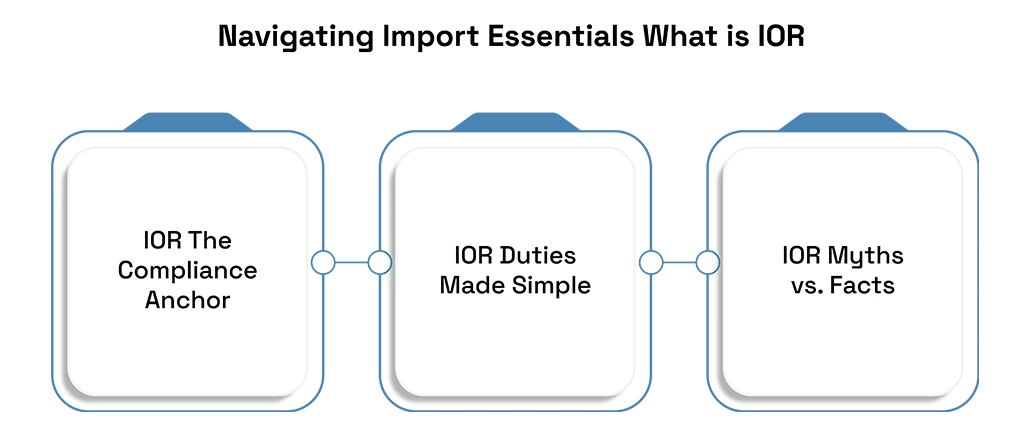
Navigating Import Essentials: What is IOR?
The Importer of Record (IOR) is a crucial organization that guarantees adherence to customs laws and promotes the efficient importation process. Their main duties include paying taxes, complying with customs, and handling paperwork. For IOR to efficiently negotiate regulatory duties, such as record-keeping and fines for non-compliance, they must have a thorough understanding of the legal landscape. Clarifying IOR place in international trade can be achieved by dispelling certain frequent misconceptions about them. Businesses must consider operational effectiveness, risk minimization, and compliance knowledge when analyzing the strategic ramifications of collaborating with an IOR. Understanding the fundamentals of IOR is ultimately necessary for smooth importation procedures and the ease of international trade.
Understanding IOR: comprehending the Fundamentals
Fundamentally, an Importer of Record is a person or organization that has been officially assigned legal responsibility for carrying out all import-related duties. This covers tasks including making sure import laws are followed, paying applicable taxes, and keeping accurate records. Businesses may ensure seamless operations and streamline their import procedures by assuming the role of IOR.
Historical Evolution of IOR: From Origins to Present
The Importer of Record is a historical development that illustrates how international trade procedures have changed throughout time. Importer were directly responsible for adhering to customs laws and tariffs, and importation procedures were initially more straightforward. Nonetheless, the requirement for a specialized organization to oversee these duties emerged as international trade increased and rules grew more intricate. In order to satisfy the needs of contemporary commerce, the IOR function has changed throughout time.
The IOR has evolved into a more sophisticated process due to technological improvements and globalization, frequently incorporating third-party logistics providers or expert compliance professionals. This progression signifies a change toward increased proficiency and effectiveness in handling the complexities of imports. Presently, the IOR is essential in promoting global trade by guaranteeing adherence to rules, reducing potential hazards, and expediting the customs clearing procedure. Business owners involved in international commerce must comprehend the IOR historical growth since it sheds light on how the laws and procedures that control imports today were developed.
Understanding the Significance of Being an Importer of Record
In global trade, the value of the Importer of Record (IOR) cannot be undermined as it guarantees the business meets the requirements of imports, legal penalties, and adds more value through free-flow interactions with customs regulation agencies to have a smooth operation across borders. The core duties based in the IOR are paying duties and taxes, adhering to appropriate laws, accurately classifying goods, and keeping proper documentation, which makes the businesses reliable and compliant participants in international business. The absence of an IOR reveals trade delays for companies. Also, it indicates the administrative problems and non-compliance that can hinder their operations across the globe. Thus, the role is vital to effective global operations.
Moreover, the legal aspect of an IOR requires them to comply with several regulatory frameworks that vary across countries. Still, they must also fulfil licensing requirements, import bans, and documentation, which a business must take care of to comply. Experience in regulating trade, customs regulation, and international agreements, compliance monitoring, and assembling prime compliance may lower legal risk, protect reputation, and smooth international freight transportation.
How Does an Importer of Record Help Businesses Enter New Markets?
Expanding into new markets can be challenging because businesses must meet with local customs, tax, & import rules. An Importer of Record helps companies import goods without creating a local legal entity by handling required documentation, customs duties, & regulatory processes. This support helps businesses minimize delays, avoid regulatory issues, & grow their processes more efficiently while focusing on their main business goals.
IOR Simplified: Unveiling the Basics
Importer of Record (IOR) might look complicated, but educating yourself on the fundamentals makes it relatively easier: they are the ones who should ensure that the trade laws are adhered to, maintain proper documentation, and be responsible legally for the imported goods. The major responsibilities of this role entail control of the import license and permit, customs clearance, classification of the goods being imported and compliance with these regulations, pillars through which organizations control imports.
Other myths, like the fact that only the product owner can be the IOR or the belief that it is too much work, can be classified as misconceptions; the truth of the matter is that any authorized party can be the IOR, and, provided adequate information or professional support, the job is not such a huge undertaking. Businesses should consider an IOR activity as a strategic step and consider factors such as the volume of imports, regulatory difficulty, skills or expertise within the specific organization, and resources that can be employed. Through close examination of their needs and capabilities, business enterprises can assess whether to take the responsibility of an IOR to the level where it fits within their trading destiny and operational ability.
Conclusion
The term “Importer of Record” designates the entity in charge of carrying out import duties. Businesses involved in international commerce must comprehend the foundations of IOR. The main responsibilities of an importer of record are compliance, paperwork, and legal requirements. Accepting the function of IOR helps to prevent any problems and promotes effective international commerce operations. Companies should assess their import requirements and capacities before choosing to become an IOR.
Did You Know?
U.S. importers must maintain import records for 5 years. These records help customs authorities verify compliance, documentation accuracy, and import transactions.
FAQs
What is an Importer of Record (IOR)?
An Importer of Record is the person or company legally responsible for importing goods into a country. The IOR ensures that all customs laws are followed, documents are correct, and duties and taxes are paid.
Why is an Importer of Record important in international trade?
The IOR is important because it helps prevent delays, fines, and legal issues. Without an IOR, goods may be held at customs or rejected, which can disrupt global trade operations.
What are the main responsibilities of an IOR?
The main duties of an IOR include handling import documents, classifying goods correctly, paying duties and taxes, obtaining permits, and ensuring compliance with all import regulations.
Can a company use a third party as an Importer of Record?
Yes, a company can appoint a third party to act as the Importer of Record. This is helpful when a business does not have a legal presence in the destination country or wants expert compliance support.
How does working with an Importer of Record benefit businesses?
Working with an IOR helps businesses reduce compliance risks, speed up customs clearance, and focus on core operations while ensuring smooth and lawful international trade.