Overview
Global demand for data centers and IT hardware continues to rise as digital change grows across industries such as IT services, aviation systems, medical technology, and automotive manufacturing. Also, exporters operating in this storage are facing huge pressure from two fronts: increasing tariffs and increasingly difficult approval requirements. These dual challenges are changing how international trade is planned, executed, and improved for cross-border shipments of valuable hardware. For import–export businesses, guiding these conditions now requires good regulatory knowledge, strong documentation controls, and smarter supply chain decisions to remain competitive.
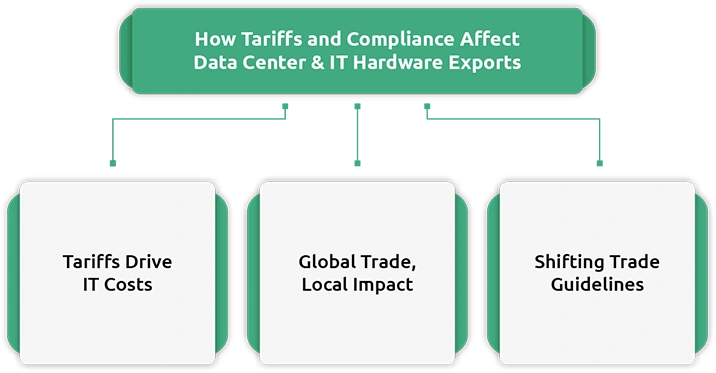
How Tariffs and Compliance Affect Data Center & IT Hardware Exports
The Impact of Tariff Structures on IT Hardware
Tariffs applied to servers, networking equipment, storage devices, and supporting infrastructure directly increase pricing and sourcing decisions. Changes in the HTS Harmonized Tariff Schedule and developing trade guidelines have increased cost uncertainty for exporters shipping to North America, Europe, and parts of Asia. Even small tariff adjustments can hugely affect margins due to the high unit value of data center equipment.
Correct HS code categorizations have become necessary to avoid overpayment, shipment delays, or execution actions during customs clearance.
Growing Compliance Requirements Across Borders
Beyond tariffs, exporters must follow stronger regulatory systems related to cybersecurity, product safety, efficiency, and origin clarity in global trade. Many countries now require increased documentation and validation before allowing entry of sensitive IT hardware.
For organizations working as an exporter of record or using Importer of Record Service support, approval failures can lead to shipment holds, penalties, or reputational damage. As a result, customs broker expertise and accurate confirmation of international shipping terms are now critical in exports.
How Data Center & IT Hardware Export Controls Are Reshaping Markets
Regulatory Controls and Market Realignment
Export controls on advanced computing equipment and data center devices are changing global trade routes. Some manufacturers are restructuring production locations or redirecting exports to reduce issues with tariffs and regulatory approval in global trade.
These controls have also increased demand for supply chain optimization trade, such as regional warehousing, alternative sourcing, and adjusted inventory and order management methods.
Industries Effects Across Multiple Sectors
The impact of these controls extends beyond IT alone. Aviation, medical, and automotive industries increasingly depend on data center infrastructure for analytics, automation, and approval reporting in industries. Delays in IT hardware exports can stop complete production ecosystems, highlighting the interconnected work of modern supply chains.
Effective international freight services and premium delivery service options are now frequently used to maintain continuity for time-sensitive deployments.
How to Avoid Export Dual Challenges for Data Center & IT Hardware
Strategic Planning and Documentation Accuracy
Proactive trade planning is the first step in reducing risk. Exporters must confirm product categorizations, valuation details, and supporting documents work with destination-country requirements. Proper use of Incoterms, such as DAP, can help clearly define cost and risk responsibilities between buyers and sellers.
Strong work with a qualified customs broker improves the accuracy of completion and speeds up customs clearance.
Using Integrated Trade Services
Working with providers that provide end-to-end logistics, importer of record services, and international freight services can hugely reduce administrative load. This approach allows exporters to focus on core operations while maintaining approval across borders. Integrated logistics, inventory, and order management systems also help businesses respond more quickly to regulatory changes without stopping the delivery schedule.
Building Agreement Supply Chains
Exporters serving data center and IT hardware markets must build agreement into their supply chains from the outset. This includes supplier vetting, regulatory tracking, and consistent communication with partners involved in international shipping terms and documentation handling.

Conclusion
Data center and IT hardware exports are entering a more regulated and cost-sensitive era for trade. The combined tension of tariffs and compliance requirements is forcing exporters to rethink how they manage trade work across global trade. Organizations working in IT, aviation, medical, and automotive industries, success now depends on major planning, regulatory approval, and improved logistics systems. Working with tariff management, approval execution, and supply chain optimization, exporters can overcome these dual challenges and continue to support the growing global demand for digital systems.
DID YOU KNOW?
Last month, exports increased by 43.4 percent compared to the previous year, reaching $62.48 billion, thus maintaining the growth trend that has continued for 26 consecutive months.
FAQs:
1. How do tariffs affect data center and IT hardware exports?
Tariffs increase the landed cost of servers, networking equipment, and storage systems, directly impacting pricing, margins, and sourcing strategies in international trade.
2. Why is compliance critical for IT hardware exports?
Compliance ensures adherence to export controls, cybersecurity rules, safety standards, and documentation requirements, helping exporters avoid shipment delays and penalties.
3. What role do export controls play in reshaping global markets?
Export controls influence production locations, trade routes, and sourcing decisions, encouraging supply chain optimization and regional diversification.
4. How can exporters reduce risks related to tariffs and compliance?
Exporters can minimize risks through accurate HS classification, proper documentation, customs broker support, and integrated trade and logistics services.
5. Which industries are most affected by IT hardware export challenges?
Industries such as IT services, aviation, medical technology, and automotive manufacturing are highly impacted due to their dependence on data center infrastructure.