Insight
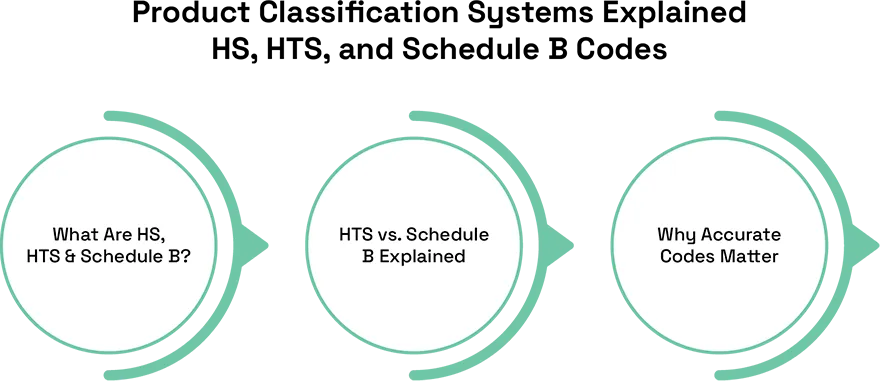
The exact identification of products forms an essential element in global commerce systems. The classification system helps identify products correctly, enabling proper tariff and taxation procedures and regulatory compliance. The product classification methods for aviation, automobile, IT/data centers, & medical equipment present complex business challenges since these techniques differ between countries. Three classification systems repeatedly used in international trade include the HS Harmonized System, the HTS Harmonized Tariff Schedule, and the Schedule B coding system. Businesses must understand product code operations and their importance because it ensure perfect import/export trading processes.
The Harmonized System / HS
The Harmonized System (HS) is a globally standardized classification system used by customs authorities worldwide. The World Customs Organization (WCO) developed and maintains it. More than 200 countries and economies use the system to categorize products traded internationally.
The HS is a six-digit code that classifies goods according to their nature and composition. The first two digits of the code show the chapter, which indicates the product category (machinery, medical equipment, electronics, etc.). Then, it is followed by two digits for the heading, further dividing the category into even more specific product groups. The last two indicate the subheading, which details the product’s characteristics.
For instance, the HS code of the aircraft is 8802. In plain English, the “88” means the chapter covering aircraft and spacecraft, and the “02” means the heading covering parts of aircraft.
The main advantage of HS lies in its worldwide popularity. Using the same classification system helps businesses identify goods properly across borders. Simplifying import/export processes while adhering to international trade regulations. Making customs declarations easier.
The Harmonized Tariff Schedule (HTS)
The HS system is universally accepted, while the HTS code is specific to the U. The HTS determines which tariffs, or duties, apply to imported products that enter the U.S. The last two digits of HS (HSN) are subdivided into sub-script levels of 4 digits as per the HSN code, and the Director General of Foreign Trade (DGFT) has its extended classification (HTS). The HS code system has been extended to HTS to provide a 10-digit code.
The first six digits of the HTS code correspond to the HS code, with the next four digits denoting U.S. regulations and trade agreements.
Schedule B Codes
Schedule B is specific to the U.S. and is used for export reporting. The Schedule B system, which focuses on goods for export, is maintained by the U.S. Census Bureau. Similar to HS and HTS codes, Schedule B codes are a means of product classification that allows goods to move freely across international borders.
While the HS and HTS codes help identify products for customs purposes, Schedule B codes are specifically designed to track exports. The Schedule B system is more detailed than the HS system, adding additional digits to the code to provide greater precision.
Like the HTS, which evaluates tariffs and taxes on imports, Schedule B codes allow the U.S. government to monitor export trends and where American-made goods are sent.
For instance, if a company were exporting IT equipment like servers or routers, it would be required to apply the appropriate Schedule B code on its export documentation. Improper misidentification of products under Schedule B may cause delays in shipment, licensure problems, or even trade compliance violations for businesses.
Why Product Classification Matters for Faster Customs Clearance
Product classification helps customs quickly understand what goods are being shipped. When HS, HTS, and Schedule B codes are correct, shipments pass faster through customs and reduce checks and delays. It also helps avoid confusion, extra inspections, and wrong duty charges. Correct classification makes the import and export process more smooth and simple. With proper product codes, businesses can save time, reduce delays, and ensure goods reach their destination faster and without problems.
Ensuring Correct Product Classification
Companies need to stay updated when there are changes to HS, HTS, and Schedule B codes to make sure their products are classified correctly. Since these codes can differ by country and are updated regularly, businesses should review them often and recheck their product classification whenever changes occur.
Working with trade compliance specialists or customs brokers who can guarantee products are classified correctly is also important. These experts understand classification systems and can ensure your products are applying the right codes.
Conclusion
Knowledge of product classification systems is vital for businesses engaged in international shipping. Accurate classification is important for adhering to global trade regulations and minimizing the chances of delays, preventing businesses from facing expensive errors. We help businesses avoid such bulky scenarios as compliance and logistics; professionals at One Union Solutions validate proper product classification and ensure uninterrupted international trade operations.
Did You Know,
In 2022, over $200 billion worth of IT equipment was exported from the US, with classification codes playing an essential part in facilitating trade agreements and export control compliance.
FAQs
1. What is the difference between HS codes and HTS codes?
HS codes are used globally to classify products in international trade, while HTS codes are specific to the United States and determine applicable import duties. HTS codes extend the HS code by adding extra digits for more detailed classification.
2. Why are Schedule B codes required for exports?
Schedule B codes are used to classify U.S. export goods. They help track trade data, meet export compliance requirements, and ensure products are correctly declared to customs authorities.
3. What is product classification in international trade?
Product classification means giving a correct code to a product so customs can identify it and apply the right rules, taxes, and duties.
4. How does One Union Solutions help with classification?
One Union Solutions helps businesses select correct HS, HTS, and Schedule B codes to ensure smooth customs clearance and compliance.
5. How frequently do product classification codes get updated?
Customs authorities periodically revise classification codes. Businesses must stay updated and regularly review their product classifications to ensure ongoing accuracy and compliance.