Overview
The aviation industry has long depended on global supply chains, such as parts and manufacturing goods shipped across borders in global trade. Also, growing geopolitical tensions, trade controls, and economic restoration are changing this method. Aviation decoupling describes a growing trend in which global aircraft supply chains are gradually reorganizing into regional blocs that work for political and economic interests rather than working as a single combined system. Aircraft manufacturing has conventionally depended on cross-border trade supported by standardized trade systems, systematic logistics networks, and clearly defined Incoterms that allowed suppliers and manufacturers to work effectively.
This shift is happening because countries now want more control over critical aviation parts and technology. As a result companies are focusing on local or regional suppliers instead of relying only on global partners. This change helps reduce risks from trade restriction and supply delays. It also encourages faster production and more secure supply chains within specific regions.
What is aviation decoupling in the global aircraft supply chains?
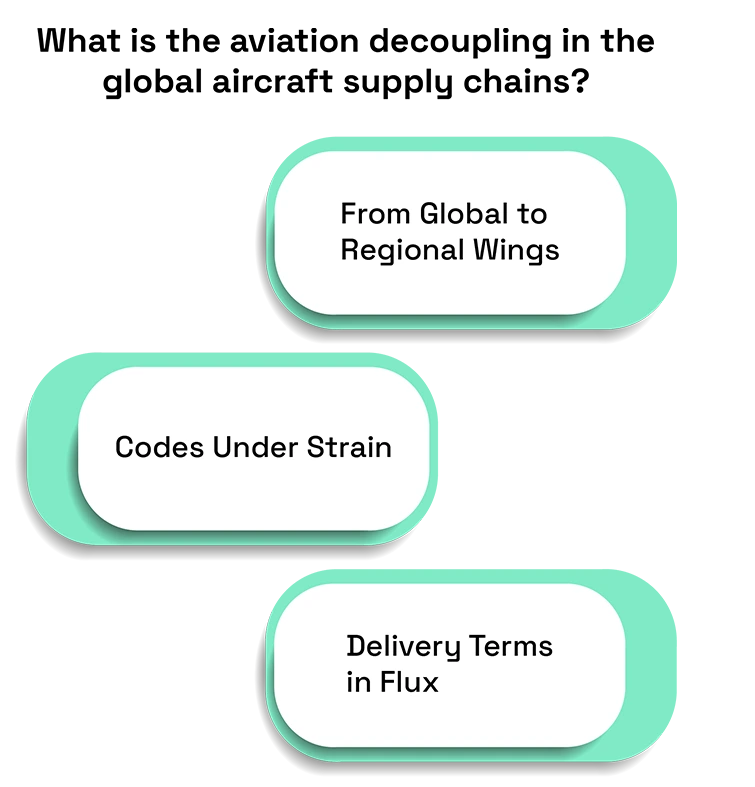
Aviation decoupling refers to the gradual separation of aerospace production ecosystems into regional chains with reduced dependence on global partners. Also, manufacturers such as Boeing and Airbus sourced parts globally using standardized categorization systems such as HS code structures and the HTS Harmonized Tariff Schedule to simplify the global shipment of aircraft components. These global systems allowed effective customs clearance processes and predictable trade shipping. However, stronger export controls and tariff structures are changing how organizations structure agreements such as DAP and DAPs delivery arrangements under Incoterms rules. Businesses must now carefully manage responsibilities connected to shipping and risk allocation.
Why are global aircraft supply chains splitting into blocs
Geopolitical tensions and regulatory variations
In 2025 political tensions between big economies like the US, China and Europe continued to affect the aviation industry. Governments also added more restrictions on exporting advanced aerospace technology to other countries to protect national security and support their own industries. Many countries made trade rules stricter and added more cheeks for aircraft parts and items that can be used for both civil and military purposes. This made the approvals process more detailed and time consuming for companies. This made international approvals slower and more complex for aviation companies. At the same time, global sanctions and trade barriers in certain regions forced companies to change suppliers and find new partners. As a result, many businesses started focusing more on the regional supply chain instead of depending fully on global sourcing.
Operational flexibility and supply chain restructuring
Global disruptions exposed weaknesses in the extended supply chain. Aerospace organizations are now investing in supply chain optimization plans that balance cost efficiency with dependability. Organizations increasingly combine inventory and order management systems to maintain visibility across suppliers located in different blocs. International freight services and advanced logistics planning have become necessary for maintaining the production schedule as routes and approval requirements grow more difficult in global trade.
Approval and documentation challenges
As regulations change, organizations must know their responsibilities clearly. Questions such as can a freight forwarder be an exporter of record or can a customs broker handle both import and export documentation are becoming central to working planning. Organizations must align exporter of record services and importer of record Service roles to confirm the right documentation and smooth customs clearance procedures. The need for the best trade compliance software for import export rules has also increased, allowing aerospace organizations to manage tariff categorizations, regulatory checking, and documentation accuracy across multiple administrations.

Learn How One Union Solutions Help You
Managing complexity in the aviation ecosystem
As aviation supply chains reorganize into regional blocs, businesses must maintain approval while confirming the uninterrupted shipment of high-value aircraft components. One Union Solutions supports aerospace organizations by simplifying operational workflows connected to international trade requirements. Through structured exporter of record services and importer of record services support, organizations can guide developing regulations without stopping production schedules.
Improving operational efficiency
Organizations benefit from combined logistics work, international freight services planning, and documentation management, working with Incoterms problems. This structured approach increases supply chain optimization while reducing delays caused by regulatory mismatches between regions. Combining compliance expertise with inventory and order management visibility, aviation companies can maintain operational continuity even as global trade.
Ensuring regulatory compliance across regions
One Union Solutions helps businesses stay updated with changing aviation and trade regulations in different regions. This reduces the risk of penalties, shipment delays, and documentation errors, ensuring smooth international operation.
Conclusion
Aviation decoupling does not show the end of globalization but rather its transformation. The industry is changing toward interconnected regional ecosystems shaped by geopolitical priorities, regulatory systems, and dependence strategies. Manufacturers must be used to developing tariff systems, delivery terms such as DAP arrangements, and stricter approval expectations connected to HS code categorizations and trade programs. Countries such as India may play an important role by supporting varied manufacturing partnerships across multiple blocs. Shipping forward, aerospace companies that invest in approval readiness, improved logistics plans, and supply chain methods will be best positioned to succeed in a world where aircraft supply chains are no longer global.
DID YOU KNOW?
Boeing China President Alvin Liu said in June 2024 that Boeing had resumed deliveries of its new aircraft to China, including the 737MAX and 787 Dreamliner.
FAQs:
1. What is aviation decoupling in simple terms?
Aviation decoupling refers to the gradual shift from globally integrated aircraft supply chains toward regional manufacturing and sourcing networks influenced by geopolitical and regulatory factors.
2. Why are aircraft supply chains becoming regional instead of global?
Rising geopolitical tensions, export controls, tariffs, and supply chain disruptions have encouraged countries and manufacturers to prioritize local or regional sourcing for greater stability and security.
3. How do Incoterms like DAP affect aerospace logistics?
Delivery terms such as DAP define responsibilities for shipping, risk transfer, and customs obligations, making them critical when managing cross-border aircraft component shipments.
4. What role does trade compliance play in aviation supply chains?
Trade compliance ensures accurate HS code classification, documentation, and adherence to import-export regulations, helping avoid delays, penalties, and shipment disruptions.
5. Can freight forwarders or customs brokers manage export and import documentation?
Depending on regulations, freight forwarders or customs brokers may support documentation, but companies must clearly assign exporter of record and importer of record responsibilities to remain compliant.