Overview
Penalties and enforcement trends in export control violations have become a main issue in global trade. As geopolitical problems, technology risks, and dual-use goods policies rise in the supply chain, governments are increasing analysis over cross-border trade. Export controls are no longer restricted to defense goods; they now extend to new electronics, devices, semiconductors, and even developing technologies. Administrators expect organizations working with international freight services and across the region logistics to have clear documentation, correct HS code categorizations, and full approval with Incoterms in the global trade.
Principles and Objectives of Export Controls Violations in Global Trade
Export controls are related to protecting national security, foreign policy, and economic safety. Organizations such as the Bureau of Industry and Security in the United States and the Directorate-General for Trade in the European Union apply strong rules governing the shipments of controlled goods.
The primary objectives include:
Stopping Unauthorized Technology Changes
Governments regulate the export of sensitive goods to limit the extent of military technologies and the misuse of dual-use products. Miscategorizations of goods under the HS code or the HTS harmonized tariff schedule can result in inspections and penalties.
Confirming Accurate Documentation and Responsibilities
Clear identification of the exporter of record services and the importer of record services is necessary for customs clearance. Many businesses ask, can a freight forwarder be an exporter of record? While possible in limited scenarios, authorities mostly hold the actual seller responsible for approval in destinations.
Maintaining Trade Integrity
Export control systems work with broader trade policies, including tariff preferences under programs like generalized system of Preferences (GSP). Misuse of such systems may result in enforcement actions and suspension of trading benefits in the supply chain.
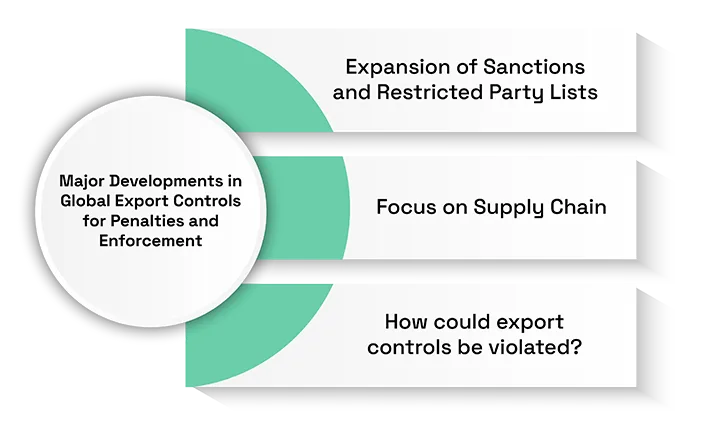
Major Developments in Global Export Controls for Penalties and Enforcement
Recent years have seen fines and aggressive enforcement actions. Authorities are using advanced data analytics and best trade compliance software for import export rules to identify exceptions in shipments.
Expansion of Sanctions and Restricted Party Lists
Exporters must see all trades against updated sanctions lists. Errors in customs clearance or inaccurate declarations of DAP and DAPs shipping terms can raise approval red flags.
Focus on Supply Chain
Authorities are not only penalizing manufacturers but also brokers. Questions such as ” Can a customs broker handle both import and export documentation are increasingly related, as brokers and freight forwarders face dependability for neglect or planned violations.
How could export controls be violated?
In some cases, these actions may be taken intentionally to avoid getting an export license, but most violations occur unknowingly; e.g., organizations that lack a formal export classification process may be uninformed of applicable licensing requirements or may fail to properly screen the businesses involved in a transaction or to recognize red flags.
Fundamental changes to the supply chain in Export Control Violations
Export control enforcement is reshaping global supply chains in significant ways.
Change Toward Regionalization
Businesses are re-evaluating sourcing plans to reduce regulatory problems. Supply chain optimization is now looking for political risk, permits requirements, and export restrictions before going into new markets.
Increase Responsibilities and Tracking
Inventory and order management systems are combined with approval tools to confirm traceability from production to final delivery. Correct HS code categorizations and documentation, working with Incoterms reduces execution risk.
Greater Dependence on Specialized Compliance Services
Organizations increasingly depend on exporter of record services and Importer of record service providers to manage regulatory problems. Also, third-party service providers do not reduce dependability; ultimate responsibility remains with the exporting companies.
Future Trends of Export Controls Violations to Avoid Penalties
Authorities are investing in new analysis to track shipments in real time. Automated systems cross-check customs data, HS code, and shipping patterns for inconsistencies. Executives and administrative officers may face personal dependability in many cases. Regulators increasingly expect board-level problems with export control programs. Growing industries such as artificial intelligence, quantum computing, and advanced manufacturing mainly see stronger guidelines. Companies working in these industries must combine approval into early-stage business planning. In this evolving environment, businesses must confirm that their customs clearance processes, documentation accuracy, and trade agreement systems are strong and continuously updated.
Conclusion
Penalties and enforcement trends in export control violations show a global change toward stronger regulatory problems. Governments are expanding controls, increasing penalties, and using digital tools to detect non-agreement. Organizations must use proactive approval strategies, including accurate HS code categorizations, clear Incoterms usage, effective Inventory and order management, and complete screening guidelines.
DID YOU KNOW?
The President’s 2026 budget request calls for a 133% increase in BIS enforcement spending. The proposal would cost BIS an additional $122 million, allowing it to hire nearly 200 additional special agents across the United States.
FAQs:
1. What are export control violations?
Export control violations occur when companies fail to comply with government regulations governing the shipment of controlled goods, technologies, or dual-use goods across borders.
2. What are the common penalties for export control violations?
Penalties may include heavy financial fines, shipment seizures, loss of export privileges, criminal charges, and reputational damage. In serious cases, executives may face personal dependability.
3. How can export controls be violated?
Violations can happen intentionally or unintentionally. Common causes include incorrect HS code classification, failure to get export licenses, improper sanctions screening, and inaccurate documentation.
4. What role do sanctions lists play in export compliance?
Sanctions and restricted party lists must be checked before completing any trade. Failure to screen properly can lead to enforcement action and regulatory penalties.
5. How can companies reduce the risk of export control penalties?
Businesses should implement strong compliance programs, use trade compliance software, conduct regular audits, confirm correct documentation, and train staff on export regulations and Incoterms.