Global trade in 2026 is described by a paradox: while technology speeds up operations, the regulatory, geopolitical, & environmental landscape has managed the most complex operating environment in decades. Customs management has changed from a back-office compliance task to a critical strategic function, with 60% of executives indicating customs clearance as the main issue in global supply chains.
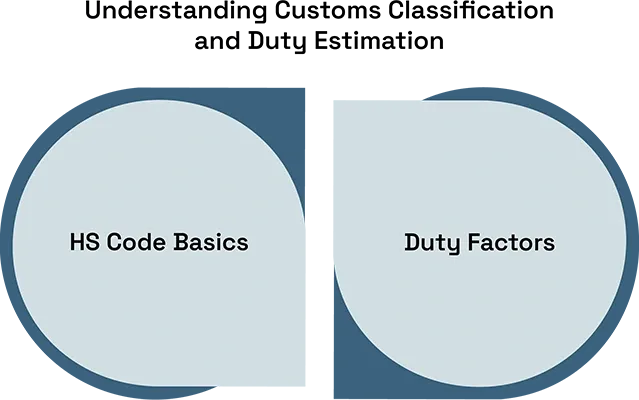
Understanding Customs Classification and Duty Estimation
Customs classification added assigning a specific Harmonized System (HS) code to goods to verify applicable duties, usually calculated as a percentage of the Cost, Insurance, & Freight value. Main factors affecting duties include the HS code, origin country, & transaction value, with rates often ranging from 0-100%.
Customs Classification (HS Codes)
The Harmonized System (HS) Codes are a globally standardized classification system used to identify & categorize traded goods based on their characteristics, composition, & meant use. Globally, the system follows a six-digit structure, while countries such as India extend it further to eight digits for more detailed product classification. Accurate HS code classification is useful in international trade because it verifies the applicable Basic Customs Duty rates, tax exemptions, & Integrated Goods & Services Tax requirements applied to imported or exported products. Goods are mainly defined by reference to the Customs Tariff Act, where products are organized according to factors such as their degree of manufacture, capability, or technological difficulties. Proper verification helps businesses manage trade compliance, avoid customs issues, & ensure accurate duty development during cross-border transactions.
Customs Duty Estimation Components
The estimated Value, commonly referred to as the CIF value, serves as the base for customs duty calculation & includes the cost of goods along with insurance & freight charges incurred during transportation. Depending on this value, the Basic Customs Duty is applied as the main import duty, with rates ranging from 0% to 100% depending on the product category & country of origin. BCD is a Social Welfare Surcharge (SWS) that is mainly applied, which is typically calculated as 10% of the applicable BCD amount. Imported goods are also subject to managing Goods & Services Tax, which is collected on the merged value of the CIF amount, BCD, & SWS. Certain products may attract additional charges such as anti-dumping duties or security duties, mainly when governments aim to protect domestic industries from unfair trade practices or extreme imports.
Industries That Will Benefit Most from AI Workflow Automation in the U.S.
Information Technology (IT) Sector
The Information Technology sector is the biggest beneficiary of AI workflow automation in the United States. AI-powered systems are helping organizations automate copy tasks such as software testing, cybersecurity management, cloud management, customer support, & data analysis. Automation improves operational efficiency, minimizes manual workloads, & accelerates digital transformation initiatives. AI-driven tools also support predictive maintenance, intelligent coding assistance, & faster situation resolution, enabling IT companies to improve usability while minimizing operational costs.
Medical Equipment Industry
The medical equipment industry is growing, and AI workflow automation is being used to enhance manufacturing precision, regulatory compliance, & healthcare operations. AI systems help automate quality verification, inventory tracking, predictive maintenance, & supply chain management for medical devices & diagnostic equipment. In hospitals & healthcare facilities, AI-enabled workflows provide strong patient management, imaging analysis, & equipment usability. Automation also helps manufacturers meet strict regulatory standards while minimizing production errors & improving operational efficiency across healthcare ecosystems.
Aviation Industry
The aviation industry is using AI workflow automation to improve operational safety, maintenance efficiency, & passenger experience. Airlines & aerospace companies use AI-driven systems for indicative aircraft maintenance, flight scheduling, baggage handling, fuel optimization, & air traffic management. Automation helps minimize delays, improve aircraft performance management, & use workforce allocation. AI-powered analytics also support real-time decision-making, improving operational reliability & minimizing costs in highly complex aviation environments.
Automobile Industry
The automobile industry is rapidly developing AI workflow automation across manufacturing, logistics, & vehicle development processes. Automotive manufacturers use AI-powered robotics & automation systems for assembly line operations, quality control, predictive maintenance, & supply chain management. AI also supports autonomous driving technologies, smart vehicle diagnostics, & connected car systems. Workflow automation enables faster production cycles, improved product quality, & greater operational efficiency while helping manufacturers adapt to the growing demand for electric & intelligent vehicles.

Conclusion
AI-powered customs classification & duty estimation systems are developing international trade tasks by increasing accuracy, usability, & compliance in mainly difficult import-export businesses. As global trade regulations are in progress to develop, businesses are depending on AI-driven automation to develop customs processes, minimize human errors, & manage duty calculations. Automated HS code classification, real-time tariff calculation, & intelligent compliance management are helping organizations to manage regulatory requirements more easily while minimizing transportation delays & financial risks.
Did you know?
As global supply chains become increasingly complex and tariff landscapes shift unpredictably, IDC research reveals that companies using manual classification processes spend 60% more time on compliance activities. Here’s how we got here — and where the industry is headed.
FAQ
1. What are AI-powered customs classification and duty estimation systems?
AI-powered customs classification and duty estimation systems are automated solutions that use artificial intelligence to classify goods using Harmonized System (HS) codes and calculate applicable customs duties, taxes, and tariffs for international trade transactions.
2. How does AI improve customs classification accuracy?
AI improves customs classification by analyzing product descriptions, specifications, historical trade data, and regulatory databases to assign accurate HS codes while reducing manual errors and compliance risks.
3. What factors are considered in customs duty estimation?
Customs duty estimation typically considers factors such as the HS code, country of origin, Assessable Value (CIF), Basic Customs Duty (BCD), Social Welfare Surcharge (SWS), and Integrated Goods and Services Tax (IGST).
4. Which industries benefit the most from AI-powered customs automation?
Industries such as information technology, medical equipment, aviation, automotive, manufacturing, and global logistics benefit significantly from AI-powered customs automation due to their complex international trade operations and compliance requirements.
5. Why are AI-driven customs systems important for global trade?
AI-driven customs systems help businesses improve trade compliance, reduce shipment delays, automate tariff calculations, lower operational costs, and enhance supply chain efficiency in increasingly complex global trade environments.