Freight pricing has never been completely stable. Capacity, demand, distance, shipment size, route conditions, seasonal peaks, busy ports, & service requirements can all change the cost of shipping goods. Logistics companies have managed these variables through rate cards, carrier contracts, spreadsheets, manual calculations, & negotiations. That model is now changing.
Artificial intelligence is allowing freight companies to verify large volumes of pricing & market data & generate quotes much faster. Updated pricing systems can consider historical shipment data, current capacity, lane performance, carrier rates, demand patterns, & other variables when recommending a freight price.
What Is AI Freight Pricing?
AI freight pricing uses artificial intelligence & machine-learning models to estimate or recommend the price of transporting a shipment.
A traditional freight quote may depend on a predefined rate card & manual input. An AI-based pricing system can evaluate many variables simultaneously & adjust the recommended price according to changing market conditions. This creates a more responsive pricing model than depending exclusively on a fixed rate sheet.
AI Can Make Freight Quotes Faster
One of the biggest advantages of AI pricing is speed. Traditional quoting can involve multiple emails, phone calls, spreadsheets, & approvals. AI-powered systems can automate calculations & produce a recommended rate almost immediately.
This does not necessarily mean that every shipment will receive a completely automated quote. Instead, AI can function as a price assistant that provides sales teams with recommendations supported by data. This can shorten the time it takes for freight forwarders and brokers to reply to a quote request. This is important because a customer’s decision to choose one logistics provider over another might be influenced by speed. The way freight brokers and forwarders work is already being transformed by AI-powered technologies.
Better Pricing Accuracy
AI can also help minimize cost decisions based purely on intuition. A pricing model can analyze historical transactions & compare current conditions against previous market patterns.
If a particular shipping lane mainly becomes more costly during a certain period, an AI model can identify that pattern. If available capacity suddenly falls, the system can factor that into the recommended price.
Dynamic Pricing Can Improve Freight Margins
Pricing is not only about giving customers a competitive rate. Logistics providers also need to protect their margins.
An AI pricing engine can compare carrier buy rates with the company’s target selling price & recommend a rate that balances competitiveness with profitability.
Updated freight-pricing platforms are already being developed around this concept, using market & historical data to benchmark buy & sell rates & recommend prices based on target margins.
What Happens to Traditional Rate Cards?
Traditional rate cards are unlikely to disappear overnight. Long-term contracts remain important for businesses that need predictable transportation costs. Large shippers may negotiate annual or multi-year agreements with carriers. Contract pricing can provide budget stability even when spot-market rates fluctuate. The future is therefore more likely to be hybrid pricing. This approach combines the predictability of traditional contracts with the responsiveness of dynamic pricing.
AI Pricing Will Not Eliminate Human Expertise
It is tempting to assume that AI will eventually remove the need for freight pricing teams. That is unlikely. Freight is more complicated than a mathematical pricing problem. A shipment may involve customs needs, special handling, unusual dimensions, dangerous goods restrictions, delivery appointments, remote locations, or customer-specific contractual terms.
AI may identify the likely cost, but a human may still need to determine whether the proposed transportation solution is practical. Human oversight is also important when data is incomplete or market conditions suddenly change. The strongest model may therefore be AI-assisted pricing rather than AI-only pricing.

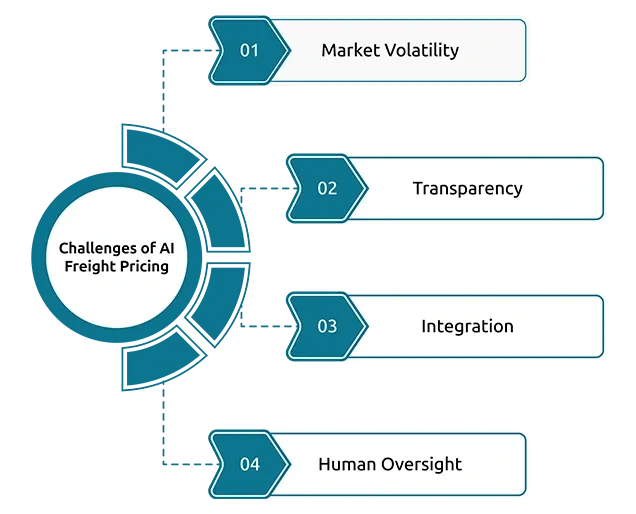
Challenges of AI Freight Pricing
Despite its potential, AI pricing has some challenges.
Data Quality
The usefulness of AI models depends on the data they are fed. Unreliable suggestions may result from old contracts, missing shipment information, inaccurate carrier rates, or inadequate historical records.
Market Volatility
Even complex pricing models can be disrupted by unforeseen circumstances. Conditions that previous statistics cannot reliably forecast could be brought on by an abrupt port shutdown, a geopolitical problem, extreme weather, or a lack of capacity.
Transparency
Customers may question why a freight price changed. Logistics providers therefore need pricing systems that can explain the major factors behind a quote rather than simply producing a number.
Integration
AI pricing needs access to transportation management systems, carrier rate databases, shipment history, customer information, & potentially real-time market data. Integrating these systems can be difficult.
Human Oversight
Automated pricing still needs rules & controls. Companies must decide when AI can automatically issue a quote and when a human employee should review it.
Conclusion
AI is changing freight pricing from a relatively static process toward a more responsive & data-driven model. Traditional shipping quotes will continue to have a role, especially for contracted transportation and predictable lanes. But the way those quotes are created is changing. A freight quote may no longer be a number manually pulled from a rate sheet. It could be a mainly calculated recommendation based on current capacity, historical performance, market demand, operational costs, & the shipper’s requirements.
AI is unlikely to eliminate traditional freight pricing. Instead, it could make freight pricing faster, more predictive, and more adaptive to the real conditions of global transportation. For logistics providers, the competitive advantage may ultimately come not from simply offering the lowest rate, but from knowing when, why, and how that rate should change.
Did you know?
These APIs allow forwarders to connect their rate management systems to their TMSs or their rate management systems to their sales portals, all still with API access to rates from the over 50% of global air cargo capacity available online.
FAQ
1. How does AI determine freight pricing?
AI freight pricing analyzes factors such as shipment details, historical rates, carrier capacity, fuel costs, route conditions, demand, and market trends to recommend a suitable freight rate.
2. What is the difference between AI freight pricing and traditional shipping quotes?
Traditional shipping quotes often rely on fixed rate cards, contracts, and manual calculations. AI freight pricing can evaluate multiple data points simultaneously and adjust recommendations as market conditions change.
3. Can AI freight pricing reduce shipping costs?
AI can help identify competitive rates by comparing historical pricing, available capacity, carrier rates, and market conditions. However, it does not guarantee lower costs because freight prices can change due to demand, fuel prices, capacity, and unexpected disruptions.
4. Will AI completely replace freight pricing teams?
No. AI can automate routine calculations and provide pricing recommendations, but human expertise remains important for complex shipments, negotiations, unusual requirements, and situations where market data is incomplete or unreliable.
5. Is dynamic freight pricing suitable for all types of shipments?
Not necessarily. Dynamic pricing can be particularly useful for spot shipments and lanes with frequently changing capacity or demand. Contract pricing may remain more suitable for businesses that require predictable rates and long-term transportation commitments.