
Semiconductors are the backbone of this growing digital economy. From artificial intelligence & cloud computing to smartphones, electric vehicles, healthcare systems, & defense technologies, chips now power almost every critical industry globally. As demand for computing capacity increases at an unprecedented pace, the semiconductor industry is rapidly becoming a trillion-dollar market, used largely by the global AI growth & the expansion of hyperscale data centers.
Understanding AI Infrastructure Demand
AI infrastructure needs are observing historic development, made by the huge computational needs of generative AI, agentic AI, & large-scale model training. International funding on AI networks is planned to grow from $334 billion in 2025 to over $900 billion by 2029. This development represents a changeable shift from past IT infrastructure to specialized, high-density computing environments.
Core Drivers of Demand
Generative AI & Agentic AI: The quick growth of generative AI is the main growth engine for data centers. Agentic AI autonomous agents that perform tasks increase demand even further by creating thousands of requests per hour compared to one for a human.
Training vs. Inference: While high GPU systems are currently built for training, inference workloads running live models are expected to account for 80–85% of AI workloads within two years, driving a need for globally shared, low-speed infrastructure.
Data speed: AI applications are predicted to make over 180 zettabytes of global data by 2025, requiring more storage & processing abilities.
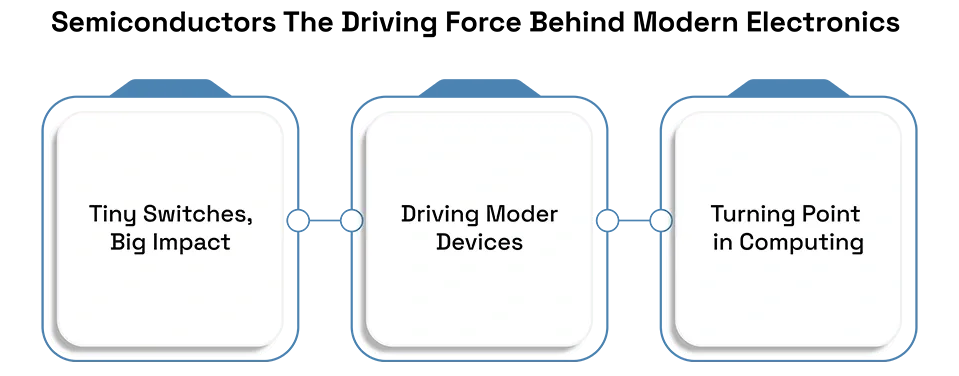
Semiconductors: The Driving Force Behind Modern Electronics
From busy cities to secluded rural villages, a singular technology is reshaping our lifestyles & professional landscapes. Whether it’s the smartphones placed in our pockets, the expansive data centers driving the internet, or the range from electric scooters to hypersonic aircraft, pacemakers to meteorological supercomputers within each of these developments, silently yet essentially, lie compact components of technology that enable it all to be driven by semiconductors.
These semiconductors serve as the fundamental building blocks of contemporary computation. Transistors, semiconductor devices, act as microscopic electronic switches orchestrating computations within our computers. The inaugural silicon transistor, a groundbreaking invention, was crafted by American scientists in 1947. Before this milestone, computing mechanics relied on vacuum tubes, which could have been more active and convenient. Silicon’s introduction marked a transformative turning point.
AI as the Core Driver of Chip Innovation
The semiconductor industry is at the beginning of a changing era, driven by the rapid adoption of artificial intelligence. This development isn’t just about limited improvements; it’s about reshaping the whole value chain, from chip design to manufacturing & beyond.
AI workloads are mainly reshaping semiconductor design priorities. Unlike past computing tasks, AI needs huge parallel processing power, ultra-low speed, & high memory bandwidth. This has accelerated the shift toward specialized architectures such as GPUs, TPUs, & application-specific integrated circuits, which are purpose-built to manage difficult neural network computations efficiently.
Memory technology has become as important as processing power. High Bandwidth Memory & advanced packaging techniques are now central to improving data throughput & minimizing bottlenecks in AI training & inference systems. Innovation is no longer limited to chip performance alone; it now extends to system-level optimization, where compute, memory, & interconnects must work seamlessly together.

Benefits of AI infrastructure
In addition to supporting the development of cutting-edge applications for customers, enterprises investing in AI infrastructure mainly see important improvements to their processes & workflow.
Increased scalability and flexibility
AI infrastructure is mainly cloud-based or deployed at the edge; it’s both scalable & flexible. As the datasets needed to power AI applications become larger & more difficult, AI infrastructure is used to scale with them, helping organizations to increase resources on an as-needed basis. Flexible cloud & edge infrastructure is highly adaptable & can be scaled up or down more easily than traditional IT infrastructure as an enterprise’s requirements change.
Greater performance and speed
AI infrastructure uses the latest high-performance computing technologies available, such as GPUs, TPUs, & supercomputing systems, to power the ML algorithms that support AI capabilities. AI ecosystems have parallel processing capabilities, which mainly minimize the time needed to train ML models. Because speed is crucial in many AI applications, such as high-frequency trading apps & driverless cars, the improvements in speed & performance are a main feature of AI infrastructure.
Better compliance
As concerns around data privacy & AI have increased, the regulatory environment has become more difficult, including data residency & AI control concerns. Strong AI infrastructure must ensure that privacy laws are observed strictly during data management & data processing in the development of new AI applications. AI network solutions ensure that enterprises closely follow all applicable laws & standards & enforce AI compliance. They also protect user data & guard against legal & reputational damage.
Conclusion
The fast development of AI infrastructure is mainly changing the semiconductor industry, transforming it from a hardware-centric ecosystem into the main backbone of the global digital economy. As generative AI, agentic systems, & large-scale machine learning models continue to develop, the demand for high-performance, energy-efficient, & specialized chips will only increase.
Did you know?
China aims to source more than 70 per cent of its advanced silicon wafers domestically by 2026 as part of a broader push to strengthen its semiconductor supply chain and reduce dependence on foreign suppliers.
FAQ
1. What is the forecast for the AI semiconductor market?
The AI chip market is expected to surge to reach $125 billion in 2026.
2. Who is winning the AI chip race?
Taiwan still leads in advanced manufacturing, producing over 70% of high-end chips.
3. How does AI affect semiconductor demand?
AI requires massive amounts of computing power and storage. While typical chips see cyclical demand, AI processors and memory are seeing exponential, continuous growth.
4. What are the main risks?
The primary risks include massive power consumption by data centers creating “energy deficits,” potential oversupply in non-AI chip segments, and intense geopolitical friction over chip access.
5. What is the global demand for AI chips?
The AI chip market is projected to grow from USD 203.24 billion in 2025 to USD 564.87 billion by 2032; it is expected to grow at a compound annual growth rate (CAGR) of 15.7% from 2025 to 2032.