
Overview of freight forwarding in global trade
The international logistics industry is changing a major transformation as Artificial Intelligence becomes increasingly combined into freight forwarding operations. Past freight forwarding has long depended on human expertise for covering shipments, managing documentation, coordinating transportation, & ensuring easy supply chain operations. The growing demand for on-time deliveries, real-time visibility, & cost-effective logistics is supporting companies to adapt AI-driven technologies.
How AI Is Changing the Future of Freight Forwarding
Artificial Intelligence is making its way into every corner of the logistics industry, & freight forwarding is no exception. While AI won’t replace experienced forwarders anytime soon, it’s quickly becoming a main tool to help them work more easily, make smarter decisions, & stay updated in today’s global market.
AI is used in every term in this year, from road improvement to customs clearance. Predictive analytics allows forwarders to predict delays due to nature, port jams, or labor shortages before they become major problems. Smart capacity matching is also gaining growth, helping match shipments with available carriers in real time to minimize costs & empty distance.
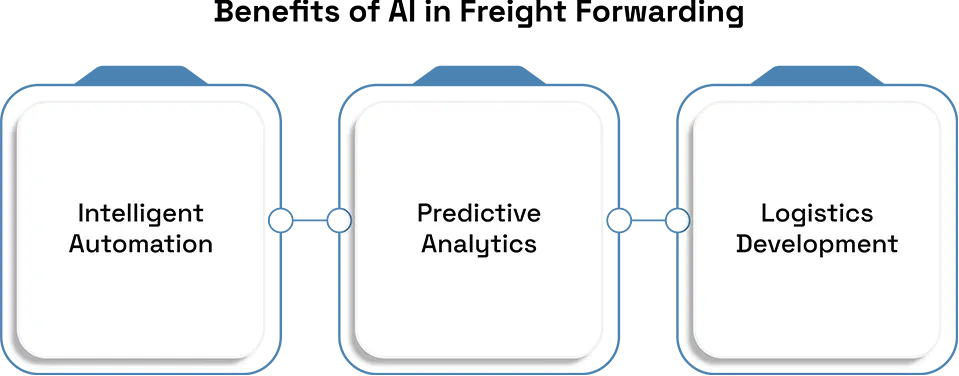
Benefits of AI in Freight Forwarding
AI in freight forwarding improves active efficiency, minimizes costs, & improves customer service by automating routine tasks, optimizing routes in real-time, & giving the best predictive analytics for shipping times. Main benefits include improved accuracy in documentation, smarter cargo fusion, risk management, & improved communication.
Benefits of AI in Freight Forwarding
Intelligent Automation: AI enhances labor-intensive operations, such as making bills of lading & invoices, which minimizes human error & speeds up executive work.
Predictive Analytics: AI models verify past data & economic indicators to predict demand, allowing companies to better plan container capacity, minimize overstocking, & calculate market changes.
Logistics development: Algorithms process real-time data with traffic, nature, & port blockage to verify the easiest routes & minimize transit times.
Improved Customer services: AI provides real-time shipment tracking, improves transparency, & fast, correct communication via chatbots, using to higher customer satisfaction.
Cost-effective: By using routes, managing shipments, & maximizing container capacity, AI mainly lowers logistics costs.
Limitations of AI in Freight Forwarding
AI in freight forwarding faces many limitations, mainly centered on poor data quality, high development costs, & the inability to manage unexpected risks without human oversight. Many companies lack the clean, centralized data required for effective machine learning, causing inaccurate ETAs & flawed predictive analytics.
1: High initial cost and investment
One of the main challenges to growing AI in supply chains can be the initial costs associated with obtaining & integrating this technology. When AI is used in the long term, it can be highly cost-friendly for businesses, it can also present main financial challenges. Also, the process of integrating AI into existing supply chain operations can be time-using. Businesses may face long timelines for system development, data usability, & process use to meet some operational needs.
2: Complexity
The linking of AI into supply chains can introduce a level of difficulty that poses challenges for organizations. This is an advanced technology, & it involves specific steps for development. AI systems might need extensive customization to align with the unique needs of a business, & they also need to be integrated with current systems.
3: Job disruption
As AI continues to be developed into supply chains, there are concerns about its main impact on job risk, & these fears are not unfounded: studies show that AI will affect nearly 40% of jobs around the world. While AI can automate repetitive tasks, use processes, & improve decision-making, it also mainly causes the risk of job relocation. Even in areas where AI is designed to help the workforce, many existing workers may not have the technical expertise necessary to work alongside these tools.

Conclusion
Artificial Intelligence is mainly developing the freight forwarding industry by improving efficiency, minimizing development costs, & enabling smarter decision-making across global supply chains. From predictive analytics & automated documentation to real-time transportation tracking & route use, AI is helping logistics companies manage operations & respond more easily to changing market demands.
Did you know?
The rise of agentic AI won’t replace procurement professionals; it will redefine their role. As AI agents take over execution-heavy tasks, procurement teams will shift their focus to strategic oversight, AI-driven decision-making, and supplier relationship management.
FAQ
1. How will AI change freight forwarding in 2026?
By 2026, AI is transitioning from simple predictive analytics to “agentic” systems that can autonomously execute solutions, such as rerouting cargo during delays or handling complex customs documentation without human intervention.
2. What are the key benefits of AI in logistics?
Key benefits include 15% lower logistics costs, 35% lower inventory levels, 65% higher service levels, and improved sustainability through optimized, greener routing.
3. Will AI make freight forwarders obsolete?
No, AI will not make forwarders obsolete, but it will make forwarders who don’t use AI obsolete. The future is a collaborative model where AI enhances human decision-making and productivity.
4. How does AI improve supply chain visibility?
AI-powered tracking tools analyze vast datasets to provide real-time updates and predict arrival times more accurately, often detecting potential disruptions before they occur.
5. What is the role of Generative AI in freight forwarding?
Generative AI can be used to analyze large, unstructured data sets, such as emails and contracts, to automatically generate shipment updates, process documents, and provide customer support, reducing the time spent on manual communication.