Between labor shortages & associated supply chain issues, the logistics & warehousing industry is under great pressure. To keep up, warehouses are turning to automated models where technology can greatly help fill production gaps. One of the best tools for this automation is the digital twin. It is a technology that can help test different production line situations, mainly by replicating the real environment.
Work Of Digital Twins in Logistics
Digital twins in logistics make development, real-time virtual copies of physical supply chain goods like warehouses, goods, or transportation networks using IoT sensors & data analytics. They recreate networks to use routes, predict issues, & improve operational efficiency by providing a linked map of live operations.
Main Applications in Logistics
Warehouse Optimization: Digital twins allow managers to test, design, & use warehouse framework, workflows, & inventory management before making changes in the physical space.
Transportation Management: They use transportation routes & schedules by considering real-time factors like traffic overload, weather conditions, & vehicle availability.
Predictive Risk Management: By verifying main fraud, like supplier delays or failed network, digital twins allow businesses to expect problems & prepare alternative plans, minimizing operational risks.
End-to-End Visibility: They provide complete visibility of goods & shipments, improving goods tracking & improving customers’ trust with accurate, real-time updates
Digital Twin Benefits in Warehouses
Digital twins collect data from many elements of the real warehouse environment, with physical size, traffic patterns, & staff movement, to create an accurate virtual copy of operations. This allows users to recreate how changes in the real warehouse would expand before developing them. The system enables testing of different scenarios such as introducing new technology, updating warehouse layouts, or adjusting workforce levels without risking actual operations. Digital twins provide the main benefits, with accurate data-driven decision-making, improved inventory management, improved workflows, increased usability, & the ability to adjust processes through simulation. They also improve warehouse flexibility while minimizing operational risks & costs, making the whole logistics management easier & more flexible.
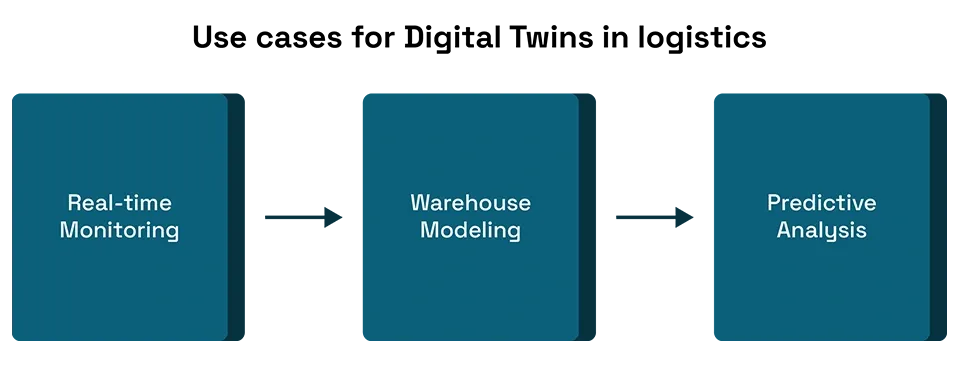
Use cases for Digital Twins in logistics
Digital twins help in many ways in warehouse management, giving easy & more secure strategies. We have collected some of the most common use cases.
Real-time monitoring
IoT sensors capture relevant information & then feed it into the digital twin model to enable proper tracking & well-informed decision-making.
This allows malfunctions, stock-outs, or bottlenecks to be resolved quickly & proactively, improving operational flow from the outset.
Warehouse Modeling
The main application of digital twins is to imitate different scenarios to use processes without risking operations by creating virtual replicas of the warehouse & its equipment.
Experimenting with different workflow designs & strategies helps to identify the easiest layout & material management processes. The benefits are many, such as minimizing overload, reducing the need for travel, & improving use of space.
Predictive analysis
Digital twins, being data-driven, facilitate the application of predictive analytics to forecast potential problems & trends within the warehouse. It is very useful when forecasting maintenance needs, product shortages, & demand variations, all in real-time.
Having this information in advance makes it easier to take proactive measures, avoiding costly issues, using inventory levels, & serving customers more easily.
Inventory management
One of the great applications of digital twins is improved inventory management, giving real-time visibility of each item’s location, status, & movement. It speeds up order fulfillment & minimizes overstocking or shortages. When coupled with order processing systems, products can be replaced automatically. This optimizes the order-picking process, improves & uses inventory, and saves costs.
How are digital twins transforming warehouse operations?
The time for making decisions based on guesswork & judgement is disappearing. Digital twins give a risk-free platform for warehouse managers to experiment with what-if scenarios based on real data. It is a technology that provides a safe arena for innovation & experimentation. Different scenarios can be explored, strategies refined, & processes optimized in a virtual space while gaining valuable insights without risking real-world operations. This translates into continuous improvement and sustainable growth.
Each warehouse can have its own set of opportunities for improvement and optimization. A basic infrastructure is required to support warehouse functions (building, machinery, tools), and with a digital twin, functions, requirements, challenges, & risks are simplified. Optimizing the design & flow allows owners or operators to maximize inventory storage capacity, increase throughput, & minimize the space, equipment, & manpower required to run business operations.
A tipping point thanks to digital twin technology?
Developing digital twins is a difficult & challenging endeavour that needs to match complex assets & their behaviour in a digital environment, with precision & in real-time. It is also important to note that a digital twin is heavily reliant on quality data at every stage of the supply chain: good data in, good decisions out.
Conclusion
Digital twins are developing as an impactful force in warehouse & logistics planning by enabling organizations to create real-time virtual replicas of physical operations. This technology allows businesses to duplicate workflows, use warehouse layouts, improve goods management, & predict important issues before they occur. Companies can make more accurate, data-driven decisions while minimizing operational risks, money, & frauds.
Did you know?
Artificial intelligence and digital twin systems have quietly begun to reshape the operating logic of modern supply chains. They are not just digital tools; they represent a shift from response management to behavioral foresight, a new way to understand how networks behave under stress.
FAQ
1. What are digital twins in logistics?
A digital twin in logistics is a dynamic, real-time representation of your entire logistics network that mirrors the current state of shipments, inventory, vehicles, routes, and capacity constraints.
2. What are the 4 types of supply chains?
Supply Chain Modeling: Types, Models, and Best Practices. The four main types of supply chain models, which are often used to optimize product flow based on demand and efficiency, are the continuous-flow model, fast model, efficient model, and custom-configured model.
3. How do Digital Twins Integrate with AI and IoT?
Digital twins are “fed” by IoT sensors, which provide live data on equipment health, warehouse temperatures, and staff movement. AI algorithms analyze these data streams to predict failures or suggest automated adjustments to improve speed, cost, and service quality.
4. What are the Challenges of Implementing Digital Twins?
While beneficial, implementing digital twins requires significant investment in technology (IoT, simulation software) and training. It also involves integrating diverse data sources from legacy warehouse management systems (WMS) and ensuring data accuracy for reliable simulation.
5. Which software is used for digital twins?
Decoding digital twins: Exploring 6 main applications and Digital twin software enables the creation of virtual replicas of physical assets to simulate, monitor, and optimize performance, with leading platforms including Siemens Xcelerator, Ansys Twin Builder, Microsoft Azure Digital Twins, and Dassault Systèmes 3DEXPERIENCE