
Introduction
Over the last decade, Southeast Asia has fastly become one of the world’s most active manufacturing and export regions. Countries like Vietnam, Thailand, Indonesia, Malaysia, & Singapore are attracting global manufacturers because of their lower production costs, skilled workforce, & strong trade connections. Businesses from industries like IT, aviation, healthcare, & automotive are increasingly moving their production and supply chains to this region.
The growth of Southeast Asia is also connected to the expansion of international trade networks. As businesses grow internationally, they need smooth cross-border shipping services, reliable international logistics services, & strong customs compliance solutions to ensure goods are moved easily across borders. Because of this, Southeast Asia is becoming an important part of global manufacturing and export networks.
Why Southeast Asia Is Emerging as a Global Manufacturing and Export Hub
Many factors are helping Southeast Asia to grow as a global manufacturing center. One of the most important is cost efficiency. Compared to traditional manufacturing hubs, many Southeast Asian countries provide minimal labour costs while still providing strong production capabilities.
Another advantage is the strategic location. Southeast Asia is located between major international markets such as East Asia, South Asia, and the Middle East, which makes it a strong center for international trade routes. This location helps businesses to use faster cross-border shipping services & build easy distribution networks.
Governments in the region are also investing a lot in industrial zones, digital infrastructure, & export-friendly policies. These efforts help to improve supply chain optimization and encourage international companies to establish manufacturing facilities in the region.
Key Industries Driving Southeast Asia’s Manufacturing Growth: IT, Aviation, Medical, and Automotive
The growth of manufacturing in Southeast Asia is strongly supported by a few fast-growing industries.
IT & electronics manufacturing is one of the biggest sectors in the region. Countries such as Vietnam and Malaysia have become important producers of semiconductors, electronic components, and networking equipment. These products are shipped worldwide through well-developed global freight forwarding networks.
The aviation industry is also expanding in the region. Southeast Asia now produces aircraft components, avionics equipment, & maintenance parts used in global aviation supply chains. As aviation technology continues to grow, the demand for specialized parts manufacturing is also increasing.
The medical equipment sector is another area seeing strong investment. Many international healthcare companies are setting up manufacturing units in Southeast Asia to produce diagnostic equipment and medical devices.
The automotive manufacturing supply chain is also very important for the region. Countries like Thailand and Indonesia are major production hubs for vehicles, auto parts, and electric vehicle components. Automotive companies depend on efficient international logistics solutions and supply chain optimization to make sure parts move quickly between factories and export markets.
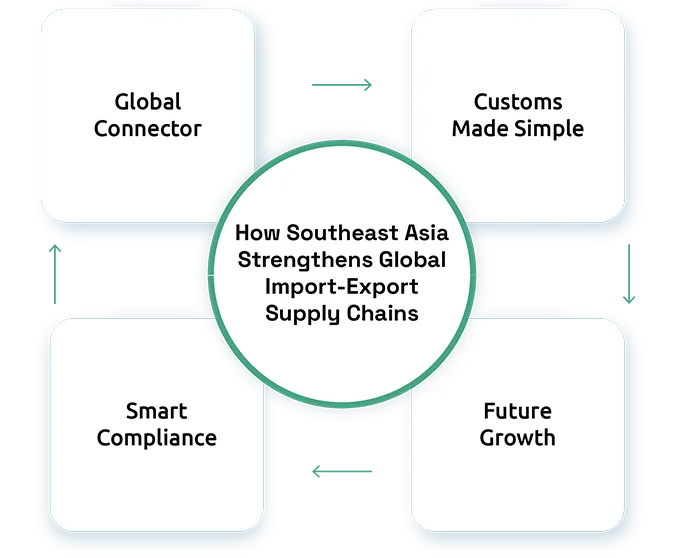
How Southeast Asia Strengthens Global Import-Export Supply Chains
Southeast Asia is not just a manufacturing hub, it also plays an important role in connecting global supply chains. The region helps to link trade between different continents, making the movement of goods faster and more efficient.
Today, many companies are spreading their production across multiple countries instead of depending on just one. Because of this, Southeast Asia has become a popular choice. Manufacturers are developing regional production networks here, supported by simple and smooth customs clearance processes and reliable international shipping services.
The increasing use of customs compliance solutions also helps businesses to manage difficult rules & paperwork when exporting goods from Southeast Asia to global markets.
Trade Opportunities and Export Potential in Southeast Asian Markets
Southeast Asia gives strong opportunities for international businesses that want to grow their export service. The region’s growing consumer market, along with strong export infrastructure, is creating new trade opportunities in many industries.
Technology companies are exporting networking equipment, servers, and digital hardware. Medical manufacturers are exporting diagnostic tools and medical devices to hospitals across the world. The automotive industry is exporting vehicle parts, engines, and electric vehicle components to global markets.
These export activities are supported by growing international freight services & advanced global freight forwarding networks that connect Southeast Asia with North America, Europe, and emerging markets.
The Role of Logistics and Importer of Record Services in Southeast Asia Trade
Efficient logistics operations are very important for companies that are working in Southeast Asia’s global trade environment. Businesses that move their goods across borders must follow shipping rules, manage documentation, & also handle import responsibilities in different countries.
This is where Importer of Record services become important. These services help companies to manage legal & regulatory responsibilities when importing goods into another country. Many businesses use Importer of Record services when they do not have a legal entity in the destination country.
In addition to import responsibilities, companies may also need exporter of record services to manage export documents & follow international trade rules & regulations. These questions show how difficult international trade operations can be.
To manage these difficulties, organizations are highly using the best trade compliance software for import-export rules. These systems help businesses to manage paperwork, maintain regulatory compliance, & coordinate supply chain operations across global trade.

Conclusion
Southeast Asia is fastly becoming an important manufacturing and export hub in the global market. With growing industries like IT, aviation, medical, and automotive, many companies are selecting this to grow their production and trade activities.
To succeed in these markets, businesses need reliable international logistics solutions, strong global freight forwarding networks, and effective customs compliance solutions. With the right trade support and planning, Southeast Asia offers strong opportunities for companies looking to grow in global import-export operations.
Did you know?
ASEAN countries together form one of the world’s largest manufacturing regions, supporting global exports in electronics, automotive components, and industrial goods.
FAQs
Why is Southeast Asia becoming a manufacturing hub?
Southeast Asia is attracting global manufacturers because of lower production costs, skilled labor, and strong trade connections. Countries like Vietnam and Thailand are becoming key production centers.
Which industries are growing in Southeast Asia’s manufacturing sector?
Major industries include IT and electronics, aviation components, medical equipment, and automotive manufacturing. These sectors support the region’s growing export economy.
How does Southeast Asia support global supply chains?
Southeast Asia connects global markets through strong logistics networks, efficient shipping routes, and growing export infrastructure that supports international trade.
What role do logistics services play in Southeast Asia’s exports?
Logistics services help manage transportation, customs documentation, and cross-border shipping, allowing goods to move smoothly from factories to international markets.
Why are companies shifting production to Southeast Asia?
Companies move production to Southeast Asia to reduce costs, improve supply chain flexibility, and take advantage of the region’s strategic location in global trade routes.