Insight
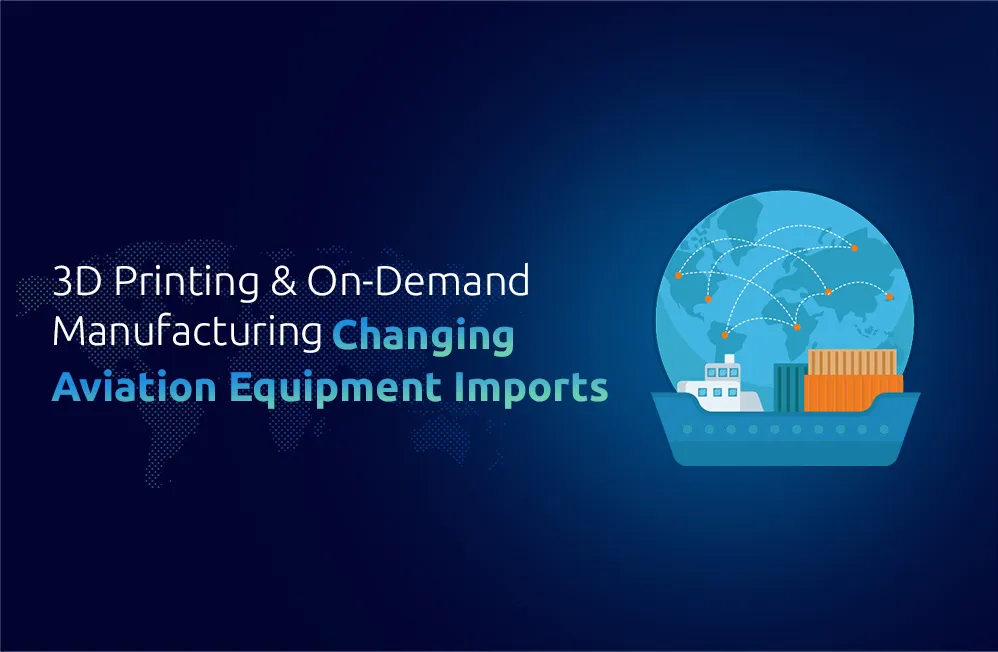
Aviation is one of the most complex and high-stakes industries globally with precision, safety, and efficiency critical. Over the last several years, two divergent technological developments have significantly influenced how aviation equipment can be procured, manufactured, and imported 3D printing and on-demand manufacturing. These innovations also brought about changes to the traditional supply chain, and they are now critical in transforming aviation equipment imports.
This helps businesses shorten lead times, cut costs, and source aviation parts more flexibly and sustainably using 3D printing and on-demand manufacturing. These changes affect the entire supply chain, including freight forwarding and customs compliance. It marks a major technological shift in aviation equipment imports and creates new strategic advantages, which we will explore in this blog.
3D Printing & On-Demand Manufacturing
3D printing makes 3-dimensional solid objects from a digital file. Airframe Brackets into fixtures and even engine parts are examples of this technology used in aviation. Conversely, on-demand manufacturing enables a company to build the parts when they are needed and avoid massive inventory and extensive lead times. These technologies are collectively allowing companies to manufacture customized, high-quality parts on demand. They provide more flexibility than traditional manufacturing methods, which may require parts to be produced in advance and stored in warehouses until they are needed. This change in manufacturing approaches also significantly impacts the import and supply of aviation equipment.
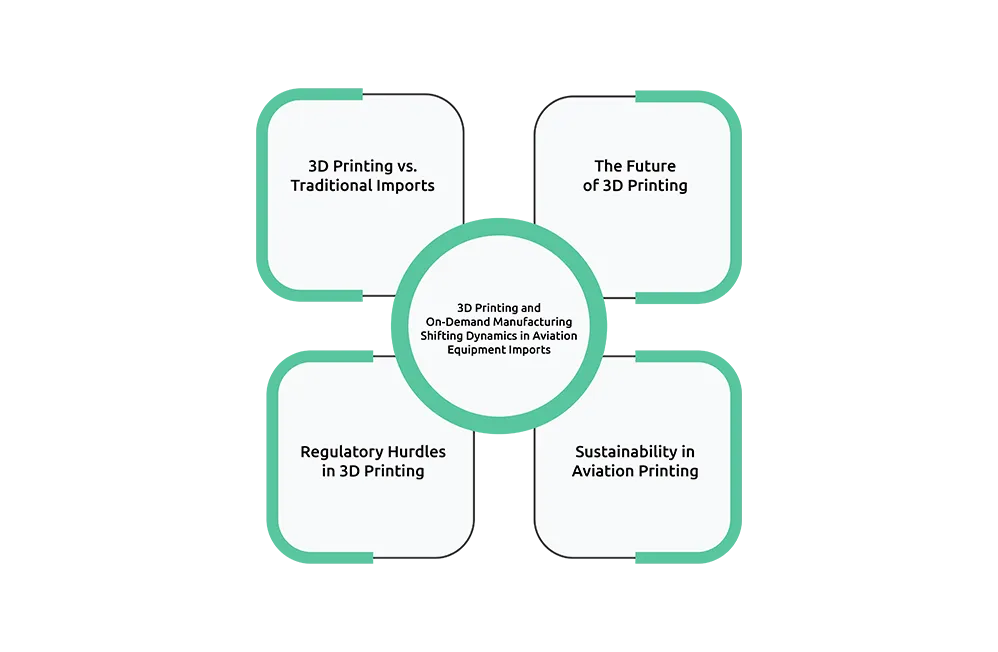
The Impact of 3D Printing & On-Demand Manufacturing on Aviation Imports
Practices such as 3D printing and on-demand manufacturing are completely changing the methods behind aviation parts manufacturing and importation, with results that include faster production times and shorter lead times. Co-packers have also used additive manufacturing, which can reduce air cargo rates and emergency shipments by significantly speeding up the time it takes to source parts where traditionally (and still, in many cases), this process can take weeks or months. Another significant factor is customization, as certain components or modifications can be manufactured at a lower cost than traditional processes.
Equipment is often shipped in small quantities, making it difficult to estimate costs; using air freight cost calculators and similar devices, companies can more accurately predict shipping costs for these custom components, although they can help improve logistics efficiency. On-demand manufacturing reduces the need for excess inventory, lowers warehousing costs, and enables parts to be produced closer to their destination, saving long-distance shipping. 3D printing also has considerable sustainability benefits, as it can help minimize material waste and decrease the carbon footprint of transporting a large number of parts. These technologies simplify logistics operations since components can be manufactured locally or closer to the final destination. This simplifies customs clearance and costs associated with freight forwarding with tools like the chargeable weight air freight calculator.

Challenges & Solutions in Adapting to New Manufacturing Models
3D printing & on-demand manufacturing have their benefits, but they also come with challenges. International trade has always been more complex in terms of customs compliance and duties, which is a significant hurdle. Such joint developments include manufacturers that carefully navigate the Generalized System of Preferences (GSP) to ensure they receive the preferable duty treatment when parts are made abroad and imported to the country.
Working with experienced freight forwarding services specializing in aviation equipment can help businesses deal with these challenges. Companies can use the right cargo forwarding services to ensure that their shipments meet customs regulations and that correct duties are applied. In this context, the importance of an importer of record (IOR) cannot be overstated as the party responsible for declaring all imports from new, sometimes unusual, parts manufactured by 3D printing.
The fast growth of on-demand manufacturing services is reshaping how aviation companies approach equipment sourcing and production. From the production of engine brackets to cabin components, aviation 3D printing now enables the manufacture of mild, durable parts with precision and speed. These innovation eliminates the need for broader warehousing, reduce the lead time, and improve the supply chain accountability. The most influential on-demand manufacturing examples are retrofits adapted to emergency part replacement and specific aircraft models. By using a reliable on-demand manufacturing service, aviation organizations can be tight, cost-skilled, and obedient, ensuring continuity in operations by embracing the manufacturing models prepared for the future.
Key Benefits of On-Demand Manufacturing in Aviation Imports
Cost Savings: Eliminating large-scale inventory requirements, where you may not use the stock and need to pay for its storage and transportation costs, where both result in long-term cost savings.
Speed and Flexibility: Demand-based manufacturing speeds up production and caters to urgent demands while providing parts that can be customized.
Improved Supply Chain Management: On-demand manufacturing improves overall supply chain efficiency and management by reducing reliance on physical stockpiling and optimizing parts production.
Reduced Environmental Impact: Reducing unnecessary production and transportation with 3D printing makes for more sustainable practices and reduces the carbon footprint of aviation equipment imports.
Key Hubs for On-Demand Manufacturing in Aviation Imports
The following regions are leading the way in the aviation industry on-demand manufacturing and 3D printing:
Dubai: In a short period, it established itself as a center of aviation equipment imports and on-demand manufacturing. Aviation parts can be easily produced and distributed from Turkey due to its strong logistical network and advanced customs facilities.
Singapore: Changi Airport is a major international air cargo hub that handles aviation parts. With strong manufacturing capabilities and an efficient logistics service, the city is an important partaker in on-demand manufacturing by aviation companies.
Frankfurt: Frankfurt is the 4th largest European airport by passenger volume and a key European gateway for air travel and the import/export of aviation equipment, where customs procedures are optimized, particularly for air cargo. The city also has some of the leading 3D-printed aerospace manufacturing facilities.
Los Angeles: Major aircraft manufacturers are near Los Angeles, and the region has a sizable freight forwarding network, making the city and surrounding areas one of the largest aviation import hubs. The city embraces on-demand manufacturing processes to fuel the aerospace sector.
Conclusion:
The landscape of aviation equipment imports is undergoing a seismic shift with the beginning of 3D printing and on-demand manufacturing. These technologies provide various benefits, including cost and lead time reductions, enabling customization and contributing to sustainability. Despite the challenges faced with these advances, such as regulatory measures and scalability issues, the positives outweigh the negatives.
As the industry adapts to modern manufacturing methods, businesses that embrace these changes can improve both their import processes and overall market performance. One Union Solutions supports companies in staying aligned with these developments and helps them make the most of new approaches to aviation equipment sourcing and production.
Did You Know?
According to a recent report, the global aerospace 3D printing market was valued at about $1.38 billion and is projected to reach $6.80 billion by 2030, growing at a steady CAGR from 2021 to 2030.
FAQs
How does 3D printing reduce lead times for aviation components?
3D printing allows parts to be produced on demand, removing long manufacturing and shipping delays common with traditional production methods.
Why is on-demand manufacturing useful in the aviation industry?
It lowers inventory costs, improves supply chain flexibility, and makes it easier to produce customized parts when needed.
How does 3D printing affect air freight logistics?
By reducing the need to ship large inventories, 3D printing supports localized production, cutting transportation costs and environmental impact.
What role does the Importer of Record (IOR) play in 3D printing imports?
The IOR ensures all imported materials and components meet customs rules and that the correct duties and taxes are applied.
Can 3D-printed aviation parts meet regulatory standards?
Yes, when approved materials and certified production processes are used, 3D-printed aviation components can meet strict aviation regulations.