Insight
The value of goods at customs plays a significant part in the smooth functioning of international trade, especially in the aviation industry & this global economy. Not only is proper valuation relevant for compliance with customs regulations, but it is also important for optimizing the costs in freight forwarding, warehousing, and delivery processes. Navigating the General System of Preferences (GSP), more Importers and exporters still need to navigate a web of regulations to ensure the fair and correct assessment of customs duty.
In this blog, we will talk about the customs valuation challenges encountered by aviation stakeholders, working solutions to resolve such challenges, and the involvement of other services like freight forwarders, cargo forwarders, and logistics.
Understanding Customs Valuation in the Aviation Sector
Customs valuation is the process of determining the value of real property that crosses international borders, directly affecting the customs duties and taxes applied. These would usually consist of aircraft elements and equipment, along with other high-value machinery used in aviation functions. Mis-valuations can result in expensive penalties, protracted service, and other harm to business operations.
Air freight cost calculations, for instance, play an essential role in determining the total cost of transferring goods across borders. But calculating the right value isn’t as easy as adding shipping fees to the cost of the goods. It is essential also to look at working with delivery duty paid (DDP) shipping terms, the significance of the exporter of record (EOR), and the correct classification of goods.

Strategies for Accurate Customs Valuation
Leverage Importer of Record (IOR) Services
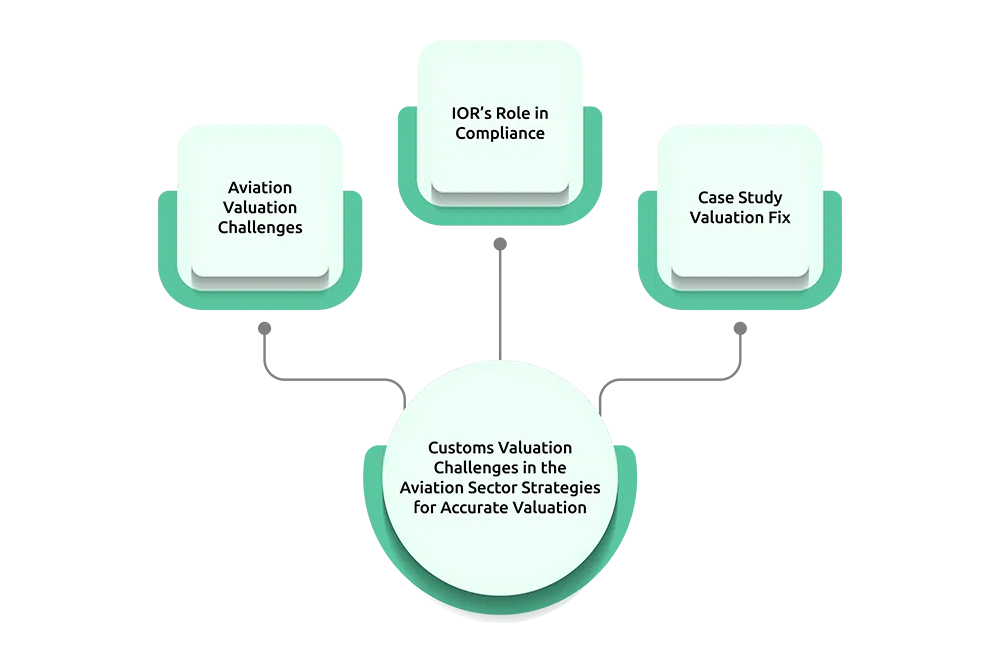
One of the most successful methods to avoid customs valuation errors is incorporating an IOR (Importer of Record). The IOR is the party required to comply with all import laws and regulations, including proper customs valuation. An IOR will submit the correct paperwork and apply appropriate valuation methods for each shipment.
To enhance valuation accuracy and compliance, businesses increasingly rely on aviation valuations and professional custom valuation and assistance services. These services provide critical insights into what is valuations in global trade compliance—ensuring all aviation-related imports are accurately priced according to international customs valuation standards. Leveraging these specialized services not only helps avoid costly errors and penalties but also streamlines trade operations in high-value sectors like aerospace and defense.
Utilize Freight and Cargo Forwarding Expertise
The customs valuation can be substantial when working with international freight forwarding service-providing companies, and it is critical to streamline the process by partnering with professionals experienced in customs regulations. The lines handle everything from calculating air freight charges to navigating the complex world of shipping goods under DDP conditions. In addition, the logistics of moving high-value aviation goods can be complex, but a reliable freight forwarder can take the load off your hands.
Use Air Freight Calculators
Data-centric tools like air freight cost calculators are vital for evaluating the total landed cost of goods brought to an overseas destination (i.e. shipping, handling, insurance, and customs duties). These calculators ensure that companies do not face any unexpected costs and that their customs declarations are accurate.
Ensure Proper Documentation and Reporting
The correct customs valuation depends on good documentation. A declaration of each imported item’s value, origin, and purpose must be submitted to customs authorities. If the value of the goods is not the same as the declaration value, you may be penalized accordingly. A preventive step is to ensure all reports are accurate and up to date.
Sensitive goods: White Glove Delivery
In the aviation sector, critical and high-value equipment is often subject to much more than just basic handling. Investing in white glove delivery services ensures safety and extra care for proper customs valuation. Greater service can reduce losses and ensure that the value of goods is based on what they are like when they arrive.
Training on Customs Value Regularly
Constant training of your logistics team is necessary to remain abreast of changes to customs regulations, tariff schedules, and valuation approaches. Each country has customs valuation rules specific to its requirements, so regularly reviewing compliance requirements can help minimize the risk of incorrect declarations.
Trade in Aviation Equipment | Key Hubs
Various countries/regions worldwide are important hubs of aviation equipment trade and can provide logistics support and customs clearance convenience. Another example is Dubai. Dubai International Airport (DXB) is among the largest logistics hubs for aviation equipment, and its strategic location connecting the Middle East, Africa, and Asia makes DXB perfect for transshipment. Thanks to smooth customs processes, Singapore Changi Airport is regarded highly for its ability to clear high-value commodities quickly. One of Europe’s busiest airports for air freight, Frankfurt Airport (FRA) provides access to a vast network of customs experts and freight forwarders; the German customs authority is known as a rigorous but fair player in valuation. Los Angeles International Airport (LAX) is the major participant in this region, providing modern logistics and warehousing services that guarantee appropriate customs clearance of aviation equipment. These hubs are essential for companies participating in the aviation industry that want to simplify their global trade and customs activities.
Conclusion
Customs valuation remains a continuous challenge in the aviation sector; however, with proper strategies, businesses can ensure customs valuation accuracy and prevent unnecessarily expensive mistakes. Companies can improve their processes and boost compliance by accurate classification, maximizing digital tools, and utilizing customs brokers. One Union Solutions specializes in taking you through the whole process if you need a comprehensive minefield for aviation equipment valuation.
By adopting a proactive approach, aviation businesses can minimize delays, avoid penalties, & manage easy cross-border operations. Accurate customs valuation also helps improve cost control & supply chain transparency. Working with experienced partners ensures regulatory requirements are met without disruption. This allows companies to focus on safety, efficiency, & long-term growth.
Did You Know,
According to Statista, 4.5 billion passengers traveled by air. This betokens the high level of international trading activity and the demand for fast customs processing
FAQs:
What does customs valuation mean in the aviation industry?
Ans: Customs valuation is the process of determining the value of imported goods so customs authorities can calculate duties and taxes. In aviation, this includes aircraft parts, equipment, and related materials.
How do changing exchange rates affect customs valuation?
Ans: Exchange rate changes can affect the declared value of imported goods. This may increase or decrease the customs duties and taxes payable.
What are the methods of customs valuation?
Ans: There are three main methods: transaction value (the price actually paid), deductive value (based on the resale price), and computed value (based on production costs).
How can I ensure accurate customs declarations for aviation equipment?
Ans: Accuracy depends on correct customs procedures, proper HS code classification, and complete supporting documentation.
Are there penalties for incorrect customs valuation?
Ans: Yes. Penalties depend on the size and seriousness of the error and can include fines, shipment delays, or legal action.