Introduction
In today’s continuously growing digital economy, downtime is no longer acceptable. Organizations depend heavily on continuous cloud services to support vital work, user-facing services, and data-related decision-making. As organizations expand globally, data centers may face the difficult challenge of deploying or changing its location of thousands of servers without issuing live environments. Zero-downtime global deployments have therefore become a major priority, allowing scalability, dependance, and business continuity even during large-scale development systems are changes.
Understanding Zero Downtime and the Significance of Zero Downtime in Modern Data Centers
What Does Zero Downtime Mean?
Zero downtime shows the ability to perform system development, server migrations, or storage expansions without causing service interruption. From a user perspective, applications remain available, and performance remains stable, even while backend systems are actively changing. Achieving zero downtime means that the data center can manage maintenance, improve, and address unexpected issues without affecting the supply of services.
Why Zero Downtime Is Critical Today
Advanced data centers support cloud-native applications, AI workloads, and high-availability sources that demand continuous uptime. Even a few minutes of issues can result in revenue loss, trust damage, and customer loss. As digital services grow across regions, having continuous access becomes necessary to meet service standards.

Achieving Zero Downtime: Best Practices for Data Centers
Unwanted Architecture and Failover Planning
Zero-downtime deployments depend on redundancy at every stage, such as compute, storage, and networking. Using designing systems with active-active or active-passive setups, workloads can change smoothly if one environment changes.
Virtualization and Workload Abstraction
Virtual machines and containerized settings allow workloads to be decoupled from manual hardware. This absence allows live system transition, where applications move between servers without issues, supporting smooth global deployments.
Automation and System Coordination
It plays an important role in working on many of the implementation tasks at the same time. From provisioning to validation, automated workflows reduce human mistakes and confirm continuous use across regionally spread-out data centers.
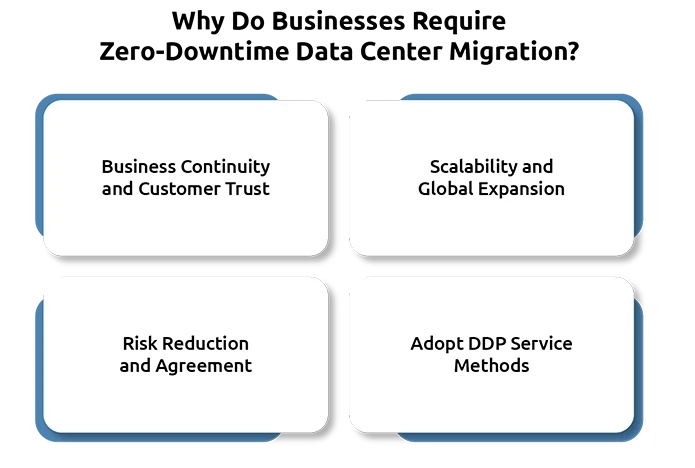
Why Do Businesses Require Zero-Downtime Data Center Migration?
Business Continuity and Customer Trust
For organizations working on 24/7 services such as SaaS suppliers, economic services, and e-commerce, continuous supply is directly attached to customer trust and quality of delivery. Zero-downtime migration confirms users experience no issues during system changes.
Scalability and Global Expansion
As businesses enter new markets, they must deploy infrastructure closer to users to reduce delay. Zero-downtime global deployments allow organizations to expand storage while keeping existing services completely working.
Risk Reduction and Agreement
Planned downtime introduces working and economic risks. Zero-downtime plans reduce downtime by confirming that upgrades and issues occur without service degradation, even during difficult international trades.
How Data Centers Move Thousands of Servers Without Interrupting Cloud Services
Phased Deployment and Parallel Environments
Rather than moving everything at once, data centers use phased deployment plans. New infrastructure is conducted online in alignment, workloads are mainly changed, and traffic is rerouted only after validation is complete.
Real-Time Data Replication
Continuous data synchronization confirms that both source and destination environments remain combined in the data center. This allows workloads to change continuously without data loss or performance affect on systems.
Network Traffic Steering
Advanced traffic management tools varied direct user requests to the optimal server location. During deployments, traffic can be changed away from systems changing, confirming uninterrupted access.
Continuous Monitoring and Testing
Live tracking way performance, delay, and error rates throughout the deployment process. Automated testing verifies the application is running or not before, during, and after server shipment, allowing a quick restore if required.
Conclusion
Zero-downtime global deployments have become a cornerstone of modern data center strategy. Combining redundancy, virtualization, automation, and intelligent traffic management, data centers can ship many of the servers while keeping cloud services fully working. For businesses, this approach delivers unwanted user experiences, supports global growth, and reduces operational risk. As digital demands continue to grow, zero downtime is no longer a vital; it is a necessity for a complete, flexible system.
DID YOU KNOW?
According to a Gartner report, the average cost of IT system downtime is $5,600 per minute, which amounts to more than $300,000 per hour.
FAQs:
What is zero downtime in data centers?
Zero downtime refers to performing maintenance, upgrades, or server migrations without causing service interruptions, ensuring applications remain fully available to users.
Why is zero-downtime deployment important for cloud services?
Zero-downtime deployment prevents revenue loss, protects customer trust, and ensures compliance with strict service-level agreements in always-on digital environments.
How do data centers move thousands of servers without downtime?
Data centers use phased deployments, real-time data replication, traffic steering, and parallel environments to migrate workloads without interrupting services.
What technologies enable zero-downtime global deployments?
Key technologies include virtualization, containerization, automation tools, redundant architecture, load balancing, and continuous monitoring systems.
Which industries benefit most from zero-downtime data center migration?
Industries such as cloud computing, fintech, e-commerce, SaaS, healthcare, and AI-driven enterprises benefit most due to their need for continuous service availability.