Overview
The fast expansion of cloud computing, AI workloads, and digital infrastructure has made data centers an important support of modern economies. Deploying a data center is not as easy as shipping servers from one country to another location. Valuable, urgent equipment frequently requires customs clearance under special customs processes to stop delays, approval risks, and system downtime. Understanding why data center equipment is managed differently at borders helps organizations plan simple global deployments and improve their supply chain optimization plans.
What Logistical Barriers Affect the Deployment of Data Centers?
High-Value and Sensitive Equipment
Data center equipment, such as servers, networking hardware, storage systems, and power modules, is mainly valuable and sensitive. Any delay or mishandling during international shipping terms execution can lead to economic losses and missed go-live schedules. Temperature sensitivity, anti-static requirements, and security risks add more difficulty to international freight services.
Tight Project Timelines
Most data center projects work under aggressive timelines. Delays at ports or airports due to documentation errors, inspections, or regulatory mismatches can disrupt complete deployment schedules. This makes predictable customs clearance processes necessary for successful deployment.
Multi-Jurisdiction Compliance
Large data center builds frequently involve equipment sourced from multiple countries. Managing compliance across authorities requires coordination between exporters, freight partners, and the Importer of record Service, increasing the risk of customs issues.
Are there government incentives for importing data center equipment?
In many cases, countries offer duty benefits or special schemes to support digital infrastructure growth. These incentives are designed to attract investment in data centers, cloud services, and IT infrastructure, which are critical for economic and technological development.
Governments may provide reduced or zero customs duties on specific IT hardware, exemptions under project import schemes, or tax benefits for companies setting up large-scale data centers. In India, initiatives aligned with the country’s digital expansion—supported by bodies like the Central Board of Indirect Taxes and Customs—can allow simplified clearance processes, concessional duty rates, and faster approvals for essential equipment such as servers, cooling systems, and networking gear.
Why Data Center Equipment Is Cleared Under Special Customs Clearance
Risk Mitigation and Compliance Control
Special customs procedures are commonly used to reduce regulatory risks when importing high-value system devices. These procedures allow authorities to confirm agreement without holding shipments for extended periods. For data center operators, this means faster access to equipment while maintaining full legal conformity.
Simplified Documentation Handling
Data center shipments frequently include difficult trade invoices, technical descriptions, and valuation data. Special customs clearance device simplifies documentation review and reduces disputes related to categorization or valuation under the HTS harmonized tariff Schedule.
Faster Release for Mission-Critical Deployments
Because data centers support critical digital services, governments and customs authorities frequently allow expedited processing. This confirms continuity for cloud services, fintech platforms, and organizations’ IT systems dependent on timely infrastructure deployment.
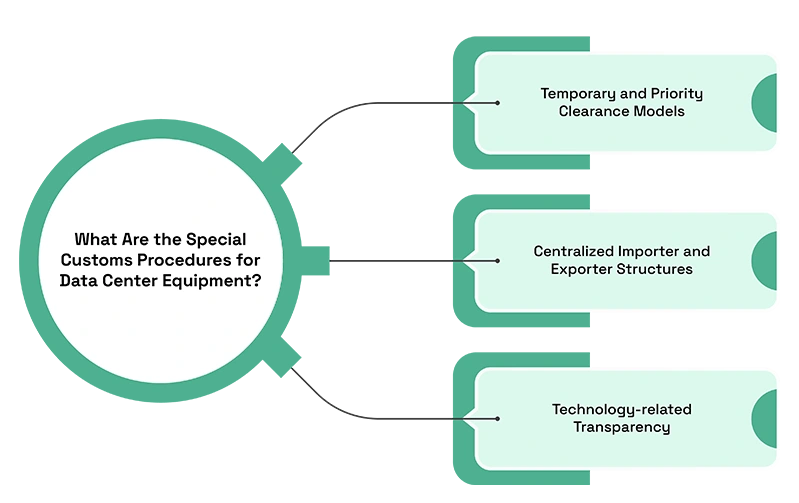
What Are the Special Customs Procedures for Data Center Equipment?
Temporary and Priority Clearance Models
Certain officials allow data center equipment to be cleared using priority or provisional release devices. These methods allow equipment to be released quickly while post-clearance verification continues in parallel, minimizing downtime.
Centralized Importer and Exporter Structures
Using a centralized exporter of record services and an Importer of record Service simplifies approval across multiple shipments. This approach confirms continuous declarations and reduces the risk of issues during customs checkups.
Technology-related Transparency
Advanced customs environments increasingly depend on blockchain in supply chain systems to improve traceability and data integrity. These technologies support faster verification of shipment data and reduce manual intervention.
How One Union Solutions Helps You Get Cleared Under Special Customs Procedures
End-to-End Customs Expertise
We specialize in handling difficult infrastructure imports, including data center equipment. With good expertise in customs clearance and regulatory approval, the company confirms shipments qualify for special customs procedures where applicable.
Integrated International Freight and Delivery
Combining international freight services with a premium delivery service, One Union Solutions reduces logistics risks and confirms equipment arrives on schedule and in optimal condition.
Strategic Supply Chain Support
From planning import strategies to execution, we focus on supply chain optimization. Their services related to logistics planning, documentation accuracy, and agreement execution into a single work process.
Conclusion
As global demand for data centers continues to grow, the difficulty of importing high-value IT devices grows alongside it. Special customs procedures play a vital role in allowing quick, safer, and more complete shipment of data center equipment across borders. Using expert partners such as One Union Solutions and using systematic import plans, organizations can reduce deployment risks, maintain regulatory approval, and confirm their digital system goes live without unwanted delays.
DID YOU KNOW?
The modular data center market is projected to grow from $29.93 billion in 2024 to $79.49 billion by 2030.
FAQs:
1. Why is data center equipment cleared under special customs procedures?
Data center equipment is high-value, sensitive, and often required urgently. Special customs procedures help minimize clearance delays while ensuring regulatory compliance and risk control.
2. What types of equipment qualify for special customs clearance?
Servers, networking hardware, storage systems, power modules, cooling systems, and other mission-critical IT infrastructure components commonly qualify.
3. How do special customs procedures reduce deployment delays?
They allow priority or provisional clearance, simplified documentation review, and post-clearance verification, ensuring faster equipment release without compromising compliance.
4. What role does an Importer of Record play in data center imports?
An Importer of Record ensures legal responsibility for customs declarations, duty payments, and compliance across jurisdictions, reducing clearance errors and shipment risks.
5. How can logistics partners improve data center customs clearance?
Experienced logistics providers manage documentation, regulatory approvals, international freight coordination, and delivery timelines to support smooth and predictable data center deployments.