Introduction
In today’s growing and developing global economy, global trade depends on a smooth exchange of goods and services across borders. Businesses engaged in the import and export business face many challenges, from agreement with international export regulations to the difficulties of customs clearance and shipping documentation. This is where freight forwarders play a vital role in shipping to a country. They work as a combination that confirms the smooth movement of goods while having efficiency, clarity, and affordability in global supply chain services.
Who Are Freight Forwarders and Their Responsibilities
These service providers are experts or organizations that focus on working and managing the shipment of goods between countries. Working as intermediaries between importers, exporters, and carriers, they organize logistics through air, sea, or land and manage necessary documentation such as the HS Code and HTS Harmonized Tariff Schedule with their categorizations.
Their responsibilities extend beyond transportation; they provide Customs clearance support, manage International export regulations, and provide Comprehensive import-export support. Many freight forwarders also provide Importer of Record (IOR) services, Exporter of Record services, confirming that businesses comply with all legal and customs requirements during cross-border shipments. Knowledge about Incoterms and conditions such as DAP (Delivery At Place) or DDP shipping helps importers and exporters define clear guidelines of delivery and cost responsibilities.
The Role of Freight Forwarding Service in Global Trade Logistics
In global trade logistics, freight forwarders work as major partners for organizations expanding their global reach. They confirm that goods move effectively from one location to another through improved routing, carrier agreements, and freight combination in global Trade.
A major advantage of using a freight forwarder is their expertise in handling documentation and regulatory approval. They manage export declarations, export customs brokerage, and maintain accuracy in import export registration and export registers, reducing risks of delays or fees. Through their huge network of carriers and brokers, they create a flexible logistics approach that increases visibility and dependability across global supply chains.
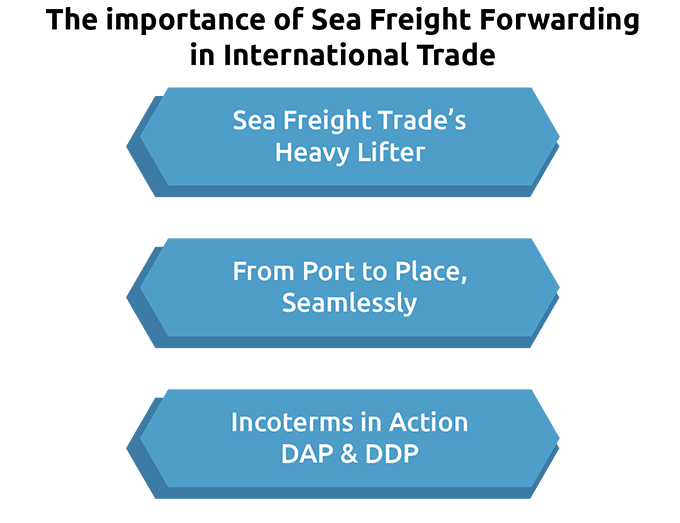
The importance of Sea Freight Forwarding in International Trade
Sea freight forwarding remains a vital part of global trade because of its storage and affordability. Freight forwarders working in sea shipments work between suppliers, port officials, and logistics to confirm smooth delivery of goods under Incoterms such as DAPs (Delivery At Place) and DDP shipping.
They help customers comply with seaport laws, shipping documentation, and HTS Harmonized Tariff schedule codes while providing ambitious pricing and cargo insurance. If it’s bulk shipments for the automotive sector or sensitive equipment for IT and medical industries, sea freight forwarders confirm that every logistics is moved safely and in agreement with International export regulations.
Strengthening Supply Chain Management with Freight Forwarding
Freight forwarding contributes hugely to improving their modern supply chain management. By combining Global supply chain services with digital tracking, route optimization, and customs officials, forwarders increase efficiency and clarity during shipping.
Through IOR services and Comprehensive import-export support, freight forwarders help global organizations manage import approval, tax issues, and import permits. Their knowledge of Incoterms and country regulations simplifies trade agreements, confirming on-time and secure deliveries. Businesses take advantage of reduced risks, improved costs, and improved control over their global trade, making freight forwarders necessary for effective logistics plans.
Conclusion
Freight forwarders play a vital role in the global economy, connecting organizations and global trade. Their expertise in logistics, Customs clearance support, and Importer of Record services confirms that organizations can guide difficult trade environments with confidence. From managing HS Code classifications to managing DDP shipping terms, freight forwarders provide the support of global supply chain services, enabling businesses to expand globally with efficiency and compliance.
DID YOU KNOW?
The air cargo market, valued at US$33.0 billion in 2025 and projected to reach US$51.2 billion by 2035 at a CAGR of 4.5%, is hugely impacted by regulatory systems governing global trade, aviation security, and compliance.
FAQs:
What is a freight forwarder, and what do they do?
A freight forwarder is a logistics expert or company that manages the international shipment of goods, including documentation, customs clearance, and coordination with carriers to ensure smooth transport across borders.
Why are freight forwarders important in global trade?
Freight forwarders simplify international trade by managing shipping regulations, customs procedures, and Incoterms, ensuring timely and compliant delivery of goods.
How do freight forwarders assist with customs clearance?
They handle customs documentation, HS Code classification, and tariff calculations, ensuring goods comply with import and export laws while minimizing delays or penalties.
What is the difference between a freight forwarder and a customs broker?
A freight forwarder manages the overall logistics and transportation of goods, while a customs broker specifically handles import/export clearance and tariff compliance.
What services do freight forwarders provide besides transportation?
Beyond transport, freight forwarders offer Importer of Record (IOR) services, cargo insurance, documentation support, trade compliance, and route optimization for efficient logistics.